






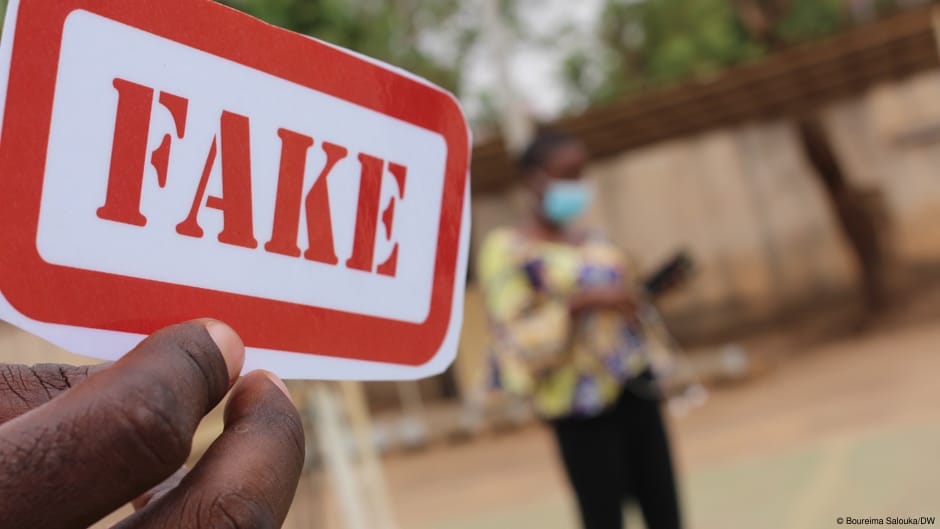
Misinformation endangers democratic processes globally, with a single exaggerated WhatsApp message, a fabricated TikTok video, or a misleading Facebook alert capable of swaying opinions across Africa and beyond, especially during election periods.
Rising artificial‑intelligence capabilities now make it easier than ever to fabricate images, audio, and video, prompting many African nations to teach citizens how to spot and counter fabricated content.
Yet it raises the question whether such initiatives genuinely aim to inform the public or whether some governments are exploiting the fight against disinformation to shape opinion, silence dissent, and manipulate citizens both domestically and abroad.
Civil society groups fill gaps left by governments
University of Sheffield journalism lecturer Dani Madrid‑Morales argues that African governments need to intensify their response to disinformation and misinformation.
He told DW that “there are very few countries — if any — that are actually doing a good job” to beat the influence of fake news.
He also highlights the presence of civil‑society groups across the continent that educate citizens about the risks of false narratives.
In South Africa, groups such as Africa Check and Media Monitoring Africa collaborate to expose the impact of false information on electoral processes. Comparable coalitions can be found in the Democratic Republic of Congo and Senegal.
These organisations, however, tend to concentrate their efforts on election periods, leaving them under‑funded and lacking continuous engagement outside of those windows.
When African governments become part of the problem
Some African governments either tolerate false information or actively spread it, choosing not to combat disinformation.
Madrid‑Morales identifies three main categories. The first includes scams and financial schemes that many governments inadequately address, leaving citizens vulnerable.
A second type comprises foreign influence operations that seek to sway opinion from outside the target nation—and often beyond Africa.
The third category consists of domestic political disinformation campaigns designed to distort impartial viewpoints.
“Governments are especially interested in the third category,” Madrid‑Morales notes, “and it is particularly common in the Sahel region.”
He observes that in countries such as Burkina Faso and Mali, military regimes have closed media outlets, prosecuted journalists, and expelled foreign correspondents to suppress free expression.
According to him, these juntas are mainly focused on suppressing unfavorable or false narratives about themselves rather than on recruiting supporters.
Why we need fact-checking more than ever
To view this video please enable JavaScript, and consider upgrading to a web browser that supports HTML5 video
Do outside forces shape public opinion in Africa?
Foreign powers also appear to exert considerable influence on public opinion throughout Africa.
Afrobarometer, a pan‑African research network, surveyed the impact of international actors—including those suspected of spreading false information—on the continent.
The study revealed that more than 60 % of respondents view China’s political and economic impact favourably, while 52 % hold a positive view of the United States.
Both nations lack a colonial history in Africa, yet they are now competing for economic advantage and investing in infrastructure projects, partly to sustain this largely favourable perception.
Perceptions of other former colonial powers differ more sharply, often reflecting historical grievances. In French‑speaking nations, for instance, only 34 % see France’s current influence positively.
Komi Amewonou of Afrobarometer told DW that these attitudes are not necessarily the product of coordinated propaganda but rather stem from governments allowing negative views to persist unchecked.
The mixed role of media literacy initiatives
Several countries have launched media‑development projects designed to teach citizens to think critically and counter false information.
In Ghana, the NGO Penplusbytes leads the ‘Caravan of Hope’, a mobile initiative backed by Germany’s development agency GIZ and DW Akademie.
The campaign travels to rural areas, using theatre, role‑playing, public discussions, and videos in local languages to teach media literacy. To date it has reached 3,000 people across five districts.
It also engages respected community figures because research shows that locals place the most trust in people they know personally, especially traditional chiefs and local representatives.
Penplusbytes project developer Rebecca Avusu told DW, “Information must be verified before people believe or share it—especially for those without smartphones or limited formal education.”
South Africa hosts Africa Check, one of the continent’s most recognised fact‑checking organisations.
It visits schools to teach students how to spot manipulated images, verify sources, and handle misinformation on platforms such as WhatsApp.
Madrid‑Morales cautions that media‑literacy programmes can have a downside. Citing South African research, he notes that while some youths become more discerning, others become so sceptical that they distrust virtually every source, leaving them unaware of crucial developments.
Limited powers elsewhere in Africa
Elsewhere on the continent, media‑literacy efforts often face stronger resistance, frequently from the governments themselves.
In 2026, UNESCO inaugurated the International Media and Information Literacy Institute (IMILI) in Abuja, Nigeria, with a mandate to promote research, training, and cross‑border collaboration in media literacy.
The move followed a Nigerian government pledge to become a leading African voice in the fight against fake news. Yet civil‑rights groups argue that the state frequently conflates combating disinformation with silencing dissent.
In Kenya, the Media Council is charged with supporting journalists and enhancing fact‑checking, but its reach is constrained by the need to obey national laws—especially legislation ostensibly aimed at curbing false information.
Conversely, these laws have drawn scrutiny for being exploitable to silence government critics.
Madrid‑Morales argues that independent oversight bodies are essential in such environments to ensure that citizens do not self‑censor out of fear of retaliation.
Mozambique: Fighting disinformation as a tool of control
In Mozambique, the media institute MISA has introduced several initiatives, including MISACheck, which trains young journalists and activists in fact‑checking techniques.
MISA vice‑president Olívia Massango acknowledges that such civil‑society efforts may feel like a drop in the ocean, and she is especially critical of how state authorities handle misinformation.
“When something becomes inconvenient, the government invokes public interest but often ends up protecting only what suits it,” she told DW.
She warns, “Combating disinformation must not be used to criminalise opinions, criticism or journalistic work.”
Guidance from Europe — with limited safeguards
Increasingly, African countries are looking to Europe for models to combat fake news.
Morocco and Senegal, for example, have drafted disinformation laws inspired by EU standards. Madrid‑Morales cautions that while adopting robust EU‑style legislation can be effective, it must be paired with independent oversight and enforcement mechanisms to succeed.
He points out that both Senegal and Morocco have yet to establish such mechanisms, noting that each has repeatedly grappled with political instability fueled by fake news.
Rebecca Avusu also warns that such legislation can contain loopholes that governments may exploit: “We do not want anti‑disinformation laws to become tools for silencing people who question government decisions or voice legitimate opinions.”
A journalist’s guide to spotting fake news
To view this video please enable JavaScript, and consider upgrading to a web browser that supports HTML5 video
Edited by: Sertan Sanderson
Also Read
- Goldman Sachs CEO David Solomon: AI Investment Demand Stays Robust Amid Market Volatility
- Krakow Shooting Suspect Dies After Attack That Killed Six and Injured Fifteen
- Army Deploys Launched Effects to 11 of 12 Divisions, With Griffon Aerospace Leading Delivery
- Rubio, Barrot Discuss ICC Concerns, Middle East Security, and Ukraine Peace Path


