







AI-directed bank accounts could shift deposits quickly between banks, undermining a funding advantage that supports long-term lending, according to a Federal Reserve Bank of Dallas analysis released Aug. 25.
Although customers can withdraw demand deposits at any time, balances often stay with banks for years, and deposit rates typically increase slower than market rates. This behavior gives deposits some characteristics of long‑duration funding.
The Dallas Fed estimates effective duration as the weighted average life multiplied by (1 minus the deposit beta), where the beta gauges how deposit rates respond to short‑term rate changes.
Instant settlement would enable yield‑sensitive customers to move funds rapidly, while programmable rules and agentic AI could automate the shifts. In June 2026, The Clearing House launched an initiative to create 24/7, interoperable tokenized commercial‑bank money, including uses for automated and agent‑driven commerce.
Applying commercial‑bank balance sheets as of July 15 and its own duration assumptions, the Dallas Fed calculated roughly $7 trillion of asset‑side interest‑rate exposure expressed in 10‑year‑Treasury equivalents. About $5.84 trillion of that exposure is underpinned by the duration traits of deposits excluding large time deposits.
In simple terms, these stable funding traits allow banks to hold assets whose values fluctuate with interest‑rate movements.
In one sensitivity scenario, a 10 % rise in deposit price sensitivity—assuming a four‑year weighted‑average life—cuts the aggregate duration‑risk appetite by approximately $700 billion in 10‑year equivalents.
A separate 10 % reduction in weighted‑average life lowers the modeled maturity‑transformation capacity by about $580 billion.

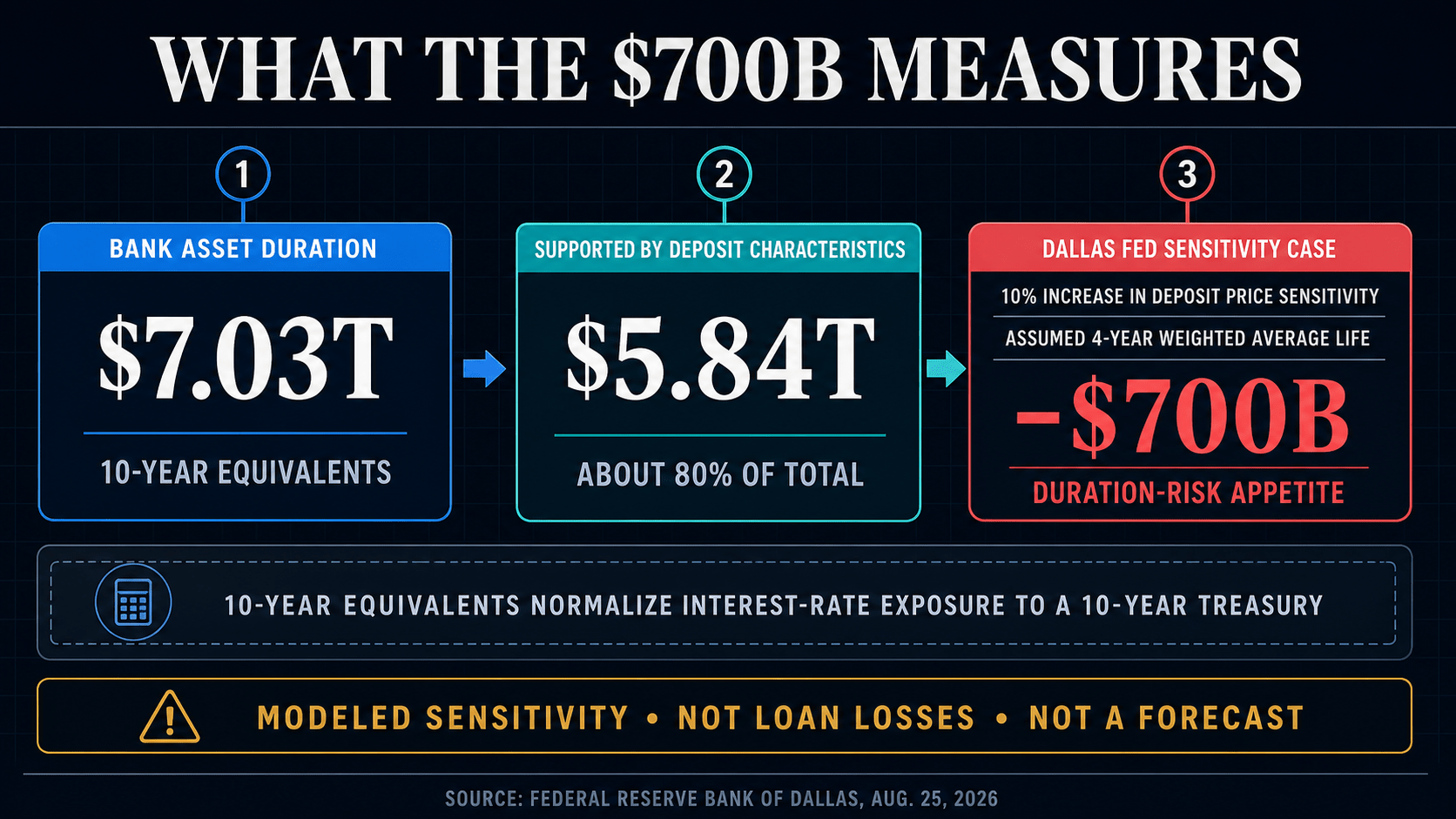
A 10‑year equivalent translates an exposure into the interest‑rate risk of a comparable position in 10‑year Treasuries, though the actual credit impact depends on how banks adjust their assets and funding.
Banks could issue more term debt to keep their lending mix largely unchanged, but the Dallas Fed warned that relying on wholesale funding would likely increase borrowing costs for consumers and businesses. Alternatively, they could hold more reserves and Treasuries to guard against faster, less predictable outflows, which would leave less capacity for illiquid credit.
A 2025 Central Bank of Brazil study found that heavier use of the Pix instant‑payment system boosted liquid‑asset holdings and reduced liquidity transformation, showing that instant payments can reshape bank liquidity behavior even though Pix is not a direct analogue of US tokenized deposits.
Tokenized deposits remain in early development, their scale is uncertain, and the authors cautioned that their views should not be ascribed to the Dallas Fed or the Federal Reserve System.
Also Read
- DAX Index Nears Completion of Wave V Ahead of Broad Corrective Phase
- Cardano and Solana Highlight Competing Fault Lines in On-Chain Governance Models
- Coinkite’s Coldcard Bug Exposed Single-Sig Risk. Multi-Vendor Multisig Is the New Bitcoin Custody Baseline
- Stand With Crypto Endorses 32 House Members Supporting CLARITY Act in Key Reelection Push


