






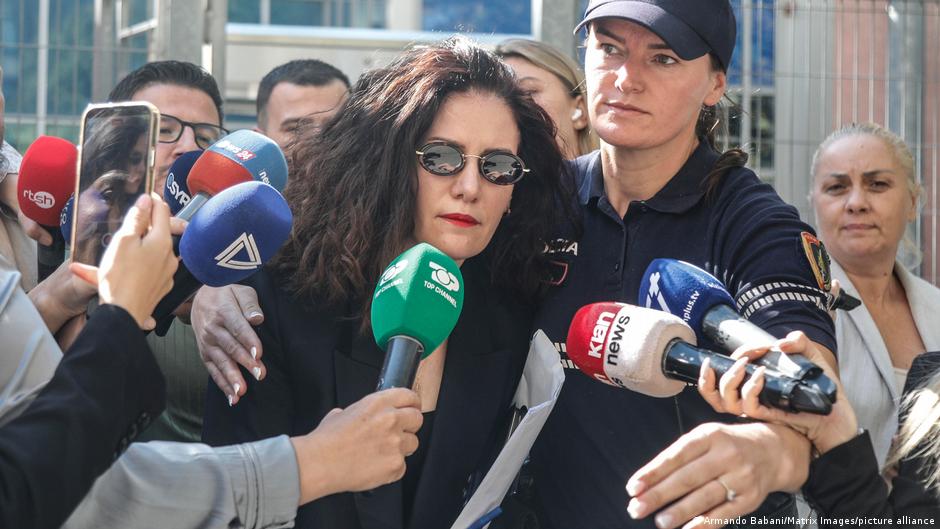
On September 22, the director of Albania’s State Intelligence Service, Vlora Hyseni, was attending an international conference of intelligence chiefs in Baku, Azerbaijan. Meanwhile, in Tirana, the Special Court had ordered her house arrest on suspicion of two criminal offenses: aiding a perpetrator and disclosing investigative secrets.
The investigation into Hyseni originated from a broader corruption probe involving the National Agency for Information Society (AKSHI), the body overseeing much of Albania’s digital public infrastructure. Prosecutors allege she leveraged classified information accessible through her position to assist an individual wanted in that inquiry.
Hyseni surrendered to Albanian authorities later that day and remains under house arrest as the investigation proceeds. She has since been dismissed from her post as intelligence chief.
Surge in High-Level Criminal Proceedings
Hyseni’s case marks the latest in a series of criminal proceedings reaching unusually high into Albania’s political and state establishment.
A former president has spent nearly two years in detention, a former prime minister is on trial, the mayor of Tirana has been incarcerated since early 2025, two former deputy prime ministers under Prime Minister Edi Rama have faced criminal proceedings, and investigations have been launched into senior officials overseeing major public spending and state infrastructure agencies.
While these are distinct cases, they share a common thread: alleged abuse of public authority.
Origins of the Current Reckoning
For years, the opposite dynamic prevailed: high-level corruption in Albania was synonymous with impunity.
Holding senior political figures accountable became a central pillar of the justice reform launched in 2016.
“The expectation was that the new justice institutions would focus on high-level corruption and ‘VIP’ cases,” says Afrim Krasniqi, a political scientist and executive director of the Institute for Political Studies in Tirana. “There were individuals who stood above the law, and impunity was pronounced,” he told DW.
The reform overhauled Albania’s justice system and established new institutions to investigate corruption and organized crime, notably the Special Anti-Corruption Structure (SPAK).
Progress was not instantaneous. Building these institutions took years, and legacy cases proved difficult to prosecute.
For Dorian Matlija, a lawyer and executive director of the Albanian civil society organization Res Publica, the volume of senior officials now facing charges does not necessarily indicate corruption is more pervasive today than in the past.
“What has changed significantly is the institutional reaction,” Matlija told DW. “Today, SPAK is a specialized structure with greater independence, stronger capacities, and international support, as well as the willingness to undertake investigations that have broken the myth of the untouchability of senior officials.”
The Limits of Accountability
However, prosecuting senior officials is only one metric of institutional health.
By the time a corruption case reaches prosecutors, the alleged abuse has already occurred. In Matlija’s assessment, this is where Albania’s progress is far less evident.
“We are becoming more effective at punishing corruption after it has occurred, but much less capable of preventing it,” he said.
Matlija highlights the institutions and mechanisms designed to intervene before a case becomes criminal: administrative controls, audits, conflict-of-interest regulations, and asset declarations. In his view, these have largely proven ineffective.
The European Commission’s 2025 report on Albania reaches a similar conclusion. While acknowledging SPAK has made “tangible progress towards a solid track record in the fight against corruption,” the report notes that corruption remains widespread and that “the institutional framework for prevention of corruption continued to have a limited impact.”
Impact on Citizens
The deficiency is also apparent in citizens’ daily interactions with public officials.
A 2023 survey by the anti-corruption and good governance coalition SELDI (Southeast Europe Leadership for Development and Integrity) found that 52% of respondents in Albania reported experiencing corruption pressure from public officials, while 40% admitted to paying a bribe.
Krasniqi frames the issue in broader political terms. Albania has been governed by Rama’s Socialist Party since 2013, and the party currently holds an outright parliamentary majority. He argues that this prolonged dominance has eroded the checks and balances meant to constrain the executive.
“We have a deformed system,” he said. “The head of the executive controls the executive, parliament, and institutions.”
He contends this concentration of power has fostered informal networks of influence, allowing actors outside state institutions to shape political decisions, legislation, and the allocation of public assets.
Rama has consistently maintained that criminal liability is individual when investigations implicate senior officials. Addressing the Hyseni case, he reiterated this stance.
“When a senior official has opened an account with justice, the case of the former intelligence chief is an individual matter between her and the justice system,” Rama said.
Implications for EU Accession
In May, the EU confirmed Albania had met the interim benchmarks for the “fundamentals” cluster, which includes the rule of law, advancing the process to a phase focused on implementation and sustainable results.
Transparency International’s Corruption Perceptions Index shows Albania improving from 33 points in 2012 to 39 in 2025, though it still ranks below all EU member states.
For Matlija, the push for EU integration helped create the conditions enabling institutions like SPAK to grow stronger and more independent.
“The EU no longer demands only the adoption of laws and reforms, but also concrete and sustainable results. This creates constant pressure for justice institutions to be genuinely effective and independent of political power,” he said.
For Krasniqi, this is also where the true meaning of European integration lies. Membership, he argues, should not be judged solely by Albania’s progress through the formal accession process, but by whether the country itself transforms.
“The essence should be for Albania, Albanian society, and Albanian institutions to change and improve, so that we become worthy of integration,” he said. For him, that change must be felt by citizens through greater social security, prosperity, and independence, rather than remaining a series of formal achievements.
Edited by: Aingeal Flanagan


