







Astronomers using the Vera C. Rubin Observatory have identified two ancient Trojan asteroids traveling alongside Neptune, marking the first new discoveries of their kind in 15 years.
The results, published Oct. 15 in The Astrophysical Journal Letters, could sharpen our understanding of the early solar system while underscoring the Rubin Observatory’s capacity to reveal fresh cosmic objects as it rapidly surveys the sky.
Trojan asteroids are icy, rocky bodies that occupy a planet’s orbital neighborhood without circling the planet itself. Instead, they orbit the sun along the same path as the planet, gathering in two distinct swarms positioned roughly 60 degrees ahead of and behind it. At these locations—known as Lagrange points 4 and 5 (L4 and L5)—the gravitational forces of the sun and the planet balance out, effectively holding the asteroids in place, according to NASA.
Yet very few Trojans endure for billions of years. These bodies are thought to be leftover building blocks from the solar system’s infancy, and spotting them in the distant outer solar system is no easy feat.
Jupiter’s Trojans are the best known, and the International Astronomical Union’s Minor Planet Center reports that some 15,000 of them have been cataloged to date. Other planets, Neptune among them, host Trojans as well. A 2005 study even proposed that Neptune may harbor up to ten times more Trojans than Jupiter. Even so, astronomers had confirmed only 28 Neptunian Trojans, just two of which belonged to the long-term L5 population.
Two factors make these rocks so elusive. First, Neptunian Trojans are exceedingly faint. More importantly, for nearly 15 years the swarm’s position in the sky, as seen from Earth, coincided with the crowded central region of the Milky Way. The resulting glare from countless background stars rendered the tiny, dim asteroids almost impossible to pick out, according to Megan Schwamb, the study’s lead author and a researcher at Queen’s University Belfast who studies how planets and their building blocks form and evolve.

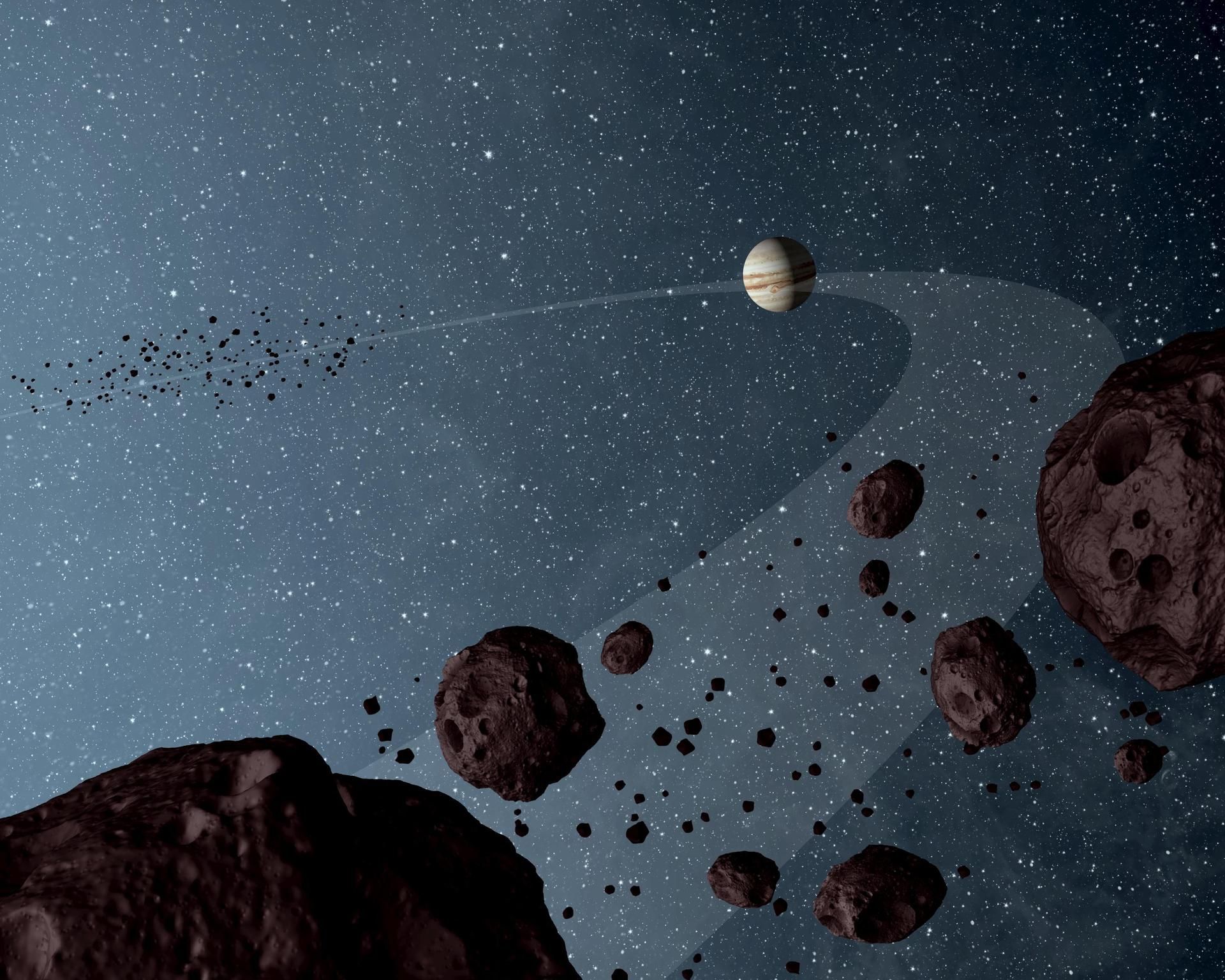
Beginning in 2025, however, the L5 swarm’s position began to drift—ever so gradually—away from the galactic plane, making the population somewhat easier to observe. At the same time, the Rubin Observatory commenced its scan of the entire Southern Hemisphere sky using the world’s largest digital camera.
“Rubin is pretty uniquely suited to being excellent at discovering Neptune Trojans,” study co-author Kathryn Volk, a scientist at the Planetary Science Institute in Arizona, said in an email to Live Science. “The on-sky density of these objects is not particularly high, so having a large field of view helps a lot!” Rubin’s field of view spans an area equal to seven full moons, according to the observatory. That wide view, combined with optics sensitive enough to detect objects 100 billion times fainter than Venus, made the discovery possible.
Steadfast Trojans
The new observations are part of the Rubin Science Validation Survey, a three-month trial conducted in mid-2025 ahead of the observatory’s flagship Legacy Survey of Space and Time (LSST), a decade-long effort now in progress. By happenstance, the validation survey covered the patch of sky that includes Neptune’s L5 Trojans, allowing the asteroids to be captured within three weeks of the survey’s launch.
After the detections, the team built computer models to reconstruct the asteroids’ orbits. The simulations showed that the pair will continue trailing Neptune for a billion years, and that their trajectories have likely remained stable for several billion years—implying the objects may have traveled these paths since the early solar system. A third object appeared in the Rubin data, but it held a stable orbit in only some of the simulations, so the researchers classified it as a Trojan candidate rather than a confirmed member.
The two confirmed Trojans, though, probably did not form in place alongside Neptune. Their highly tilted orbits mirror those of the previously identified L5 asteroids, suggesting Neptune captured the objects as they swept past.
Characterizing both the Jovian and Neptunian Trojan populations should help researchers reconstruct events from the solar system’s infancy, when the giant planets are thought to have migrated to their current positions, Volk said.
Schwamb anticipates that the LSST will reveal many more of the hypothesized Neptunian Trojans, particularly since it will revisit this same region of the sky repeatedly over the coming months.


