






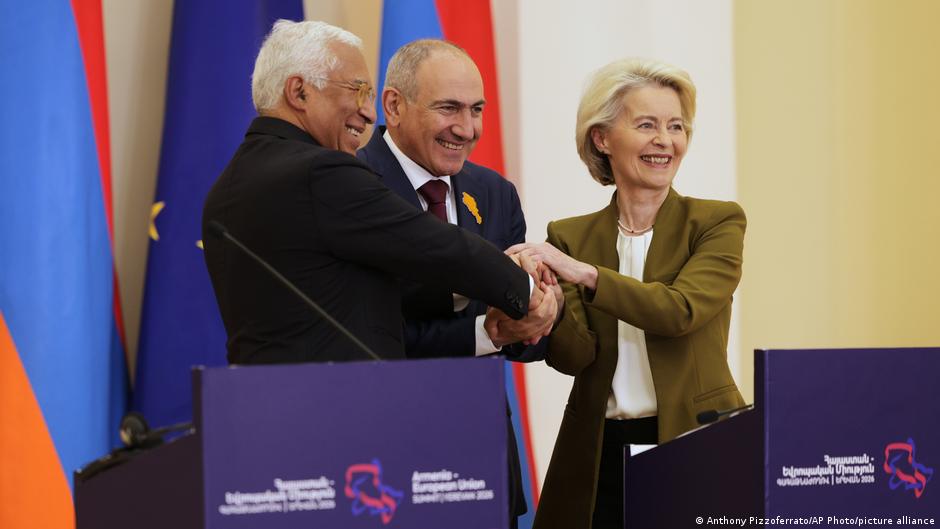
Armenia’s Selective Prosecution: A Challenge to Democratic Norms and EU Ties
In early October, Artur Danielyan, leader of Armenia’s opposition party Adekvad, was arrested after a Facebook post in which he criticized Prime Minister Nikol Pashinyan.
The incident is part of a growing trend: over the past two years, Armenian authorities have charged multiple opposition figures primarily on the basis of their social media activity.
Civil society representatives warn that such selective justice signals a concerning shift toward democratic backsliding.
The arrest of Artur Danielyan
The grounds for Danielyan’s detention were Facebook posts in which he lampooned both Prime Minister Pashinyan and the country’s security services.
A specific point of contention involved Pashinyan’s position on a potential prisoner exchange concerning an Azerbaijani soldier accused of breaking into the home of a 39-year-old woman in the Armenian village of Shaki, an act that injured her and her children.
In an interview with the Armenian news outlet Infocom, Pashinyan denied the possibility of swapping the imprisoned soldier in Armenia for detained Armenians in Azerbaijan. Danielyan retorted with a scathing attack, labeling the prime minister a “scumbag” and accusing him of refusing to extricate his fellow citizens.
This context stems from the protracted conflict between Armenia and Azerbaijan over Nagorno-Karabakh, a breakaway region declared independent in the 1990s. Following Azerbaijan’s 2023 military offensive, Baku regained control, forcing over 100,000 Armenians to flee. Consequently, 19 Armenian individuals, including former high-ranking officials from Nagorno-Karabakh’s de facto administration, remain detained in Baku.
Growing trend of selective prosecutions?
More than a dozen Armenian civil society organizations have condemned the prosecution of the Adekvad party leader, describing the actions as “patently illegal, disproportionate, and politically motivated.”
They characterize the proceedings as punitive, stating that such steps send a direct message to the public, aimed at silencing dissent, critical viewpoints, and undesirable speech.
Additional criminal investigations have targeted activists who criticized the ruling establishment or Prime Minister Pashinyan.
A related case arose before the June parliamentary elections involving Artur Osipyan, a displaced activist from Nagorno-Karabakh, who was arrested following a verbal altercation with Pashinyan over his policies regarding Karabakh.
Subsequently, prosecutors charged Osipyan with disrupting public order and obstructing the ruling party’s campaign, and he was also charged with inciting violence against Pashinyan in a social media post from March.
Is freedom of expression in danger in Armenia?
On April 15, 2020, Article 226.2 was introduced into the Criminal Code of Armenia, criminalizing public calls to violence as well as the public justification or promotion of such violence.
In response to strong civil society outrage, these offenses were subsequently decriminalized. A 2025 report by Freedom House indicated that nearly 95% of court cases involving the 2020 amendment’s violence incitement provisions concerned threats against Prime Minister Pashinyan and his supporters, whereas statements by ruling-party members were rarely subject to similar scrutiny.
Throughout the 2026 pre-election period, the Regional Center for Democracy and Security (RCDS), an independent think tank based in Yerevan, monitored online hate speech targeting Nagorno-Karabakh refugees. Their reports documented how pro-government bloggers and influential social media users directed hostile rhetoric toward displaced Karabakh Armenians, labeling them with derogatory terms. Notably, law enforcement agencies largely refrained from pursuing criminal prosecutions against these activists.
Why doesn’t the EU react?
Despite Armenia’s efforts to bolster its ties with the European Union, Brussels has provided no clear response to the suppression of opposition voices, according to observers in Yerevan.
Political analyst Tigran Grigoryan noted that the EU has largely adopted a pragmatic, geopolitically driven approach. “Given various regional developments, including ongoing tensions in Georgia, Armenia has become the EU’s primary regional partner,” he stated. “Coupled with the reality that the alternative to Pashinyan is a pro-Russian opposition, there is ultimately no substantive response to these criminal cases.”

Eastern Europe expert Stefan Meister of the German Council on Foreign Relations (DGAP) echoed this perspective. European support for Armenia appears primarily motivated by European Russia policy—”strengthening those forces that undermine Russia’s influence in the country and the region.” Meister pointed out that Pashinyan exploits this dynamic to categorize internal political opponents as Russian proxies, though he warned that the EU risks falling into the trap of accepting this narrative.
Also Read
- President Isaac Herzog Assigns Gadi Eisenkot to Forge Israel’s Next Government
- Donald Trump Urges UFC CEO Dana White to Join as White House Press Secretary
- Malay King Cautions Ex-PM Najib Against Contesting House Arrest Order
- Credit Saison Teams with ADB to Scale SME Lending Across Asia Using India-Honed Model


