



![Maple Leafs Sign Elite Defenseman Darren Raddysh to Eight-Year Contract]](https://i2.wp.com/deweb-519a7.b-cdn.net/post-images/2113bbc5-c78b-45be-ac83-bc688b7363c9.jpeg?w=1024&resize=1024,1024&ssl=1 "Maple Leafs Sign Elite Defenseman Darren Raddysh to Eight-Year Contract]")





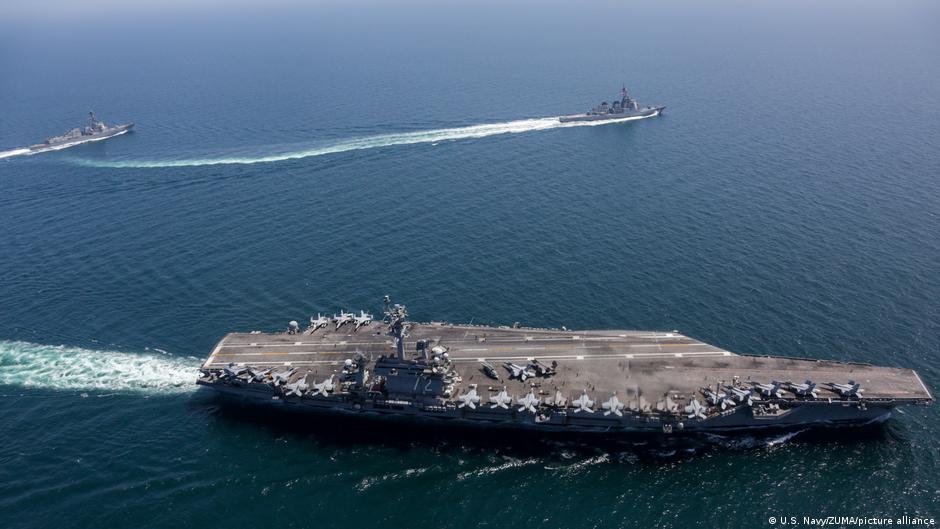
Russia’s war of aggression against Ukraine on the EU’s eastern flank, U.S. disregard for the international order under President Donald Trump, and allegations of Israeli violations of humanitarian law in the Middle East have unsettled many Europeans.
The post‑World‑War‑II world order appears to have ended. German Chancellor Friedrich Merz declared at the February 2026 Munich Security Conference: “Even at its best, that order no longer exists in its former shape.”
In Asia, observers often find European dismay surprising. At the Shangri‑La Dialogue, an annual security conference in Singapore, former Singaporean diplomat Bilahari Kausikan told DW that Europe “thought the jungle had been tamed for good. And then it got a shock.”
“Competition and conflict are fundamental features of international relations,” he added. “These stark realities were masked for roughly two decades—from the fall of the Berlin Wall to the global financial crisis—a unique interlude in world history.”
The US as we knew it is not coming back
Marc Saxer, head of the Asia‑Pacific programme at Germany’s Friedrich‑Ebert‑Foundation, told DW that Europe and Asia have divergent historical experiences. Protected by the United States, Europe could envision a liberal world order—something Asia never could.
Saxer argues that attempts to preserve a liberal world order have failed and that “for structural reasons, the US cannot return to the role it held until the 2010s.”
He maintains that the unipolar era is definitively over, as the US has become over‑stretched across Europe, the Middle East and the Asia‑Pacific.
Thomas Kleine‑Brockhoff, director of the German Council on Foreign Relations (DGAP), told DW that under Trump the US now seeks “a hegemonic world of great powers—a global directorate with Russia and China—creating spheres of influence dominated by the major powers.”
Consequently, international law and multilateral institutions like the United Nations are being eroded by the United States, China and Russia—each for its own strategic reasons.
Saxer, author of a book bearing the same title, describes this outcome as a “wolf world” – a system where “the law of the strongest triumphs over the strength of the law.”
National interests always shape security: German minister
To view this video please enable JavaScript, and consider upgrading to a web browser that supports HTML5 video
Middle powers push back
Most other states naturally reject such a system, prompting the question of what counter‑currents are emerging.
Kleine‑Brockhoff outlines three distinct reactions, each shaped by geography and strategic considerations.
Japan, situated next to a rising China and lacking many like‑minded allies in the region, must deepen its cooperation with the US.
Europe, a geographically and politically integrated bloc, is concentrating on “strengthening itself economically and militarily,” Kleine‑Brockhoff notes. It aims to retain the US during the transition period, ultimately becoming self‑reliant.
A third model, a counter‑alliance of middle powers, was championed by Canadian Prime Minister Mark Carney in his acclaimed 2026 Davos address.
“The old order will not return. We should not mourn it. Nostalgia is not a strategy. But from this rupture, we can build something better, stronger and more just. That is the task of the middle powers,” he said.
German Chancellor Friedrich Merz echoed this sentiment at Davos, calling the old order “unraveling.”
A new Cold War: Can the middle powers forge a path forward?
To view this video please enable JavaScript, and consider upgrading to a web browser that supports HTML5 video
Analyst Marc Saxer stresses that non‑Western powers now shape the future global order.
The turning point is historic because, for the first time in centuries, non‑Western powers are decisively shaping the next order. “Order,” he notes, “will no longer mean Westernization.”
Regulatory frameworks must incorporate China’s collectivist view of order, where rules serve the community rather than the individual, as well as the Muslim world’s belief in a community of believers. Nonetheless, intra‑Islamic divisions, such as those between Shiites and Sunnis, also create tensions.
What could a new global order look like?
To thrive in this new world, Saxer expands on Prime Minister Carney’s “tasks” for middle powers, advocating cooperation through “middle‑power partnerships” rather than formal alliances, to avoid bloc formation.
“Given limited capacities, we cannot rely solely on coalitions of like‑minded democracies to address global challenges. Partnerships in the middle must bring together all solution‑oriented states, regardless of their internal political systems,” Saxer said.
Trump vs. the world order
To view this video please enable JavaScript, and consider upgrading to a web browser that supports HTML5 video
The approach, he argues, moves beyond values‑based politics and the hunt for like‑minded allies.
Alliances are now built on shared interests rather than shared values. Cooperation occurs where interests coincide and can be suspended where they diverge, rather than having like‑minded partners consistently act together or in opposition.
Of course, this is always done while upholding certain non‑negotiable principles, such as human rights.
Saxer proposes a modern “Helsinki Declaration”—the Cold‑War‑era security agreement summed up as “universalism without interference”—as a vehicle for this new order.
In the early 1970s, the US and the Soviet Union, together with NATO and Warsaw Pact members, reached a voluntary commitment at the Conference on Security and Cooperation in Europe (CSCE). The agreement lacked the status of a binding treaty.
According to Saxer, this approach is once again relevant today.
DGAP director Thomas Kleine‑Brockhoff doubts the arrangement’s durability, noting that, unlike the Cold War era, key global order‑keeping forces are now weakened.
“Every system requires enforcement mechanisms, baseline rules, and compliance,” he observes. The fluid model of stakeholders cooperating on climate while clashing on security remains inherently volatile.
Regarding Carney’s vision, Kleine‑Brockhoff contends that middle powers are too disparate and have conflicting interests.
“I see the opposing forces, but not the connection between them,” he said.
Will Japan become the Indo‑Pacific’s most trusted power?
To view this video please enable JavaScript, and consider upgrading to a web browser that supports HTML5 video
Bad times for common solutions
Consequently, preserving global public goods is becoming harder. Efforts to mitigate climate change, manage health threats like pandemics, and secure peace are increasingly hampered.
Kleine‑Brockhoff warns of an emerging era of “endless free‑riding,” where actors prioritize self‑interest over collective problem‑solving.
To counter this, Saxer sees pragmatic collaboration among willing stakeholders as the only viable path.
His concept of “transformative realism” offers the best chance to blend diverse post‑liberal order visions, tackling specific global challenges without returning to bloc politics.
This article has been translated from German


