



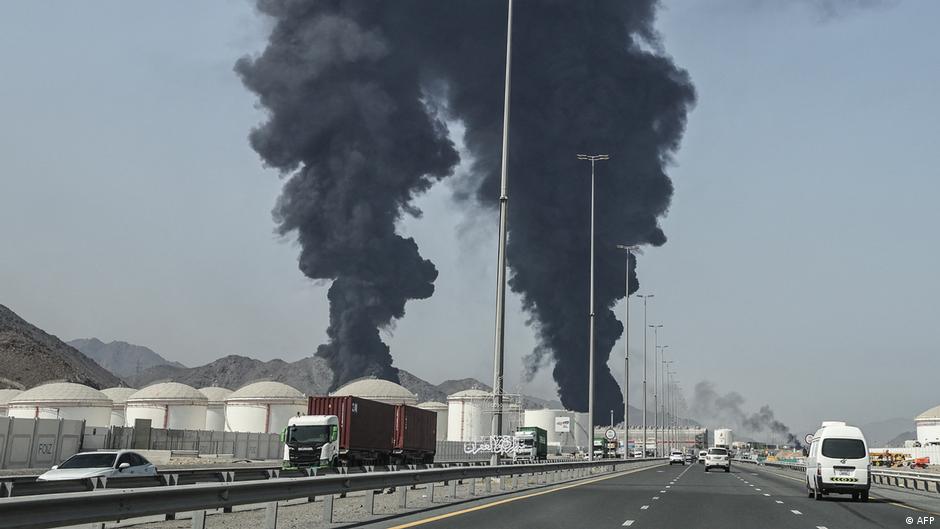
Since the war began, Gulf states have intercepted thousands of Iranian missiles and drones, while Tehran has targeted U.S. bases and civilian energy infrastructure.
On Monday, Kuwait reported that its air defenses were engaging a missile and drone barrage after the United States claimed it had struck radar and drone sites in southern Iran.
Because of their proximity to Iran and their alignment with Washington, the economies and infrastructure of Gulf Cooperation Council (GCC) members are especially vulnerable if the fighting intensifies.
If the conflict ends through negotiation while the Islamic Republic remains in power, the region will face a long‑term question: how can the GCC and Tehran move forward after hostilities cease?
Gulf Arab states have told Washington that merely ending the war is insufficient; they insist that Iran’s capacity to threaten the region with missiles and drones must be diminished.
“If Iran and the United States reach an agreement and Iran ends its state of hostility toward the West, Tehran will need to take significant diplomatic and economic steps to improve its regional standing and relations with neighbours,” said Babak Dorbeiki, a London‑based political analyst and former official at Iran’s Strategic Research Center.
Dorbeiki told DW that, from Tehran’s perspective, the GCC countries targeted in the current war are not “neutral actors”; they have participated in pressure campaigns against Iran by hosting U.S. forces, providing logistical support, or indirectly backing military action.
In the short term, Dorbeiki expects Iran’s neighbours to view Tehran with deeper suspicion and greater caution, affecting diplomacy, trade routes, regional infrastructure, and future transport and energy corridors.
Can Gulf nations close the gap between Iran and the US?
To view this video please enable JavaScript, and consider upgrading to a web browser that supports HTML5 video
Gulf states want regional stability
In late April, GCC leaders met in Saudi Arabia for the first time to coordinate a response to Iranian strikes. Between the war’s launch on 28 February and the cease‑fire announced on 8 April, Iran launched more than 4,000 missiles and drones at GCC targets, most of which were intercepted.
Although Iranian attacks have decreased, the Gulf states remain vulnerable amid ongoing regional instability. During the April talks, Qatar’s Foreign Ministry warned of a “frozen conflict” that could flare up whenever political tensions rise.
The United Arab Emirates said Iran must cease attacks on neighbouring states for diplomacy to progress, while Saudi Arabia warned Tehran not to target the kingdom or other Gulf countries.
From Iran’s side, the current hostility has alienated some former partners. The UAE, together with non‑GCC countries Iraq and Turkey, had previously facilitated trade, finance and re‑export channels that gave Iran breathing room under international sanctions.
Rivalry existed, especially in oil and gas markets, but a functional balance had emerged. If Gulf states increasingly coordinate around mistrust of Tehran, the fallout could extend beyond politics into trade, logistics and long‑term regional development.
The necessity of geography
Reza Alijani, a Paris‑based political analyst, told DW that the close proximity of Iran and its Gulf neighbours will inevitably force a degree of accommodation.
“Geography will always be more powerful than politics. These countries will always be neighbours,” he said.
Alijani added that rebuilding relations is different from rebuilding trust; the most likely outcome is a tactical reduction in open hostility rather than genuine reconciliation.
Shared interests—particularly in energy exports, trade and regional stability—may eventually push both sides toward a limited modus vivendi, but that would not necessarily end the underlying rivalry. It could simply result in a colder, more carefully managed competition.
Iran’s power projection in the Middle East
The Islamic Republic has built much of its regional influence on missiles, drones and proxy militias, a strategy intended to deter stronger adversaries and expand leverage without direct conventional confrontation.
After the current war and the overall degradation of Iranian proxies such as Hezbollah and Shiite militias in Iraq, Arab states are likely to emphasise integrated defence, economic coordination and alternative energy and trade corridors to reduce exposure to Iranian pressure.
Dorbeiki noted that mutual suspicion of Tehran could become a driver of closer commercial cooperation among Arab states and their partners, leaving Iran more isolated from emerging trade routes, transport links and future energy infrastructure.
Nevertheless, no regional order can be fully stable while Iran remains permanently outside it.
A genuine normalisation of ties would require a substantive shift in Tehran’s regional policy, a less confrontational stance toward the West, and sustained efforts to reassure neighbours that Iran is committed to stability rather than leverage through fear. At present, hostilities continue and the same policies endure.
Edited by: Wesley Rahn
Also Read
- Pakistan Stock Exchange Plunges 2,800 Points as US-Iran Diplomatic Halt Rattles Investor Confidence
- Harness Engineering Becomes Vital Backbone For AI Makers And Happy Users
- Oil Prices Rebound as Lebanon Clashes and Strait of Hormuz Bottleneck Fuel Market Concerns
- Tectonic Shift Permanently Alters Mindanao Coastline Following Devastating Earthquake