







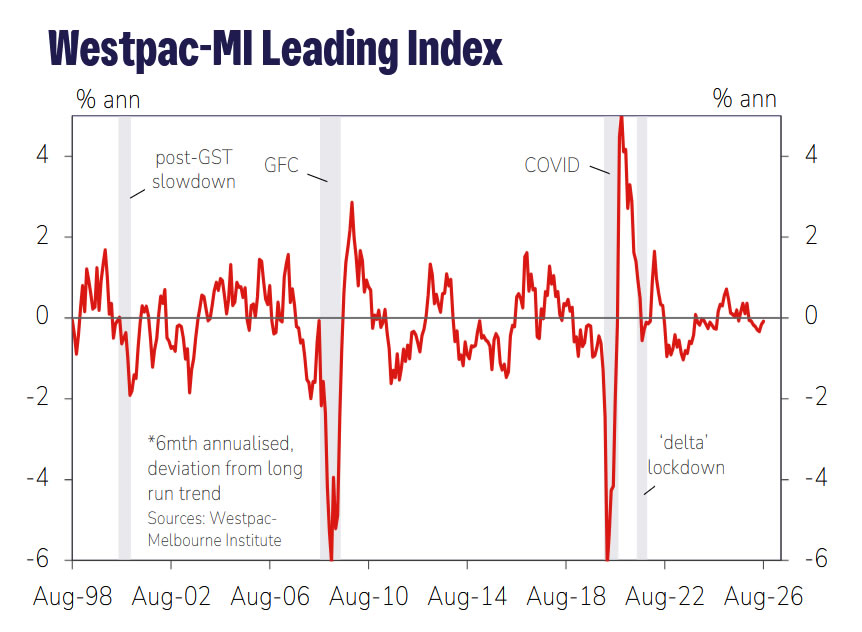
Australia’s forward‑looking growth momentum picked up in August, though it remained just below trend. The six‑month annualized rate of the Westpac–Melbourne Institute Leading Index climbed from –0.17% in July to –0.09%, indicating the likely pace of economic activity relative to trend over the coming three to nine months. Matthew Hassan, Westpac’s Head of Australian Macro‑Forecasting, noted that the economy seems to be stabilizing at a modest pace rather than stalling, buoyed by resilient households and a notable rise in data‑centre investment. Westpac also lifted its 2026 year‑end GDP growth forecast from 1.0% to 1.5%.
The underlying details, however, were less encouraging than the headline figure suggests. From February through August, drags from labour markets, financial markets, commodity prices and consumer sentiment together subtracted 0.42 percentage points from the index. This was largely counterbalanced by dwelling approvals, which added 0.32 percentage points, and firmer US industrial production, contributing 0.08 percentage points. Westpac cautioned that higher fuel prices, anticipation of additional rate hikes and a slowdown in the established housing market could intensify pressure on consumers and spill over to other components, leaving the modest gain susceptible to reversal.
This mix points to a hawkish rather than dovish policy reading. Westpac anticipates the Reserve Bank’s Monetary Policy Board will keep rates steady at the September 28–29 meeting while signalling a ‘very hawkish hold.’ Although growth remains below trend, its softer‑than‑weak trajectory is projected to persist through the second half of 2026 and into early 2027. Westpac views this resilience as reinforcing the Board’s worry that inflation remains sticky, and still forecasts another rate increase once the next comprehensive quarterly inflation report is published on October 28.

Data Summary
Indicator
August
July
Westpac–MI Leading Index growth rate
-0.09%
-0.17%
Forecast Revision
Forecast
Current
Previous
Year-end annual GDP growth
1.5%
1.0%
Six-Month Component Contributions
Component
Contribution
Dwelling approvals
0.32ppts
US industrial production
0.08ppts
Labour markets, financial markets, commodity prices and consumer sentiment
-0.42ppts
Key Takeaways
- The Leading Index growth rate rose from –0.17% to -0.09%, edging nearer to trend while still sitting slightly below it.
- The index gauges the probable pace of economic activity relative to trend over the next three to nine months.
- Westpac sees the economy stabilizing at a slow pace rather than stalling, supported by resilient households and a notable rise in data‑centre investment.
- Westpac upgraded its year‑end GDP growth forecast from 1.0% to 1.5%.
- The gain was narrow, driven mainly by dwelling approvals and stronger US industrial output, which offset weakness in several domestic areas.
- Higher fuel costs, expectations of additional rate hikes and a downturn in the housing market could add further pressure on consumer sentiment.
- Westpac expects the RBA to leave rates unchanged on September 28–29 but deliver a “very hawkish hold.”
- Another rate increase is still expected, although Westpac believes the RBA will wait for the October 28 quarterly inflation report.
Also Read
- Elliott Wave View: Dollar Index (DXY) Double Three Rally Likely to Break Lower – Action Forex
- Ripple’s university strategy is evolving from blockchain labs to XRP logos in packed stadiums
- Late-Stage Political Breakdown Doomed the Clarity Act Vote
- AUDNZD Technical Outlook: Breakout Above Key Resistance Signals Continued Upside Potential


