






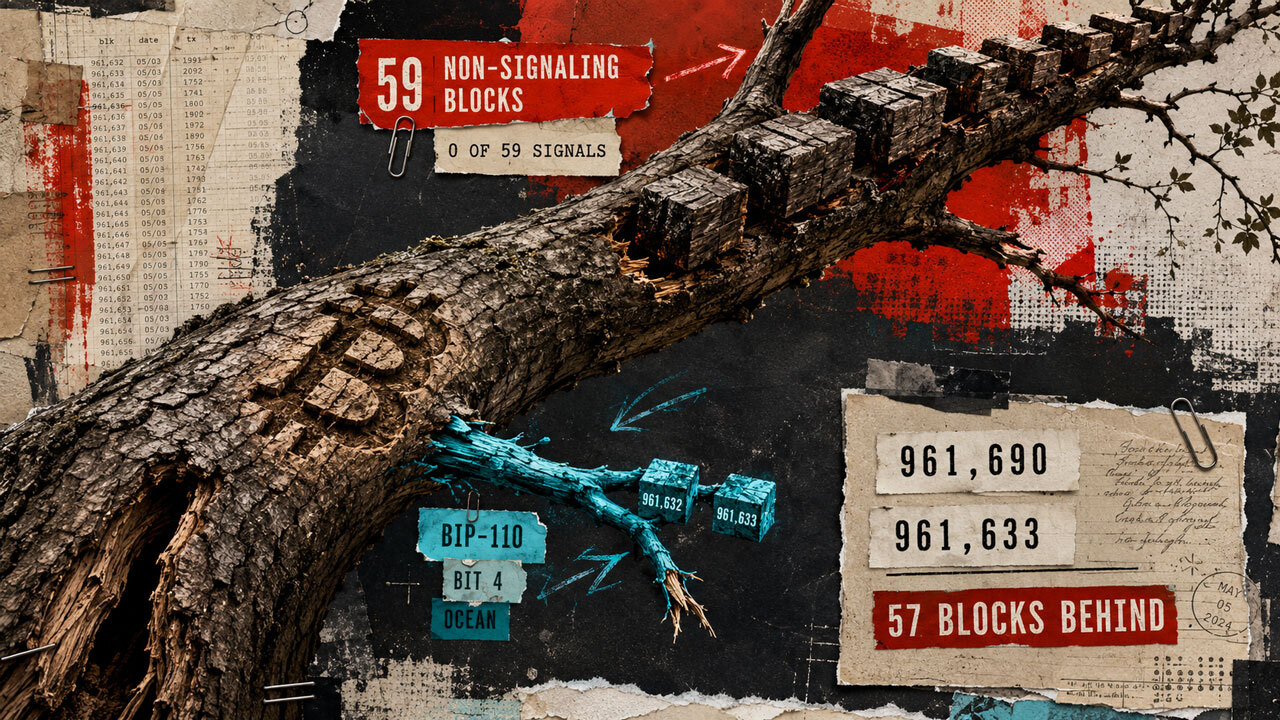
BIP-110, a proposed temporary soft fork that would restrict certain uses of arbitrary data in Bitcoin transactions, entered its mandatory-signaling window as miners produced 59 consecutive non-signaling blocks. Nodes enforcing the proposal were left on a two-block branch, falling 57 blocks behind Bitcoin’s dominant proof-of-work chain.
As of 6:34 a.m. UTC on Aug. 9, explorer data showed the dominant chain at block 961,690, while the BIP-110 enforcing branch lagged at 961,633. The latest block on the alternate chain was approximately eight hours and 45 minutes old.


The proposal sets temporary consensus limits on several methods of placing arbitrary data in Bitcoin transactions. Its deployment requires a 55% threshold, or 1,109 of 2,016 blocks, with signaling mandated between heights 961,632 and 963,647 for enforcing nodes.
Under BIP-110’s state machine, a compliant chain reaching block 963,648 transitions to LOCKED_IN, with restrictions becoming active only if the chain advances to block 965,664. At the time of the split, these restrictions remained two consensus stages distant.
BIP-110 supporters argue the proposal is necessary to prioritize Bitcoin as a monetary system, while critics contend that filtering transactions could undermine its core principle of neutrality.
The BIP-110 divergence began at height 961,632, when enforcing nodes rejected blocks lacking version bit 4 signaling. Analysis of the dominant chain’s first 59 blocks in the window revealed zero bit-4 signals.
The BIP-110 enforcing branch produced two blocks—at heights 961,632 and 961,633—attributed to miners using OCEAN, both signaling support. After height 961,633, no new blocks were mined on this branch. At the snapshot time, 1,957 blocks remained in the mandatory-signaling window, with the dominant chain’s zero-signaling result creating a measurable minority fork lacking mining support. Coinbase and Kraken confirmed normal Bitcoin system operations via their status feeds, while wallets and merchants remained unaffected.

BGeometrics data indicate BIP-110 miner signaling at 0.42% since May 1, while tools like Farside’s alerts highlight the urgency of the August lock-in deadline for exchanges, wallets, pools, and node operators. Critics have raised concerns about potential inflation of signaling statistics through coordinated node deployment, with some suggesting a single entity could be simulating widespread BIP-110 support.
Blocks from major pools—including Foundry, F2Pool, AntPool, ViaBTC, and MARA—appeared on the dominant chain during the 59-block sample, with no observable miner defection following the signaling window’s activation. Pool attribution via coinbase tags does not constitute formal policy commitments.
The fork discussion has intensified, with over 10,000 blocks remaining before the next major decision point. Market participants remain cautious as the community debates the implications of either enforcing BIP-110 or maintaining status quo.
Also Read
- Senate Block on Clarity Act Leaves Crypto Industry Navigating Regulatory Uncertainty
- AI Could Be Bitcoin’s Next Onboarding Engine, Nakamoto CEO Says
- 5 Best Solana Tools for Tracking Smart Money and Wallet Activity in 2026
- U.S. Dollar Gains as Oil Markets Rally: Comprehensive Analysis for EUR/USD, GBP/USD, USD/CAD, and USD/JPY


