




Bitcoin’s advance above the $80,000 level encountered a significant obstacle on September 4th, following the release of an August jobs report that significantly surpassed recent hiring trends. This development complicated the Federal Reserve’s ability to maintain interest rates based solely on indications of labor market weakness.
The cryptocurrency touched an intraday low of $78,660 before regaining ground to remain in proximity to the $80,000 mark.
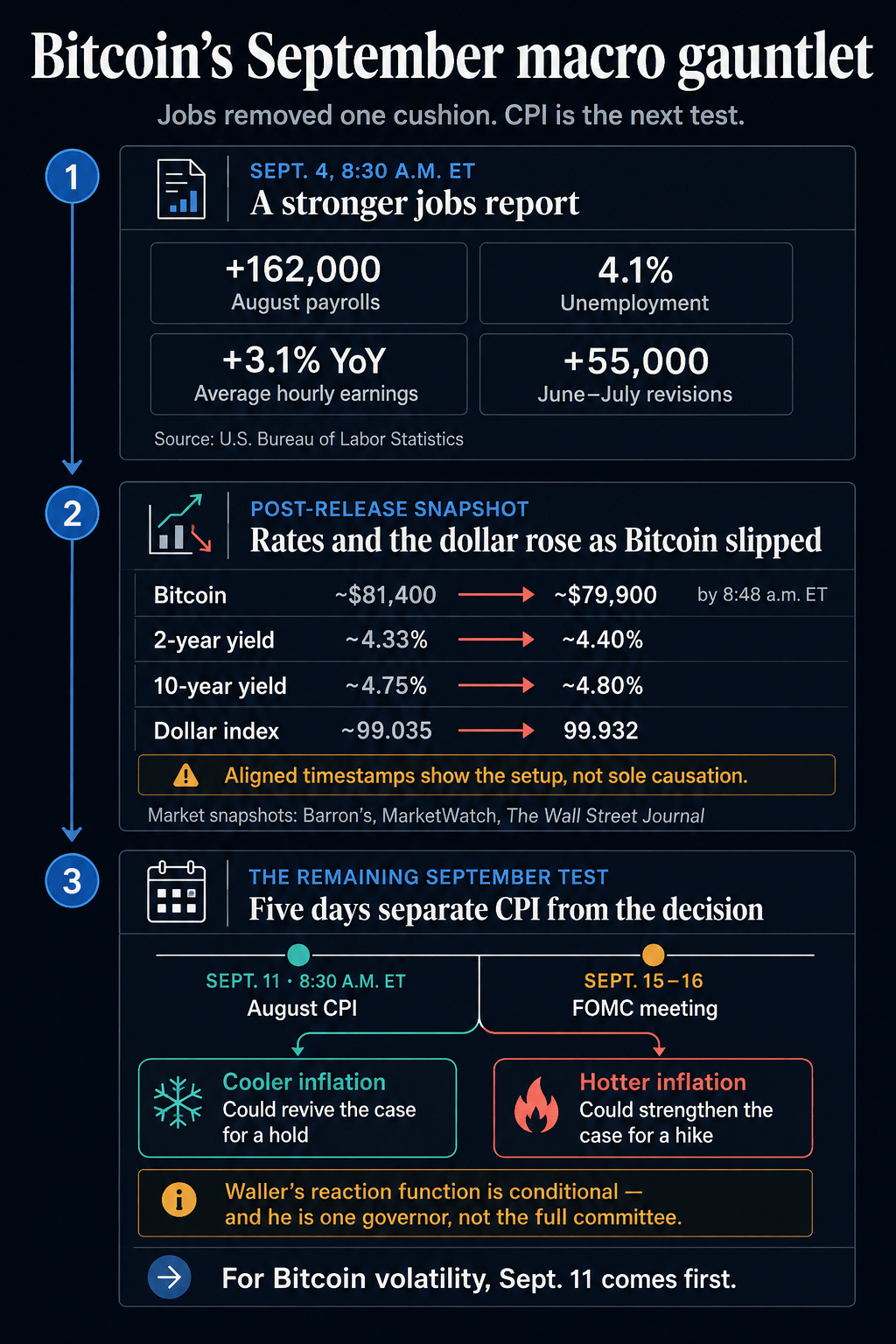
In the immediate aftermath of the report, MarketWatch indicated the two-year Treasury yield at approximately 4.40%, an increase from just over 4.33%, while the 10-year yield reached around 4.80%, up from just below 4.75%. Concurrently, The Wall Street Journal observed the dollar index rise to 99.932 from a prior level of approximately 99.035.
These synchronized movements indicated that a stronger labor market provided policymakers with greater flexibility to prioritize inflation concerns, even as rising short-term yields and a stronger dollar intensified the financial environment for dollar-denominated risk assets like Bitcoin.
Payroll Data Refines the Federal Reserve’s Policy Dilemma
According to the Bureau of Labor Statistics, nonfarm payrolls increased by 162,000 positions in August, which is more than five times the average monthly gain of 31,000 observed over the preceding year. Meanwhile, the standalone unemployment rate remained steady at 4.1%.
The BLS revised upward its June payroll figures to 31,000 and July figures to 21,000, collectively adding 55,000 jobs to its prior estimates.
Average hourly earnings for private-sector nonfarm employees increased by 0.3% in August, reaching $37.75, and were 3.1% higher compared to the same period last year.
The leisure and hospitality sector, specifically food services and drinking places, contributed 59,000 jobs, while local government education added 42,000 positions. In contrast, the information sector experienced a decline of 23,000 jobs, and healthcare added 13,000 roles — significantly below its average monthly gain of 32,000 over the past year.
The findings undermined the case for an immediate policy pause based solely on labor market weakness, without demonstrating broad economic overheating. Consequently, inflation considerations now carry greater influence in the Federal Reserve’s decision-making process regarding potential rate holds.
The day prior to the report’s release, Federal Reserve Governor Christopher Waller articulated one perspective on this trade-off. While his views do not represent the official stance of the Federal Open Market Committee, his comments provided a transparent insight into potential policy reactions.
Waller characterized the labor market as satisfactory and stable, noting that employment was close to its maximum sustainable level. He emphasized that the August inflation reading would play a significant role in shaping his policy position for September.
He indicated that sustained advancement toward the Federal Reserve’s 2% inflation target would incline him to maintain current interest rates. Conversely, an elevated inflation reading or signs of reversal in progress could prompt consideration of a rate increase.
The payroll data eliminated the presence of clear labor market weakness that might have counterbalanced an unfavorable inflation reading. As a result, the Federal Reserve’s September policy decision will now hinge more directly on the trajectory of inflationary pressures.
Consumer Price Index Emerges as Bitcoin’s September Milestone
The Bureau of Labor Statistics has scheduled the August consumer price index release for 8:30 a.m. Eastern Time on September 11th. Simultaneously, the Federal Reserve has set the Federal Open Market Committee meeting for September 15th-16th, with the policy decision expected on September 16th.
The five-day interval between the CPI release and the FOMC meeting positions the inflation data as the final significant inflation indicator ahead of the policy deliberation. For Bitcoin market participants, September 11th represents the point at which new inflation evidence can influence the ongoing rate discussion, preceding the formal policy determination.
A softer-than-expected CPI report would align with Waller’s stated condition for endorsing a policy hold, potentially alleviating upward pressure on short-term yields and the dollar. Conversely, a stronger inflation reading would reinforce the argument that progress on inflation has stagnated, coinciding with renewed strength in labor market indicators.
Waller clarified that his remarks reflect only his personal viewpoint, and a single inflation report would not override the broader set of factors considered by policymakers. Nonetheless, the CPI data could shift the equilibrium, given that the payroll figures have already provided a more definitive resolution to the labor market aspect of the debate than recent trends had indicated.
Prior to these consecutive economic releases, Bitcoin had surpassed the $80,000 threshold. Following the payroll data publication, the cryptocurrency retreated below that level as Treasury yields and the U.S. dollar experienced upward movement.
A more moderate CPI outcome could revive expectations of a policy pause, providing room for Bitcoin’s upward momentum to resume. In contrast, a stronger inflation reading might position Bitcoin to face the September 16th Federal Reserve decision under conditions where both enduring labor market strength and persistent inflationary pressures advocate for stricter monetary policy.
While the Federal Reserve meeting constitutes the ultimate policy deadline, September 11th holds initial significance for Bitcoin’s price volatility as it precedes the central bank’s deliberation.