



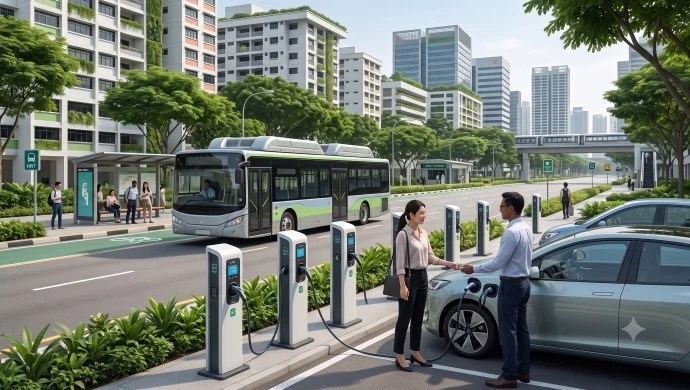

Singapore’s electric vehicle (EV) market has moved past the early adoption phase. By 2026, the transition is clearly evident on roads, in dealerships, and across public parking facilities where charging stations are now a standard urban fixture. However, sustaining this momentum will present greater challenges.
According to BMI Country Risk and Industry Research, a Fitch Group unit, EV sales in Singapore are projected to increase by 34.3 percent in 2026, reaching 34,940 units. This growth will push electric vehicles to 54.6 percent of total vehicle sales, signaling a rapid transition from niche adoption to mainstream acceptance.
The broader vehicle fleet is undergoing significant transformation. BMI projects Singapore’s EV fleet to reach 92,705 units in 2026, representing 10.7 percent of the total vehicle population. By 2035, the research firm anticipates EVs will comprise 44 percent of all vehicles, with electric sales accounting for 85 percent of total transactions.
These figures indicate a rapidly accelerating market, yet they also reveal a more complex underlying reality. Singapore’s EV transition is increasingly contingent upon effective policy design, charging infrastructure, fleet electrification, and ownership economics within a nation that deliberately limits vehicle numbers.
A rapidly growing market, yet far from typical
Singapore’s EV adoption accelerated significantly in 2026. As of June, electric vehicles constituted 70 percent of new vehicle registrations. The first half of the year saw a record 62.4 percent of new car sales be electric, a 110 percent year-over-year increase.
The first quarter marked a pivotal turning point. EVs represented 57.6 percent of new car registrations, totaling 7,679 units—the first time electric vehicles outsold combined internal combustion and hybrid models, per BMI. In June alone, EVs accounted for 4,791 new registrations.
This positions Singapore as one of Southeast Asia’s most advanced EV markets by adoption share, despite its relatively small absolute vehicle volume compared to larger neighbors like Indonesia, Thailand, or Malaysia. The city-state’s affluent consumer base, compact geography, and robust regulatory framework make it highly conducive to EV rollout. Range anxiety is less pronounced than in larger nations, and dense housing allows for centralized charging infrastructure planning.
However, Singapore differs from most car markets. Vehicle ownership is deliberately restricted through the Certificate of Entitlement system, high registration fees, and a longstanding “car-lite” strategy prioritizing public transit. Consequently, EV adoption can surge as a share of new sales while the total number of private vehicles remains strictly controlled.
BMI anticipates passenger EV sales growth will moderate over the longer term, with an average annual growth rate of 5.3 percent between 2026 and 2035. The constraint is not merely consumer demand; it is the structural framework of Singapore’s transport policy.
Incentives are driving adoption
Government incentives remain a critical driver of adoption. Singapore’s EV Early Adoption Incentive, running until December 2026, offers new electric cars and taxis a 45 percent rebate on the Additional Registration Fee, capped at US$5,864 in 2026.
The Enhanced Vehicular Emissions Scheme further supports demand, providing rebates of up to approximately US$17,592 for qualifying cars in 2026 and around US$15,637 in 2027. These incentives are crucial because Singapore is among the most expensive places globally to own a car, where even an affordable EV incurs significant upfront costs once taxes, fees, and the Certificate of Entitlement are factored in.
Simultaneously, policy is becoming more stringent. From 2026, Vehicular Emissions Scheme band thresholds were recalibrated to align with stricter real-world measurements under the Worldwide Harmonised Light Vehicles Test Procedure. BMI noted this will impact the rebates and surcharges applied to new vehicle registrations.
This recalibration is significant because Singapore aims not merely to swap petrol cars for electric ones, but to reduce transport emissions while maintaining strict control over road usage. In this context, incentives must encourage cleaner vehicles without undermining the broader push toward public transport.
This distinguishes Singapore’s EV trajectory from other Southeast Asian markets. While Thailand and Indonesia use EV policy partly to build manufacturing supply chains, Singapore’s focus remains on demand-side adoption, infrastructure readiness, and emissions reduction within a dense urban transport system.
Chinese brands reshaping the price landscape
Another major force driving Singapore’s EV momentum is the arrival of more affordable models, particularly from Chinese manufacturers. BYD has emerged as the standout example.
According to BMI, BYD captured 25 percent of Singapore’s passenger vehicle market in the first half of 2026, compared to 12.5 percent for Toyota. In the first quarter, BYD represented 24.3 percent of new vehicle registrations with 3,239 units, securing the top market position.
This reflects a wider regional pattern. Chinese EV makers have expanded aggressively across Southeast Asia, introducing lower-cost models, battery expertise, and faster product cycles. In markets where EVs were once synonymous with premium brands, Chinese manufacturers have shifted the focus toward affordability and practicality.
For Singaporean buyers, this impact is amplified by the cost of ownership. Any reduction in base price can make a meaningful difference once rebates and registration costs are applied. However, it also intensifies competitive pressure on Japanese, Korean, and European automakers that have long been established in Singapore.
Charging network becomes the next frontier
As EVs move into the mainstream, charging infrastructure transcends convenience and becomes a matter of consumer confidence.
Singapore had approximately 30,500 EV charging points as of March 2026, nearly double the 15,300 recorded in November 2024. The government aims to install 60,000 charging points by 2030 under the Singapore Green Plan 2030, including 40,000 in public car parks and 20,000 at private properties like residential developments and offices.
This target is critical because many Singaporeans live in high-rise public or private housing without access to private garages. Unlike homeowners in other markets, they rely heavily on shared charging infrastructure in car parks, workplaces, and commercial areas.
The charging market is also growing more competitive. BMI reported 36 EV charging operators in Singapore as of July 2026, though consolidation is expected as companies compete in a crowded field. In June, SP Mobility completed its acquisition of ChargEco, integrating over 1,000 public charging points and becoming the operator of Singapore’s largest EV charging network.
Regulation is also evolving. In March 2026, Singapore elevated its national EV charging standard from Technical Reference 25 to SS 722. The new standard includes requirements for smart-grid integration, electrical safety, battery-swapping protocols, and updated direct-current fast-charging specifications.
Fleets may drive the next wave of growth
Commercial vehicles could become a crucial part of the next growth phase. BMI forecasts commercial EV sales to rise 18.5 percent in 2026 to 2,652 units, following 63.4 percent growth in 2025. From 2026 to 2035, commercial EV sales are expected to grow at an average annual rate of 8.4 percent.
The drivers are clear: pressure on businesses to decarbonize supply chains, government and municipal fleet electrification, and improved charging infrastructure. Incentives also play a role. The Commercial Vehicles Emissions Scheme, running until March 2027, provides incentives of up to approximately US$15,637 for the least-polluting commercial vehicles and penalties of up to around US$11,728 for the most polluting.
For heavy vehicles, the Heavy Vehicle Zero Emissions Scheme supports businesses registering new zero-tailpipe-emission heavy goods vehicles and buses. The incentive was reduced to approximately US$11,728 from September 2026, except for vehicles with a maximum laden weight above 7,000kg, following strong take-up and a narrowing cost gap with internal combustion models.
BMI expects Singapore’s electric heavy commercial vehicle segment to remain small at approximately 212 units in 2026, but forecasts it will reach 1,131 units by 2035. Bus fleet electrification should also provide medium-term support.
Nevertheless, not all consumer sentiment is aligned. A 2026 study cited by BMI found that 32 percent of respondents planned to buy an internal combustion engine vehicle over the next two years, up from 26 percent in 2024. Concerns over charging availability and hidden costs were among the reasons.
This encapsulates the paradox of Singapore’s EV transition. Adoption is rising quickly, but future growth will not stem from a simple expansion of private car ownership. Public transport remains central: MRT, light rail, and bus networks recorded an average of 7.2 million daily rides in 2023, and the government aims for at least 80 percent of households to be within a 10-minute walk of a train station by 2030.
Singapore’s EV market is therefore entering a more mature phase. The straightforward narrative is that electric cars are winning. The more complex challenge ahead involves keeping incentives calibrated, ensuring charging reliability, electrifying fleets, and guaranteeing that EV adoption supports, rather than competes with, the country’s broader car-lite future.
Also Read
- JDW Sugar Mills Share Price Update Reflects Market Trends for Investors
- Citi Upgrades Harley-Davidson to Buy, Citing Momentum Turnaround After Multi-Year Decline
- Kyiv Claims Long-Range Strikes Have Disrupted Over Half of Russian Oil Refining
- 2026 Nobel Prize in Physiology or Medicine Awarded for Pioneering Optogenetics Research