







BNB inflows arrived before Binance’s breach
BNB exchange‑traded funds (ETFs) topped October’s inflows among U.S.‑listed spot crypto ETFs tracked by SoSoValue, with the largest portion of capital entering weeks before Binance was saddled with a record $6.3 billion cryptocurrency hack.
The U.S.‑listed VanEck BNB ETF (ticker VBNB) amassed $99 million in October, outpacing $35 million for the NEAR fund and $19 million for XRP, per SoSoValue data.
These gains were offset by broader withdrawals: $1.61 billion left U.S. Ethereum funds, $515 million exited Bitcoin products, and $144 million was removed from Solana ETFs.
VanEck’s BNB ETF, trading as VBNB, drove the entire category’s October inflows. SoSoValue’s daily flow table shows roughly $97 million on Oct. 2—about 98.8 % of the month’s net total—well before the incident.
The table also reveals that fund assets rose from roughly $3 million on Oct. 1 to $100 million on Oct. 2, then $103 million on Oct. 5. Subsequent activity was modest, with an additional $1 million entering on Oct. 9 and a $285,000 exit on Oct. 15, while the early allocation propelled BNB’s strong monthly performance.
VanEck launched VBNB on May 28 to provide U.S. investors with exposure to BNB via an exchange‑traded product. The fund stores the token in custody using reputable custodians such as Anchorage Digital and BitGo, and its shares correspond to BNB ownership rather than a stake in Binance.
This distinction grew critical after Binance revealed that hackers compromised its hot wallets at approximately 20:05 UTC on Oct. 29, resulting in an estimated loss of $6.3 billion in tokens.
The exchange responded by covering the loss with corporate resources and its Secure Asset Fund for Users, while collaborating with issuers and investigators to freeze the stolen assets.
Binance announced that roughly $3 billion of the stolen assets had been frozen on‑chain. By Nov. 1, about 95 % of the compromised tokens had been replenished, and purchases of the remaining assets continued.
The exchange also began restoring withdrawals in phases starting Nov. 1, noting that the initial outflow surge had since moderated.
Although VBNB posted strong monthly inflows, its assets fell from $98 million on Oct. 29 to $92 million on Oct. 30. These figures also incorporate price fluctuations in BNB, so the drop cannot be solely blamed on ETF redemptions.
Bitcoin’s late reversal exposes fragile ETF demand
The final trading day of October produced a markedly different outcome for Bitcoin funds, as the market responded sharply to the Binance incident.
US spot Bitcoin ETFs lost roughly $643 million on Oct. 30, reversing a positive month‑to‑date balance and leaving October with $515 million in net withdrawals. The funds had previously been on course for a third consecutive month of inflows.
The reversal followed four consecutive sessions of Bitcoin ETF buying. Research firm Ecoinometrics, which had warned that inflows were too thin to establish lasting demand, said the sudden sell‑off exposed the market’s vulnerability to another shock.
“ETF investors aren’t buying the dip. They’re selling it,” the research firm stated, adding that the first serious disruption had undone October’s tentative recovery.
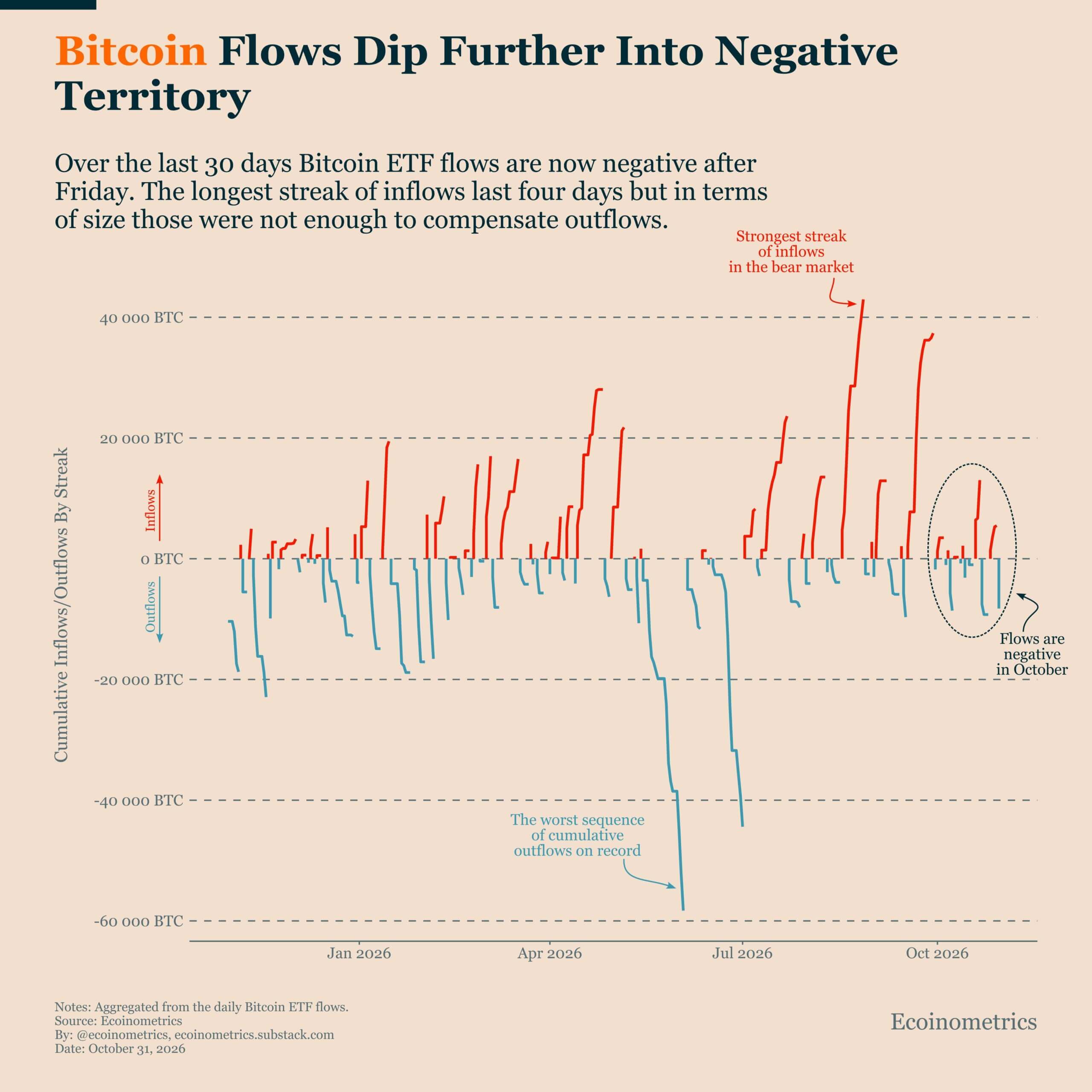


Bitcoin had fallen below $80,000 after the Binance breach. The selloff came against a backdrop of weak ETF demand even before the incident, making it difficult to attribute every redemption solely to the hack.
Ethereum faced a deeper and more persistent retreat. Its $1.61 billion in monthly ETF withdrawals was the largest since U.S. spot Ether funds began trading in July 2024.
The first full trading week of November will better test BNB fund demand after the breach. In a Nov. 2 update, Binance said the full zero‑knowledge proof for its Oct. 31 reserve snapshot had been completed for the ten covered tokens. It said about 95 % of the impacted amount had been replenished, with acquisitions of the remaining assets continuing. The exchange plans a broader snapshot on Nov. 4, followed by a proof it estimates will take 40 to 50 hours to generate.


