



Six months after Bulgaria’s parliamentary election, the country is preparing to choose its next president.
Although the Bulgarian presidency has largely ceremonial functions, the election on October 25 — with a possible runoff on November 1 — will provide an early test for Prime Minister Rumen Radev’s government. His Progressive Bulgaria party secured an unprecedented parliamentary majority in April, winning the first such mandate in almost three decades.
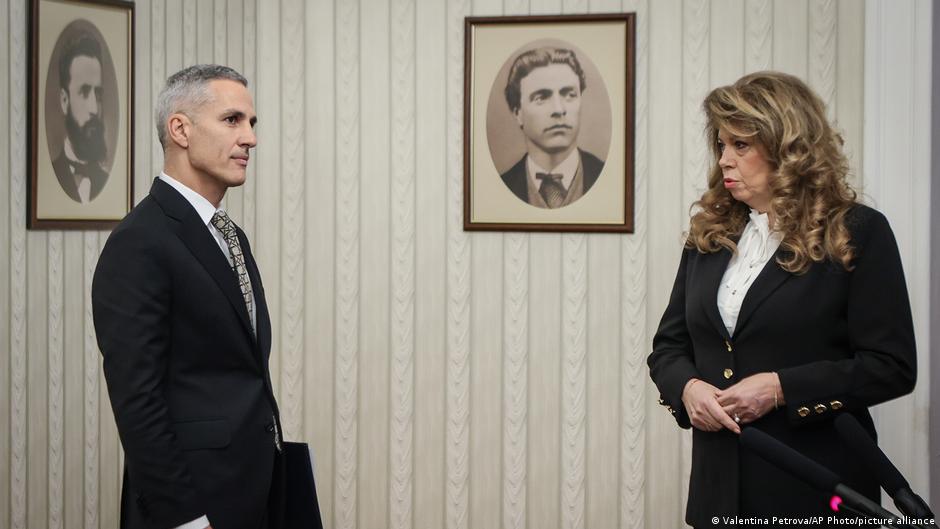
Although 27 candidates appear on the ballot, the race has narrowed to a two-way contest between incumbent President Iliana Yotova, who served two terms as Radev’s vice president and has the prime minister’s backing, and former caretaker Prime Minister Andrey Gyurov, who is supported by opposition parties.
The role of the president
Under the Bulgarian Constitution, the president embodies national unity. The officeholder represents Bulgaria internationally, with certain exceptions, serves as commander-in-chief of the armed forces, appoints members of the Supreme Judicial Council and regulatory bodies, appoints caretaker governments and has the power to veto legislation.
Hristo Panchugov, a political scientist at New Bulgarian University in Sofia, said the president’s powers are formally limited but the office is especially significant in the current political environment.
“For the first time in Bulgaria’s modern democratic history, we have a completely unchallenged majority that is not held together by a coalition, but by a single party facing an opposition that is falling apart,” he told DW.
Panchugov said the campaign should have focused more on whether the president could serve as a counterweight to the governing party.
Opposition candidate Andrey Gyurov made a similar argument in an interview with DW.
“We are seeing a concentration of power that always bears the marks of a slide toward autocracy,” he said, adding that “a president should know how to say no.”
Yotova declined DW’s request for an interview.
The war in Ukraine’s impact
The early stages of the presidential race were marked by small rallies, few televised debates and frequent personal attacks on the two leading candidates.
In recent weeks, however, drone attacks against ships in the Black Sea have brought the frontrunners’ contrasting positions on support for Ukraine into the spotlight.
Bulgaria’s government initially declined invitations to join the Coalition of the Willing and NATO’s anti-drone initiative. It subsequently changed its position on the NATO proposal following the recent attacks.
Yotova advocates creating a “Coalition of Peace,” arguing that Bulgaria would have a stronger diplomatic voice in efforts to end Russia’s war in Ukraine.
“There are many warmongers in our country, but I am not one of them,” she told a campaign rally this month. “As long as I am president — and if you place your trust in me — not a single Bulgarian soldier will go to Ukraine.”
Yotova sought to reassure voters that Bulgaria would not deploy troops to Ukraine, even though the issue had not been a central focus of the public debate. A 2025 parliamentary declaration had already reaffirmed that Bulgarian armed forces would not participate in hostilities there.
Nevertheless, the recent drone attacks on commercial ships in the Black Sea have placed fresh pressure on both the president and Radev’s Progressive Bulgaria party.
The effect of the Black Sea drone strikes
“The drone strikes in the Black Sea brought an otherwise abstract geopolitical situation directly into the daily lives of every Bulgarian,” said Boriana Dimitrova, managing partner at the Alpha Research market and social research agency.
Many European leaders, including Ukrainian President Volodymyr Zelenskyy, have directly blamed Russia for the attacks. The Bulgarian authorities’ failure to clearly identify who was responsible fueled widespread frustration.
Following the first drone attack, Yotova convened the country’s Consultative Council on National Security. Its subsequent declaration did not identify the source of the threat in the Black Sea.
A week later, after a second attack, Radev said: “We lack solid, clear evidence to level accusations against any specific party; however, logic suggests the outcome works to the advantage of Russia.” He subsequently summoned the Russian ambassador for talks.
Opposition to an ambiguous foreign policy
The government and president’s foreign policy positions are now influencing the election campaign.
“We are seeing a slight decline in support for Iliana Yotova, which does not threaten her first-place position in the first round, but reflects the ambiguity of some of the positions she has taken,” Dimitrova said.
As security became a central public issue, some Bulgarians gathered in Sofia to protest what they described as the government’s ambiguous foreign policy response.
“I think the drone attacks in the Black Sea and the utterly spineless stance of the president, the prime minister, and everyone acting in unison were the last straw. On the eve of the presidential election, this should serve as a catalyst,” protester Vlada Tzenova told DW.
Preliminary results from the latest Alpha Research poll indicate that voter turnout is expected to rise, while the gap between the two frontrunners has narrowed. Yotova remains in first place, leading Gyurov by about 12 percentage points in the first round, but her advantage is smaller than it was previously.
Who could hold the balance in a runoff?
Still, these recent developments do not necessarily signal a shift in the balance of political power.
Panchugov said Gyurov’s campaign has been hindered by his delayed decision to declare his candidacy, a lack of enthusiasm in his campaign and the limited comments he made on current affairs before entering the race.
Supporters of the pro-Russian nationalist Vazrazhdane (Revival) party, which ranks third in the Alpha Research poll, would be most likely to back Yotova in a second round.
A potentially decisive factor is that neither GERB nor DPS, two of Bulgaria’s established parties that together attracted more than 660,000 votes in April, fielded a presidential candidate.
According to Alpha Research, half of GERB’s supporters do not intend to vote in the first round. The party dominated Bulgarian politics for 17 years before losing power in December following mass anti-corruption protests backed by opposition parties supporting Gyurov.
Most of the remaining GERB supporters are expected to back Gyurov because the party has historically opposed Yotova’s Bulgarian Socialist Party.
At the same time, Gyurov’s campaign and the nationalist parties are mobilizing more voters. The latter is drawing support from people disappointed by the government’s cautious response to the drone attacks.
“We can view these elections as the first test of confidence in the party that recently won the election,” Dimitrova said. “In peaceful times, the center attracts the most attention. In turbulent times, candidates who take a clearer stance — regardless of its direction — gain greater visibility.”
How Russian aggression is shaping Bulgaria’s presidential election
To view this video please enable JavaScript, and consider upgrading to a web browser that supports HTML5 video
Also Read
- Bukangi the Celebrity Shark Is Guided Out of a South Korea Canal and Resists Release Into the Open Sea
- Pakistan’s Fiscal Year 2027 GDP Growth Forecast at 3.8%, Inflation Expected to Reach 8.2%
- ‘Facebook’s wrongdoing’: Why has Meta been fined $25bn in New Mexico?
- How Israel’s elections are structured and who is vying for power