






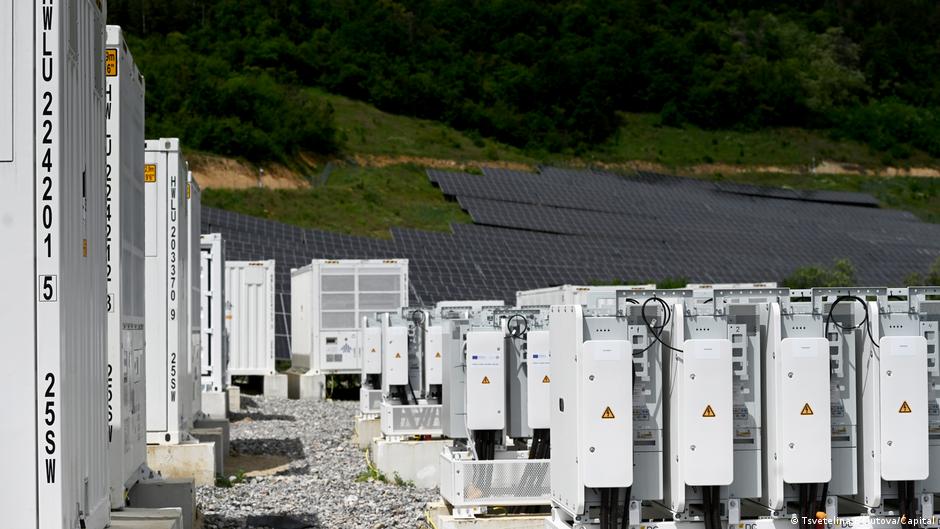
The global energy sector now highlights an unexpected case study: Bulgaria, a Southeastern European nation of 6.4 million people, boasts one of the highest battery‑storage‑to‑total‑capacity ratios worldwide, surpassing California, Germany and China.
Within just two years, Bulgaria’s battery storage capacity has risen from zero to nearly a quarter of its total installed power capacity, driven by roughly €3 billion (about $3.4 billion) in EU funds and private investment, according to analysis by the Bulgarian business outlet Capital.
Bulgaria avoided the worst of the summer heatwaves and droughts that curtailed nuclear and hydroelectric generation in neighboring Hungary and Romania.
During that period, the country deployed its batteries as a crucial grid stabilizer for neighboring markets and profited by charging them with inexpensive solar power and discharging the stored energy during evening price spikes.
Although analysts note that the Bulgarian battery surge flew under the radar, it remains uncertain how this rapid expansion will impact other power generators, whether the prevailing business model is sustainable, and whether private investment will steer a shift in the nation’s energy‑transition strategy.
What is the Bulgarian battery boom?
In January 2026, the energy think‑tank Ember estimated that Bulgaria’s battery capacity—both operational and under construction—totaled 1.66 GW.
Eight months later, the figure had more than tripled to 5.4 GW, according to ENTSO‑E data, while Bulgaria’s Ministry of Energy informed AFP that the country had already surpassed 5.7 GW.
“Just two years ago, nobody imagined we would reach even half of this capacity,” said Ivaylo Stanchev, editor‑in‑chief of Capital, in an interview with DW.
Stanchev assembled one of the nation’s most comprehensive inventories of battery projects, compensating for the lack of an official public registry; the list reveals investment levels that exceed official projections.
The swift expansion was initially triggered by the Next Generation EU recovery fund and its follow‑on RESTORE programmes, which allocated €700 million (about $797 million) to 113 projects; Stanchev estimates that private capital contributed roughly three times that amount, or about €2 billion.
Although the lithium‑ion cells are sourced primarily from China, the bulk of the investment comes from Bulgarian and other European backers who recognize the sector’s growth potential.
How much can the batteries store?
“When fully charged, the batteries could store enough electricity to supply the entire country for several hours,” Stanchev noted, acknowledging that the comparison is hypothetical but effectively conveys the magnitude of the development.
The impact is already evident: Bulgaria generates a substantial volume of solar power and imports additional electricity from Greece and Romania.
During the summer, daytime electricity prices often fall to low or even negative levels, enabling batteries to purchase inexpensive solar energy, store it, and discharge it during evening peaks when domestic and international demand drives prices upward.
Romania is the primary export market, having been especially hard‑hit by the summer drought that forced cuts to its nuclear generation along the Danube.
Historically a net electricity exporter, Bulgaria has evolved into a regional battery hub, and its operational storage capacity now exceeds the combined capacity of Greece and Romania.
What is the impact of this rapid development?
Although no metric isolates the batteries’ exact influence on electricity prices, Bulgaria’s average wholesale price was lower than that of its regional peers during the first summer of large‑scale battery deployment.
While Bulgarian households pay regulated tariffs and have not yet experienced lower bills, industrial consumers have gained from the price shifts.
“From August 1 to August 16, the average day‑ahead price in Bulgaria was €132.2 per MWh—nearly €14 below Romania’s level, despite the two markets previously being almost identical,” Stanchev observed, attributing the gap chiefly to evening periods when battery output is strongest.
He also noted that the batteries enhance grid security domestically and across the region, while generating extra export revenue and potential tax income from corporate profits.
Nevertheless, these outcomes reflect a summer‑only snapshot, prompting questions about whether the model can be sustained year‑round.
Is this all good news?
“Such rapid growth should be viewed with caution,” warned Kaloyan Staykov, chair of the Management Board at Bulgaria’s Energy Management Institute, adding that the full‑year impacts of the extensive battery expansion remain uncertain.
Staykov contends that, although the trend benefits the market overall, it has imposed costs on traditional power generators.
“Even though evening‑peak electricity prices have fallen, the generators that previously profited most during those hours must compensate for lost revenue, which tends to raise baseload prices,” he explained.
He warned that this development highlights a broader concern: battery investments are outpacing any national strategy for the sector’s outlook over the next decade or two, shifting the function of strategic roadmaps from a leading to a reactive role.
This unfolds as Bulgaria gradually moves away from coal, with an anticipated coal‑mine phase‑out on the horizon.
Simultaneously, Bulgaria is refurbishing the large pumped‑storage hydropower facility at Chaira and plans to construct two new nuclear reactors at the Kozloduy Nuclear Power Plant in the coming years.
The rise in renewable energy and the risk of cannibalization
Between 2022 and 2026, Bulgaria’s photovoltaic capacity increased more than fourfold, according to ENTSO‑E data.
Private investors have capitalized on this opportunity by installing battery storage at solar farms and other sites, a process made easier by Bulgaria’s generally permissive permitting regime for such installations.
Delyan Dobrev, a former MP and ex‑energy minister from the centre‑right GERB party who recently left politics, told Focus news agency in September that he is in advanced discussions with US firm Tesla about a new battery complex that could rank among Europe’s largest.
Staykov cautioned that it remains uncertain how much additional growth the market and grid can accommodate in the short term, as the system adapts to this new landscape and early‑mover advantages begin to erode.
As battery installations multiply, revenue per unit may decline, but both Staykov and Stanchev agree that offering ancillary services—enabling batteries to discharge power for grid stabilization—will be essential moving forward.
Such an approach would be novel for Bulgaria and could alleviate fears of cannibalization, where expanding battery capacity erodes its own profit margins.
“This year we have succeeded in exploiting the current conditions,” Staykov remarked, “but forecasting how the market will evolve this autumn or in three years remains impossible.”
Edited by: Aingeal Flanagan
How batteries stabilize the power grid in northern Germany
To view this video please enable JavaScript, and consider upgrading to a web browser that supports HTML5 video
Also Read
- When a Parking Ticket Costs More Than a Day’s Pay: How Small Setbacks Reveal Big Financial Vulnerabilities
- Transcending the Thucydides Trap: A Path Forward for US-China Relations
- Soybeans Falling Back on Little News Following Trump/Xi Meeting
- Hackers Leak Highly Sensitive Medical Records of Thousands of FBI Special Agents


