






EU-Canada Alliance Outlook: Expanding Cooperation Beyond Traditional Partnerships
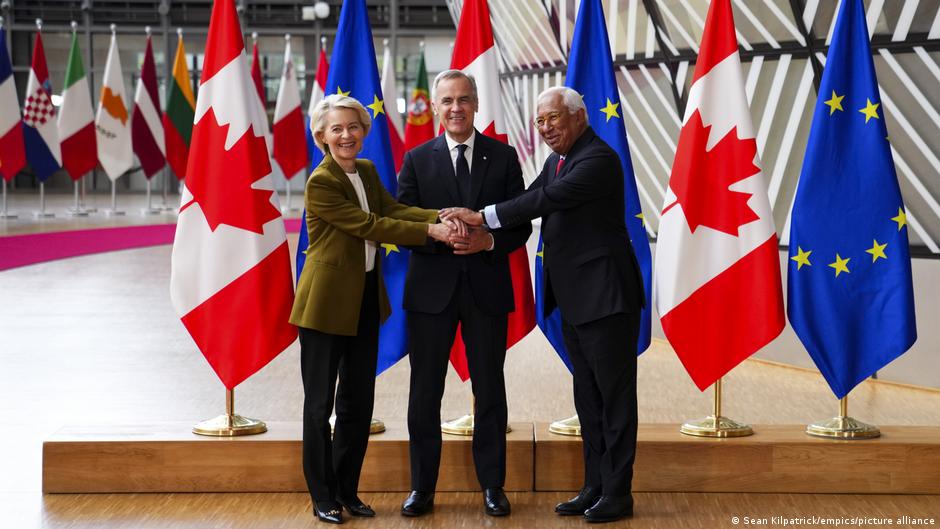
During his recent transit to Europe, Canadian Prime Minister Mark Carney signaled his ambition to forge a distinct partnership with the European Union. The Wall Street Journal later reported that Canada may well be considering associate membership status within the EU, falling short of pursuit of full integration.
In her State of the European Union address on Wednesday, European Commission President Ursula von der Leyen made clear that she remains receptive to such an expanded partnership.
“We believe that power does not belong to the strongest, the richest or the loudest, but to all of us,” she declared, addressing legislators across Europe and Vice‑President Carney in Strasbourg, France. “Democracies retain the freedom to decide with whom to collaborate.”
She elaborated that a deep EU‑Canada partnership could encompass advanced manufacturing, cutting‑edge technology, defense production, Arctic exploration, energy resources, critical minerals, battery systems, artificial intelligence, quantum computing, cybersecurity measures, and broader economic security.
Carney is slated to present his forward‑looking vision for enhanced bilateral relations during a speech at the European Parliament scheduled for Thursday.
What degree of collaboration could be possible between the EU and Canada?
EU member states enjoy seamless economic interdependence through shared markets, coordinated trade rules, and integrated customs procedures. When forging ties with non‑EU entities, nations consider various pathways—ranging from duty‑free free‑trade agreements to association accords bearing political dimensions, down to comprehensive economic arrangements comparable to full customs‑union membership exemplified by Iceland, Liechtenstein and Norway.
The EU has already secured association accords with Turkey, Israel and Ukraine, each reflecting distinct strategic goals and potentially marking preparatory steps toward aspirational European candidacy.
Professor Patrick Leblond, an international economics scholar at the University of Ottawa, cautions against overstating the significance of “association agreements.” His view: Canada would unlikely adopt European legal frameworks or seek inclusion in the EU single market or customs union—meaning the imposition of common external tariffs would not occur.
According to Leblond, Minister Carney appears primarily motivated by cultivating a strategic alliance that amplifies cooperation on economic security and defence priorities.
Closer defense cooperation?
“We have effectively assumed the US security umbrella for both parties and have under‑invested in our armed forces,” noted Leblond. He stressed an imminent shift toward joint efforts in co‑producing weaponry and developing novel defense technologies.
Defence analyst Anand Sundar of the European Council on Foreign Relations alike highlights substantial synergy potential beyond traditional spheres. Noting that Canada currently allocates roughly 70 % of its defence expenditure to US‑origin equipment, he urged Carney to pursue greater involvement in European defence projects as a cost‑effective strategy.
Canada is already an integral participant in the EU’s Security Action for Europe (SAFE) programme, which channels up to €150 billion (≈CA$ 241 billion) in financing for joint military procurement. To qualify, no more than 35 % of component costs may originate from nations outside the EU, EEA or Ukraine. Since Canada joined via a modest participation fee, more lenient acquisition rules apply to domestic enterprises. Nevertheless, Canadian firms encounter considerable obstacles when collaborating on weapon production with European counterparts—the key challenge lying in determining how far the bloc is prepared to relax its regulatory environment, with potential spill‑over effects for non‑EU partners such as the United Kingdom or Norway.
‘Underrated defense power’
“However, the foremost attraction for the European Union is Canada’s position as an underrated defence power,” Sundar remarked during his DW interview.
He emphasized that Canada devotes two percent of its gross domestic product (GDP) to defence, a commitment poised to expand in forthcoming years. At roughly 2 % of national income, Canada invests significantly more on military capacity than the fourteen smallest EU member states collectively. The North American nation allocates three and a half percent of its total defence budget toward military equipment alone, with the remaining 1.5 % directed toward ancillary defence functions.
Protecting critical infrastructure
The EU and Canada intend to explore collaborative opportunities in vital infrastructure sectors, such as the joint operation of satellite constellations in space or the maintenance of fibre‑optic cabling throughout the North Atlantic. These endeavors aim to reduce dependence on the United States and its corporate actors. Furthermore, Canada possesses substantial oil and gas reserves capable of meeting portions of the bloc’s energy requirements.
Trade relations between the two nations are formalized under the EU‑Canada Comprehensive Economic and Trade Agreement (CETA), which came into partial force in September 2017. The accord dissolves virtually all tariffs between the EU and Canada while guaranteeing reciprocal market access for industrial goods, agricultural products and services. Moreover, it enables European firms to compete in public tendering processes within Canada.
Economic analyst Leblond contends that CETA’s initial promise has yet to be fully exploited, citing the persistent tendency among Canadian corporates to prioritize markets in the United States rather than in Europe. He argues that governmental effort is required to disseminate clearer information about CETA’s benefits and to elevate interaction levels associated with this institutional framework.
Why is Carney seeking closer ties with Europe?
In January, Carney addressed the World Economic Forum in Davos, warning of an emerging rupture in the international order and exhorting middle powers to unite. ‘If we’re not at the table, we’re on the menu,’ he famously proclaimed.
Recent months have witnessed a sharp escalation of the US‑Canada trade conflict. While it is evident that Canada retains essential ties with Washington, growing consensus across Canady believes the nation requires supplementary allies. Europeans, viewed as dependable partners, are perceived as strategically valuable.
This article was translated from German
Before taking off for Europe, CanadianPrime Minister Mark Carney had set the tone for his visit, saying he was seeking to build a “unique alliance” with the EU. The Wall Street Journal similarly reported that Canada was considering becoming an “associate member” of the EU, while not aiming for full membership.
In her State of the European Union address on Wednesday, European Commission President Ursula von der Leyen indicated that she was indeed open to such an expanded partnership.
“We believe that power does not belong to the strongest, the richest or the loudest, but to all of us,” she said, addressing European lawmakers and Carney in Strasbourg, France. “That democracies have the freedom to choose with whom to work.”
Von der Leyen said a EU-Canada partnership would cover a broad range of areas including advanced manufacturing, technology, defense production, the Arctic, energy, critical minerals, batteries, artificial intelligence, quantum computing, cybersecurity& economic security.
Carney is expected to outline his vision for future relations between the EU and Canada during a speech at the European Parliament on Thursday.
What degree of collaboration could be possible between the EU and Canada?
EU member states are closely integrated economically, sharing a common market, trade and customs policy. When it comes to establishing ties with non-EU countries, a list of different options present themselves. They range from free trade agreements that scrap tariffs and trade barriers, to association agreements which may include political elements, to far-reaching economic arrangements such as participation in the common European market, as is the case for Iceland, Liechtenstein and Norway.
European Union member states are closely integrated economically, sharing a common market, trade and customs policy. When it comes to establishing ties with non-EU countries, a list of different options present themselves. They range from free trade agreements that scrap tariffs and trade barriers, to association agreements which may include political elements, to far‑reaching economic arrangements such as participation in the common European market, as is the case for Iceland, Liechtenstein and Norway.
The Wall Street Journal similarly reported that Canada was considering becoming an “associate member” of the EU, while not aiming for full membership.
Patrick Leblond, an expert on international economic relations at the University of Ottawa, urges a little more caution around the term “association agreement.” He considers it unlikely that Canada would adopt European laws or join the EU single market or customs union, which would mean imposing common external tariffs.
Leblond says Carney is likely more interested in forming a kind of alliance that deepens cooperation on issues of economic security and defense.
Closer defense cooperation?
“We have, in a way, taken the US [security] umbrella for granted on both sides. We have underinvested in our militaries,” Leblond told DW.
He added that the focus was now on joining forces, for example in the production of military equipment and the development of new technologies.
Security analyst Anand Sundar of the European Council on Foreign Relations also sees great potential for European‑Canadian cooperation when it comes to defense. Canada spends about 70% of its defense budget on US‑made equipment, according to Sundar. Carney wants to change that, the analyst said, as it would pay off for Canadians to be part of European defence projects to get “more bang for their buck.”
Canada has joined the EU’s Security Action for Europe (SAFE) programme. It provides EU member states with up to €150 billion ($173 billion, CA$ 241 billion) in loans for the joint procurement of military equipment. To qualify for funding, no more than 35% of the cost of the components can come from countries outside the EU, the European Economic Area (EEA) or Ukraine. Yet because Canada joined the SAFE programme by paying a fee, more lenient procurement rules apply to its companies.
Nevertheless, Canadian companies still face significant hurdles for producing and purchasing weapons in partnership with European firms, Sundar told DW. The big question is how far the EU is willing to relax its own rules, the expert says, which could also have implications for non‑EU countries, such as the United Kingdom or Norway.
‘Underrated defense power’
“But the biggest draw for the European Union is really the fact that that Canada is an underrated defense power,” Sundar told DW.
Canada, the expert added, spends more on defense than the 14 smallest EU member states combined.
The North American country invests 2% of its gross domestic product (GDP) on defense, Sundar said, with an increase expected in the coming years. Canada, like other NATO countries, has committed to spending a total of 5% of its GDP on defense by 2035, of which 3.5% will go towards military equipment and the remaining 1.5% towards other defence‑related areas.
Protecting critical infrastructure
The EU and Canada also intend to discuss potential cooperation in the field of critical infrastructure expansion, such as the joint operation of space satellites or maintenance of fiber‑optic cables in the North Atlantic, Leblond told DW. The goal here, too, is to become less dependent on the US and its companies. Moreover, Canada has oil and gas reserves that could meet some of the bloc’s energy demands.
Trade relations between both have already been codified through the EU‑Canada Comprehensive Economic and Trade Agreement (CETA), which entered into force on a provisional basis in September 2017. The agreement eliminates nearly all tariffs between the EU and Canada, while also ensuring mutual market access for industrial goods, agricultural products and services. It even enables European companies to participate in public tenders in Canada.
Economic analyst Leblond, however, believes that CETA’s potential has not yet been fully realized. He says many Canadian companies still tend to focus on the US and less on Europe. He believes it is the government’s responsibility to provide more information about CETA and the opportunities it offers, saying the level of exchange envisaged in this format could also be intensified.
Why is Carney seeking closer ties with Europe?
In January, Carney delivered a speech at the World Economic Forum in Davos in which he warned of a “rupture in the world order,” calling on the middle powers to act together.
“If we’re not at the table, we’re on the menu,” he said.
Indeed, in recent weeks, the US‑Canada trade war has continued escalating.
Even though it is clear that Canada cannot sever ties with the US, there is a growing belief inside Canada that the country needs additional allies, Leblond told DW. And the Europeans are considered trustworthy, he added.
Ultimately, the Canadians would want to see such an alliance, whatever form it may take, translate into concrete initiatives and projects through which Europeans and Canadians can help one another.
This article was translated from German
Also Read
- PSX slides as oil price spikes and Middle East supply concerns weigh on market
- Azerbaijan pledges to safeguard Christian heritage amid regional peace efforts
- Northrop Grumman to Lead Space Force’s GMTI Satellite Program
- Netanyahu vows tougher penalties for critics of Israeli soldiers after Gaza documentary


