



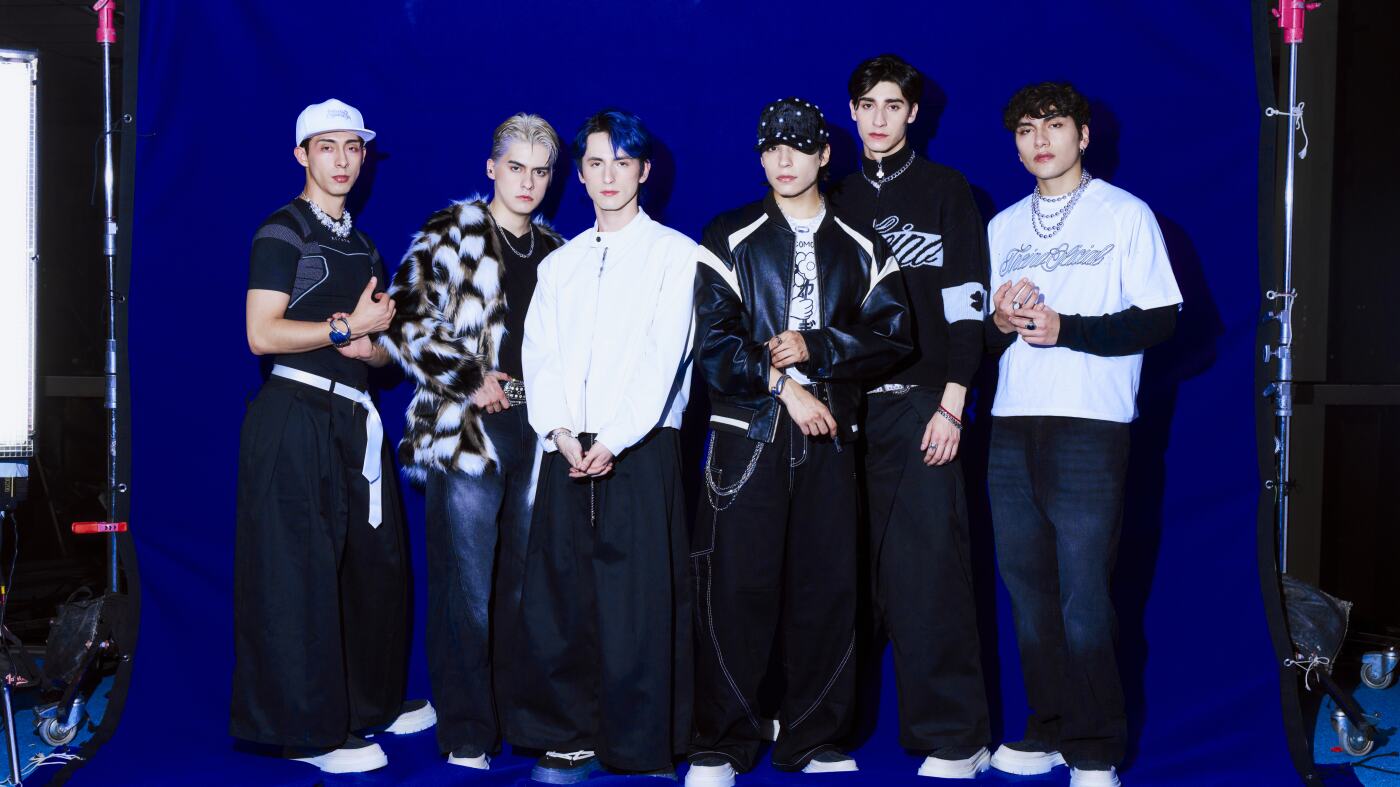
Q_ARE, a Chilean boy band drawing from K‑pop influences, poses in Santiago, Chile.
Rony Curifuta
hide caption
toggle caption
Rony Curifuta
SANTIAGO, Chile — Over the past year, the capital has been buzzing with a quiet, passionate excitement. This October, worldwide phenomenon BTS is set to perform in Santiago as part of their global comeback tour, marking a milestone in Latin America’s growing embrace of Korean culture.
After selling out shows in Mexico, BTS has announced additional sold‑out concerts in Colombia, Peru, Argentina and Brazil. The demand in Mexico was so high that President Claudia Sheinbaum reached out to South Korean officials to discuss adding more dates.
From cuisine and television to beauty and fashion, the Korean wave has reached a fervent new audience across Latin America. In Chile, a generation of young fans is not only consuming but also reshaping this wave.
The phenomenon, known as Hallyu, began in the 1990s, spreading Korean music, dramas, food and beauty trends beyond niche circles into mainstream culture across the region.
But in Chile, young people are doing more than consume the Korean wave — they are reimagining it. By adopting K‑pop’s core elements—energetic choreography, high‑quality video production, and a youthful, colorful aesthetic—they are transforming it into something uniquely their own.
And now a wave of homegrown, K‑pop‑inspired pop stars is taking shape.

(L-R) Mexico President Claudia Sheinbaum stands with BTS members V, RM, Jung Kook, Suga and Jimin as they greet fans from the balcony of the National Palace at Zócalo Square in Mexico City, May 6, 2026. BTS held three sold‑out shows at Estadio GNP Seguros.
Yuri Cortez/AFP
hide caption
toggle caption
Yuri Cortez/AFP
Q_ARE, a six‑piece boy band, produces high‑energy tracks that weave English, Spanish and Chilean slang into a K‑pop aesthetic. Their videos feature retro video‑games themes, rapid set‑changes, and vivid makeup, quickly building a dedicated following.
Prior to launching their single “FÚ” in May, the group practiced choreography at a Santiago dance studio—spinning and stepping in loose‑fitting clothing and high‑top sneakers as they refined the dance routine.
Outside, where salsa competes with reggaetón from nearby venues, the band explained their sources of inspiration.
“I entered the artistic world thanks to K‑pop,” said Seba, 22, one of the group’s vocalفلs.
waarden we are not simply copying K‑pop; we have turned it into something distinctly Latino.”
The six members—Seba, Jamin, Jota, Bin, Aiden and Fabi—responded to an online casting call two years ago, went through a six‑month audition process, and emerged with a finalized lineup. They debuted with the 2024 single “Try Again.”
The group handles everything themselves, from songwriting and choreography to aesthetics and video design, and they maintain their own fan community— the “Qniverse”—with members around the world. Q_ARE toured Brazil last year and has performed across venues throughout Chile.
“We have fans from Singapore, a follower from Japan who always comments on our uploads, many here in Chile, and also our supporters in Peru, Mexico, the United States and Costa Rica,” Bin, who raps and dances for Q_ARE, explained.
>–}}
“It’s a bit crazy, really.”

Members of Q_ARE practice choreography during a rehearsal in Santiago, Chile. The six‑member group represents a growing trend of Chilean artists inspired by K‑pop’s music, visuals, and performance style.
John Bartlett for NPR
hide caption
toggle caption
John Bartlett for NPR
Occasionally, Chilean fans will explain the meaning of Chilean slang in their lyrics for fellow Latin Americans.
The Korean wave has now fully enveloped Chile.
There are more than 50 Korean restaurants in Patronato, a small neighborhood that hosted Santiago’s first wave of Korean migrants throughout the 20th century. Many have Chilean owners capitalizing on the surge in interest in Korean culture, and others play music videos featuring quick changes and vibrant shifts on loop.
Like many Chileans, Valeria Vivar’s connection to Korea began with a childhood fascination with anime and other Asian cultures. Today, she coordinates the Rey Sejong Institute in Santiago, a Korean government‑backed cultural institution with centers around the globe.
“We have different types of students,” she says from a glass‑walled foyer at Santiago’s annual Korean cultural week. Around her, visitors sample Korean food, browse cosmetics, test their knowledge through quizzes, and take part in K‑pop dance contests.
The Rey Sejong Institute now has about 200 students enrolled in Korean, four times its original size when classes began in 2019. The center also runs a master’s program in Korean Studies at Universidad Central.
“There are students who want to learn Korean because they love K‑pop, to understand the songs of their favorite artists. Others enjoy watching K‑dramas or movies in the original language. We’ve also seen an increase in students interested in Korean literature and society.”
As interest in Korean culture expands in Chile, Q_ARE is enthusiastic about the future of pop music.
“I personally feel that Asian culture in the arts is far ahead of Chile, but that also benefits us,” Fabi said.
“We have the chance to create something new—hopefully, many more Chilean boy bands will follow, and that trend is already in motion. More boy and girl groups are emerging, and we’re thrilled because we’ve shown that taking that risk can inspire others.”
Also Read
- Classic Traffic Launch ‘Real Music’ Album With Lead Single ‘My Rage’
- Apple TV’s “Brothers” Trailer Introduces McConaughey and Harrelson as Potential Siblings
- Amy Winehouse’s ‘Back to Black’ Reimagined for Its 20th Anniversary
- Avengers: Doomsday Poised to Push MCU’s Total Box Office Past Historic $35 Billion Milestone