






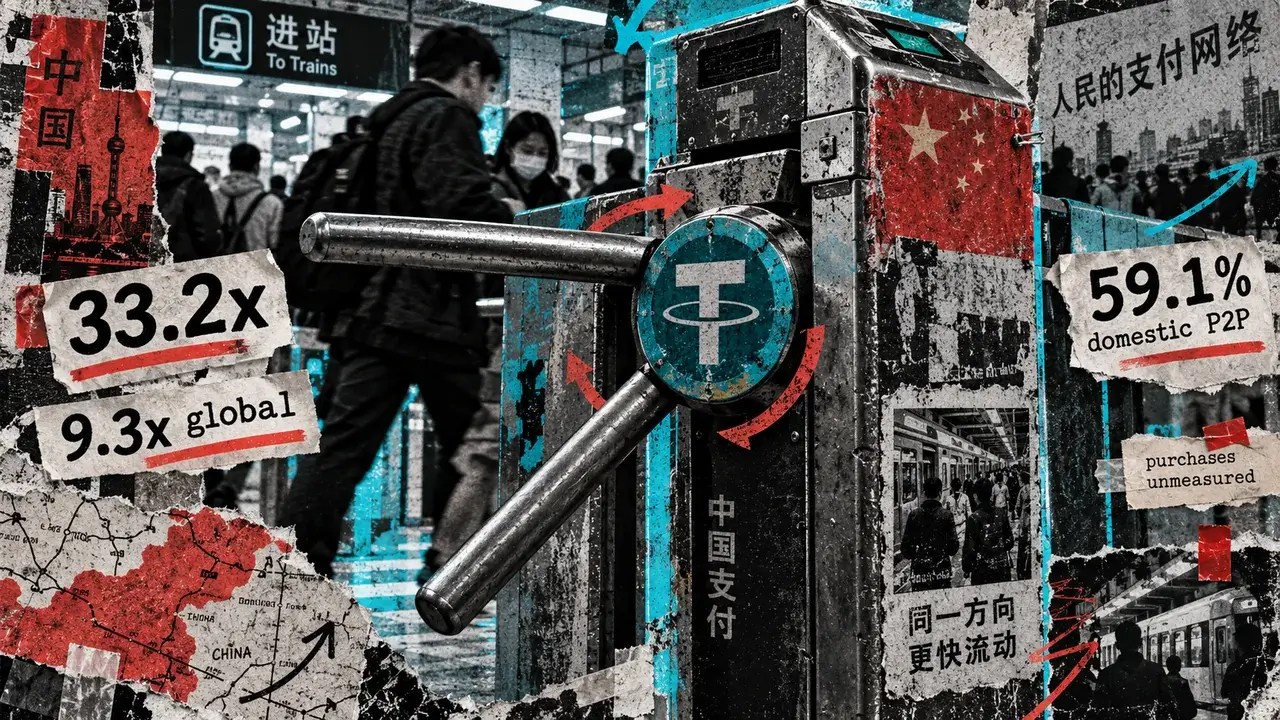
Despite Beijing’s enduring prohibitions on digital assets, China’s shadow crypto economy is pivoting decisively toward peer-to-peer stablecoin transfers.
Analytics firm Chainalysis estimates crypto activity in China reached at least $176 billion over the 12 months ending June 2026. Notably, 59.1% of this volume occurred via domestic peer-to-peer transfers, bypassing exchanges and centralized platforms.
This proportion represents a 3.5-fold increase from the prior period, diverging sharply from most major crypto markets where centralized exchanges typically serve as the primary on- and off-ramp.
Stablecoin Payments Drive Local Crypto Activity
The trend is especially evident in stablecoins. Chainalysis notes that domestic stablecoin payment activity accelerated from March 2025 and grew for 13 straight month-over-month periods, indicating a gradual migration toward direct wallet-to-wallet settlement within the country.
Monthly new activity climbed from approximately $240 million in March 2025 to nearly $5 billion a year later. Growth appeared concentrated across transaction sizes typical of individuals and small businesses, rather than exclusively large institutional transfers.
Volume in transactions under $100 surged 996% near the onset of this shift, while transfers between $100 and $1,000 rose 1,057%, and those between $1,000 and $10,000 increased 1,321%, according to Chainalysis.
The firm suggests this timing may indicate that closer integration of China’s social-credit system with financial and internet infrastructure is prompting some users to bypass traditional payment channels.
Aspects of this system were broadened into finance and online activity in March 2025. Chainalysis posits that individuals restricted from conventional financial services may turn to crypto, while others might use stablecoins to settle deals outside monitored banking or e-commerce platforms.
The company characterized this explanation as a working hypothesis rather than proof of causation, noting that blockchain data reveals when and how assets move but cannot determine why a user selected a specific payment method.
Stablecoins Evolve Toward Circulating Currency
Movement patterns within China-attributed wallets suggest users may also be treating these assets as transactional liquidity.
Chainalysis calculated annual turnover for self-custodied stablecoin holdings in China at 33.2 times, more than triple the global benchmark of 9.3 and vastly exceeding every major regional peer analyzed.
By comparison, Japan recorded 9.9 times turnover, Hong Kong 6.1, South Korea 5.1, and Taiwan 3.5.
Wallets attributed to China held an average of roughly $3.1 billion in stablecoins during the period yet moved $104.1 billion across 18.1 million transactions, indicating tokens were repeatedly re-circulated rather than sitting dormant.
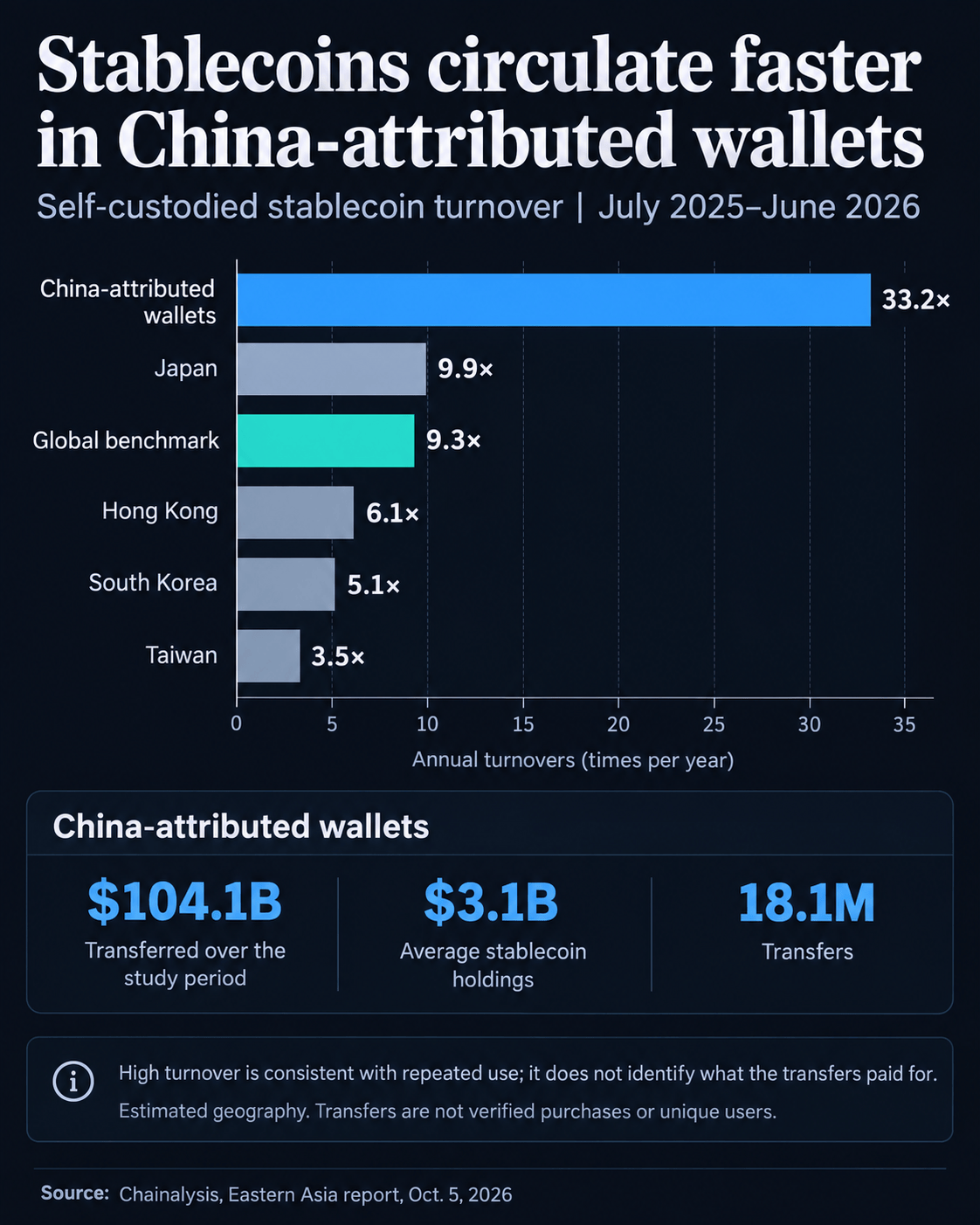

Chainalysis said such high turnover aligns with stablecoins serving as working capital or settlement assets, a pattern consistent with tokens evolving into a domestic payment rail.
This P2P structure sets China apart from neighboring markets, where most crypto economies rely heavily on regulated exchanges, whereas Chinese restrictions have driven activity toward direct wallet transfers.
This presents a potential challenge for Beijing, as stablecoins become simpler to move without domestic financial intermediaries. While exchange restrictions limit formal market access, self-custodied dollar tokens can still circulate via decentralized networks and private transfers.
For stablecoin issuers and crypto service providers, China remains a substantial potential demand source that is hard to serve directly due to regulatory hurdles. Growth is likely to persist through offshore platforms, OTC networks, and self-custody instead of conventional consumer-facing businesses.
The remaining question is whether this acceleration persists as Chinese authorities expand oversight of digital payments and financial activity.
Should smaller stablecoin transfers keep rising alongside high wallet turnover, regulators may face a growing pool of dollar-linked value circulating beyond the exchange infrastructure that earlier restrictions targeted.
Also Read
- Cardano Introduces Programmable Token Controls for Regulated Assets, Creating New DeFi Implications
- Eurozone August Retail Sales Rebound Slightly on Non‑Food Gains, but Overall Growth Remains Subdued
- Bitcoin Reclaims Market Momentum Amid Declining Volatility Amid Record High[breathe()]
- Gold Price Forecast: XAU/USD Holds $4,112 as Fed Pause Bets Rise, but $4,172 Caps Recovery – FXLeaders


![Bitcoin Reclaims Market Momentum Amid Declining Volatility Amid Record High[breathe()]](https://i1.wp.com/cdn.sanity.io/images/s3y3vcno/production/c69a265f31846f161fff5cce9c863ae358a6c589-1600x1060.jpg?auto=format&fit=crop&crop=focalpoint&w=1920&h=1080&q=75&w=1024&resize=1024,1024&ssl=1 "Bitcoin Reclaims Market Momentum Amid Declining Volatility Amid Record High[breathe()]")


