




WASHINGTON — China has been leaving spent launch vehicle stages in low‑Earth orbit (LEO) at an accelerating rate, jeopardizing both military and commercial satellites operating in this increasingly crowded orbital band with heightened risk of severe debris‑producing collisions, as a new report indicates.
Used rocket stages rank among the most hazardous forms of orbital debris because they retain residual propellant that can cause explosions, thereby generating additional on‑orbit debris.
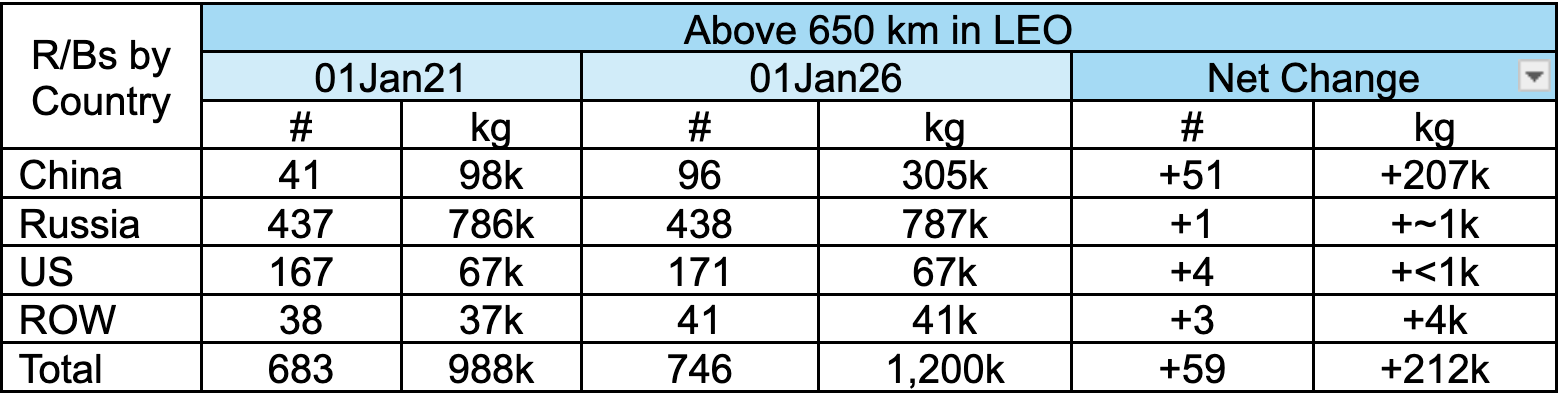
According to a LeoLabs analysis commissioned by Breaking Defense, between January 2021 and January 2025 China left 51 spent rocket bodies in LEO at altitudes exceeding 650 km (approximately 404 mi), a figure that more than doubles the previous five‑year total and brings the cumulative count to 96.
During the same period, China accounted for 86 % of all rocket bodies left in LEO worldwide — nearly seven times the combined total of the rest of the world. In contrast, the United States contributed four such objects, and Russia just one.
Most critically for assessing future debris generation, the study reveals that the mass of abandoned rocket stages above 650 km originating from China has more than tripled, increasing from 91 kg to 305 kg. This represents 98 % of the global increase in abandoned stage mass, meaning China has deposited over 40 times more long‑lived debris in LEO than all other nations combined.
Darren McKnight, the author of the LeoLabs study, attributes the surge in mass to China’s use of larger rockets for LEO satellite deployments; heavier objects, when they later fragment, generate proportionally greater amounts of debris, whether they self‑destruct or collide with another space object.
McKnight explained, “This expanding inventory of massive derelict objects — some of which have already exploded (e.g., two CZ‑6A and a recent Zhuque‑2 incident) and will remain in orbit for decades or centuries — poses an unnecessary risk of collisions with other space assets, increasing uncertainty for military operators in space,” as he wrote to Breaking Defense.
The Chinese embassy in Washington did not promptly respond to a request for comment on this report.
Victoria Samson, Director of Space Security and Stability at the Secure World Foundation, described the rise of Chinese derelicts above 650 km as “eye‑opening.”
She warned that this massive concentration of uncontrolled mass will remain hazardous for decades, potentially endangering space operations and posing serious implications for U.S. national security.
For instance, many of these stages orbit at 800–820 km, while the United States’ Proliferated Warfighter Space Architecture plans to operate at approximately 1,000 km; consequently, its satellites could be exposed to risks as they navigate through these zones, she noted.
Samson added that the situation is even more alarming given that a substantial portion of this increase stems from launches of China’s Qianfan constellation — a competitor to SpaceX’s Starlink — which now comprises 200 satellites positioned between 800 km and 1,160 km, with plans for a total of 15,000 satellites, she said.
She cautioned that without policy changes, “the situation could deteriorate dramatically,” she said.
International best‑practice guidelines, endorsed by over 60 nations — including China — and numerous national licensing regimes, such as those in the United States, prescribe a range of mitigation measures to curb the risk of on‑orbit explosions.
The LeoLabs study alleges that China’s abandonment of rocket bodies does not comply with these internationally recognized best practices.
Such measures include using residual propellant to lower spent stages to altitudes where they naturally re‑enter Earth’s atmosphere within 25 years, or, preferably, directing them for controlled re‑entry.
Another technique, employed by several operators in higher LEO regions, involves jettisoning spent launchers at lower orbits during ascent to ensure they de‑orbit within 25 years, after which electric or other propulsion can be used to gradually raise operational satellites to their final altitude.
In its June 11 statement to the Scientific and Technical Subcommittee of the UN Committee on the Peaceful Uses of Outer Space, Beijing asserted that it adheres to the 25‑year debris‑mitigation rule mandated by its domestic space‑use legislation.
Also Read
- Market Indexes Mixed as AI Chip Rally Offsets Apple Weakness; Oil Prices Jump on Geopolitical Tensions
- Seven Arrested in Reflecting Pool Vandalism Investigation Amid White House Claims
- Growing Concern Over Antisemitism in Progressive Politics Shapes Democratic Party Debate
- Venezuela Earthquake Response: Urgent Rescue Efforts amid Growing Casualties