






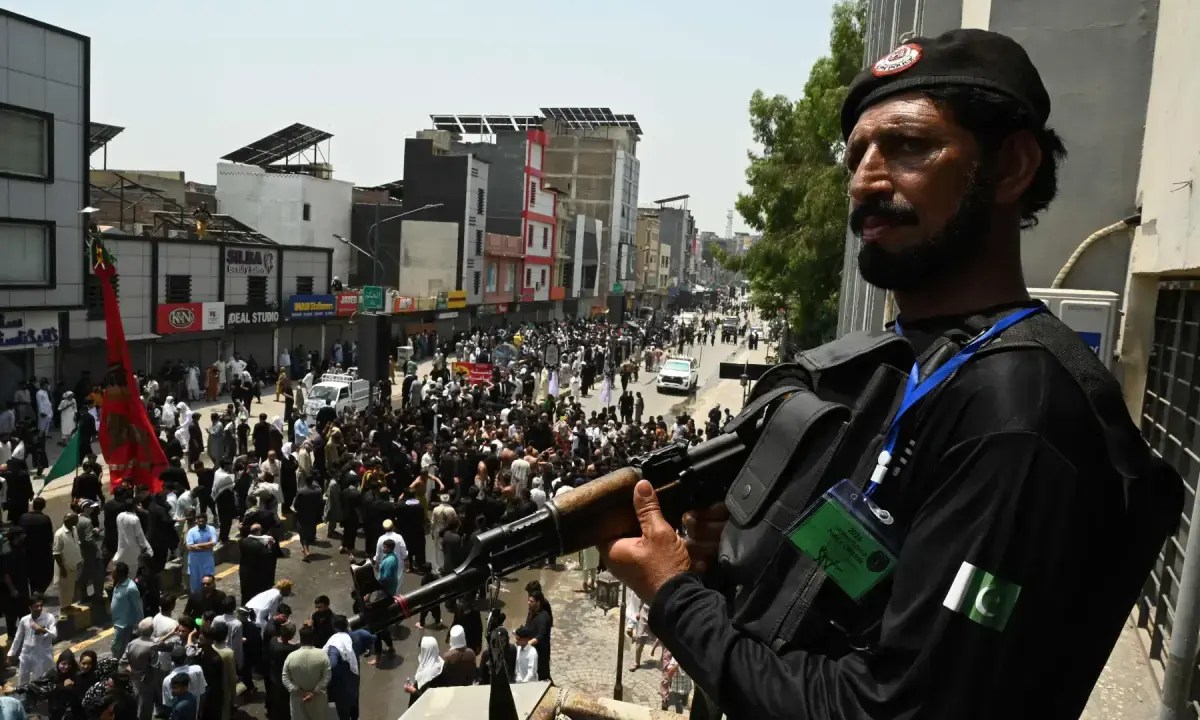
Extensive security measures have been implemented across the country as large crowds of mourners participate in Muharram 10 processions to commemorate Yaum-i-Ashura.
Yaum-i-Ashura, observed annually, features mourning processions and religious gatherings that commemorate the martyrdom of Imam Husain (RA) and his companions during the Battle of Karbala in 680 AD.
In Karachi, the main procession set off from Nishtar Park at approximately 9:30 am, and will end at Imambargah Hussainia Iranian after following its customary route.
Peshawar has 12 scheduled processions, the first of which left Imambargah Agha Syed Ali Shah near Meena Bazaar at around 11 am. The remaining processions will depart from different locations between 12 pm and 3 pm.
Islamabad did not hold any processions, while Rawalpindi’s principal procession was slated to start at Imambargah Ashiq Hussain in Taili Mohallah and terminate at Imambargah Qadeemi.
Lahore’s central procession began at Nisar Haveli.
Commuters across several cities have been urged to use alternative routes as traffic plans are in effect to accommodate road closures during the processions. Extensive security measures are also deployed to protect mourners.
Karachi
Karachi Police Chief Azad Khan announced on Thursday that mobile phone and internet services may be suspended along the main procession route. Approximately 6,500 officers will secure the principal procession, with a total city deployment of 20,000 personnel.
Earlier, traffic police released a plan for alternate routes for commuters, stating that “M.A. Jinnah Road will be closed to traffic from Gurumandir to Tower” for security reasons.
Sindh Chief Minister Murad Ali Shah participated in a mourning procession on Friday and told reporters that 60,000 police and Rangers personnel have been deployed to secure the Muharram gatherings across Sindh, where more than 1,600 processions are held.
Rawalpindi
Rawalpindi has similarly instituted robust security arrangements, deploying five Army companies, seven Rangers companies, and thousands of police officers.
Based on intelligence recommendations, the Punjab government has halted the Metro Bus Service between Rawalpindi and Islamabad because the mourning procession will travel along Murree Road from Bhabra Bazaar to Committee Chowk, passing under the metro track, which raises security concerns.
Two video monitoring control rooms—one at the Punjab Safe Cities Authority and another at the Rawalpindi Municipal Corporation—will oversee processions, gatherings, and sensitive locations.
Section 144 has been imposed district‑wide, and Rawalpindi police report that over 8,000 officers will provide security during Muharram, with 5,500 specifically assigned to the main Ashura procession.
According to a police spokesperson, roads and streets along the procession routes have been sealed, snipers are positioned on rooftops, and participants are subject to body searches before joining the processions.
Over 2,000 Safe City and other CCTV cameras are monitoring the area, with continuous surveillance from the Safe City command center and a central control room. Specialized pickets have been set up at the city’s entry and exit points.
Police have introduced a mobile application to identify and scan identity cards at pickets and bus terminals.
A total of 475 processions and 2,201 assembly events are scheduled across the Rawalpindi district during Muharram.
Punjab
In Punjab, medical and emergency services—including Rescue 1122, Civil Defence personnel, mobile health units, field hospitals, and volunteers—have been deployed to assist mourners, officials reported.
Sanitation workers have been assigned to maintain cleanliness along procession routes and around religious sites.
A three‑tier security plan has been rolled out across Punjab, deploying over 125,000 police personnel, 61 companies of the Pakistan Army, and 76 companies of the Rangers to bolster security.
Additionally, more than 30,000 trained volunteers are supporting law‑enforcement agencies.
Authorities are employing modern surveillance technologies such as AI‑based monitoring systems, CCTV cameras, body‑worn cameras, and geo‑tagged video monitoring.
The Provincial Intelligence Centre conducts 24/7 monitoring of processions and assembly events via a digital surveillance wall.
More than 5,600 CCTV cameras are operational for Muharram monitoring, and over 1,000 4G event cameras have been installed at sensitive locations.
A statement from the Punjab Home Department announced that mobile phone services will be partially suspended in 24 districts: Rawalpindi, Attock, Chakwal, Sargodha, Khushab, Bhakkar, Hafizabad, Gujrat, Narowal, Faisalabad, Toba Tek Singh, Jhang, Chiniot, Multan, Sahiwal, Okara, Pakpattan, Dera Ghazi Khan, Rajanpur, Muzaffargarh, Layyah, Kot Addu, Bahawalnagar, and Rahimyar Khan.
The service will remain suspended at religious gathering sites until 10 pm, the statement added.
KP
In Peshawar, police have devised a plan to deploy 12,000 personnel city‑wide for security during the Muharram processions.
A police statement indicated that officers from the city police, rapid response force, quick response force, ladies traffic police, and bomb disposal units will be deployed for Muharram security.
Three‑layered security will be provided to all mourning processions, with marksmen positioned in high‑rise buildings along the routes. Additionally, 1,000 traffic personnel will be posted to maintain smooth traffic flow throughout the city.
Bomb disposal units and sniffer dogs will be deployed to sweep imambargahs, assembly areas, and procession routes, the statement added. Plain‑clothes officers will also be positioned at sensitive locations and places of worship throughout the city.
Last week, KP Inspector General Zulfiqar Hameed instructed police officials to strengthen daily coordination with district administrations and peace committees at the district level to prevent any unrest during Muharram.
Separately, a police statement announced that Muharram processions and religious gatherings on Ashura will be monitored via Peshawar’s Safe City camera network.
It further stated that 43,317 police personnel would be deployed province‑wide for security duties during Muharram, and Section 144 has been imposed in several KP districts.
According to the statement, of the 614 imambargahs across the province, 127 are classified as highly sensitive, 262 as sensitive, and 225 as normal. A total of 907 Muharram processions are anticipated province‑wide, with 286 highly sensitive, 190 sensitive, and 431 normal.
Balochistan
The Balochistan government has finalised stringent security arrangements for Muharram 10, deploying over 32,000 security personnel to safeguard Ashura processions.
Main procession routes will be continuously monitored via aerial surveillance and an extensive CCTV network, while all shops, markets, plazas, and commercial centres along the routes have been sealed.
Official sources report that over 17,000 personnel have been deployed solely in Quetta. These forces will protect main procession routes, key public spaces, and all city entry and exit points. The deployment includes officers from the District Police, Balochistan Constabulary, Rapid Response Force (RRF), Anti‑Terrorist Force (ATF), Frontier Corps (FC), and the Anti‑Riot Force.
As part of the security protocol, mobile phone services and internet connectivity are suspended across Quetta and other sensitive areas of Balochistan during the procession.
Also Read
- Africa’s Premier Women’s Football Tournament Kicks Off in 30 Days
- Here’s How Many Shares of Realty Income Stock You’d Need to Make $500 in Yearly Dividends
- Best high-yield savings interest rates today, Friday, June 26, 2026: Up to 4.10% APY return
- Drew Brees Ignited Matthew Stafford’s Late‑Career Resurgence, Fueling MVP Season


