






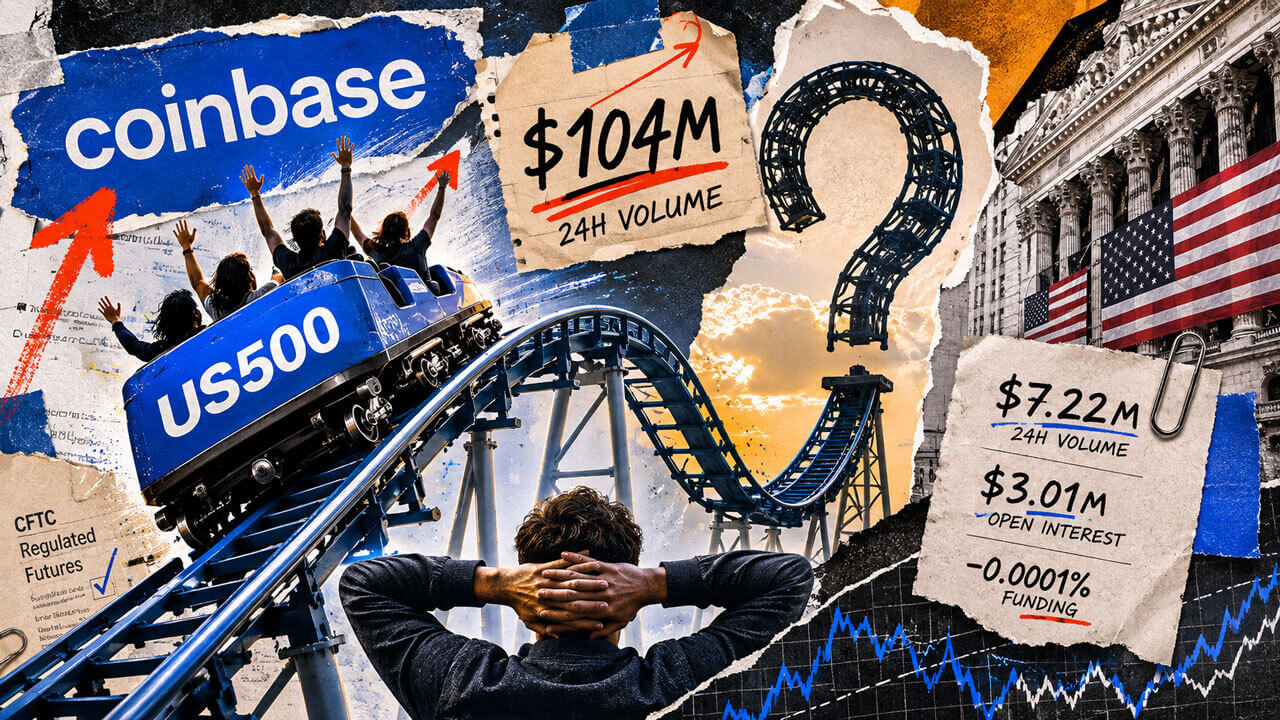
[Coinbase US500 Futures Surpass $104 M Volume Threshold – First Real‑Time Test of Regulated Crypto‑Equity Mechanism]
How Coinbase US500 futures fit US market rules
Coinbase US500 futures use what the company calls a “perp style” design. Its July 30 self‑certification filed with the CFTC defines the instrument as a five‑year, US‑dollar‑settled equity‑index future that was offered on or after Aug. 17.
The initial contract expires on the third Thursday of December 2030. Final settlement uses the value of the reference index, and open positions are settled in cash. A holder receives price exposure through the futures contract rather than delivery of the component shares, so the position carries no ownership or shareholder voting rights in those companies.
Funding supplies the crypto‑style link. Coinbase Derivatives calculates the rate hourly from the difference between the futures and spot marks. The clearing house then aggregates those hourly funding payments at its midday and end‑of‑day margin runs and applies the amounts through cash adjustments.
That system can pull a long‑dated contract toward its reference index while leaving the rest of the futures structure intact. The contract has an expiry, clears through Nodal Clear and operates under exchange position limits, price limits and market‑wide circuit breakers.
Its detailed session also follows a regulated market calendar. Trading runs from Sunday at 8 p.m. Eastern Time to Friday at 5 p.m. Eastern Time, with market holidays and other closures. Coinbase’s consumer page uses “24/7” language elsewhere, but the listed session and the CFTC filing establish a Sunday‑to‑Friday market.
The benchmark adds another layer to the design. US500 references the MarketVector Top 500 US Profitable Companies Continuous Index, identified as MVPUSC in the filing.
MarketVector describes MVPUSC as a continuous index tracking the largest securities of profitable US companies. The benchmark began on Aug. 7, 10 days before the futures contract started trading, and its page listed 501 components at the Aug. 28 reading.
The separate provider, methodology and index identity distinguish US500 from the S&P 500. Traders receive cash‑settled exposure to MarketVector’s benchmark rather than a tokenized basket of S&P 500 shares.
The volume milestone needs a longer record
For Coinbase US500 futures, Armstrong’s chart measures matched turnover. Gross volume can include repeated trading with the same capital, so it does not reveal unique deposits, unique users or retained exposure.
Open interest captures outstanding positions instead of all trades completed during a rolling window. At the preserved Aug. 28 reading, $7.22 million in 24‑hour volume was about 2.4 times the $3.01 million in open interest. The calculation describes the scale of the two metrics at one moment; it does not convert turnover into a count of traders or capital.
A longer funding history will add another signal. Persistent payments from one side of the market could indicate a repeated directional imbalance, while rates oscillating around zero might suggest more balanced positioning. One funding reading alone cannot resolve that question.
Participant breadth and concentration would complete the picture. Armstrong’s chart and Coinbase’s public page do not disclose how many traders generated the turnover or how positions were distributed.
US500 already proves that a crypto funding mechanism can operate within regulated US equity‑index risk. The translation reshaped the product: a December 2030 expiry replaces permanence, scheduled sessions replace uninterrupted access, cash settlement replaces share delivery, and MarketVector’s benchmark replaces the S&P 500 shorthand.
The $104 million figure simply confirms that traders tested the contract. Sustained volume, steady open interest and resilient liquidity will ultimately decide whether they continue using it.


Also Read
- IREN Remains Primarily a Bitcoin Miner, With 82% of FY2026 Revenue Still From BTC as AI Cloud Expansion Advances
- Fed Chair Kevin Warsh Exposes Weaknesses In Trading Bots And AI Agents
- Bitcoin Knots Prepares BLAKE2b Fork Test After BIP-110 Chain Collapse
- Bernie Sanders Pledges Legislative Action Against Flock Safety’s AI-Powered Surveillance Network


