



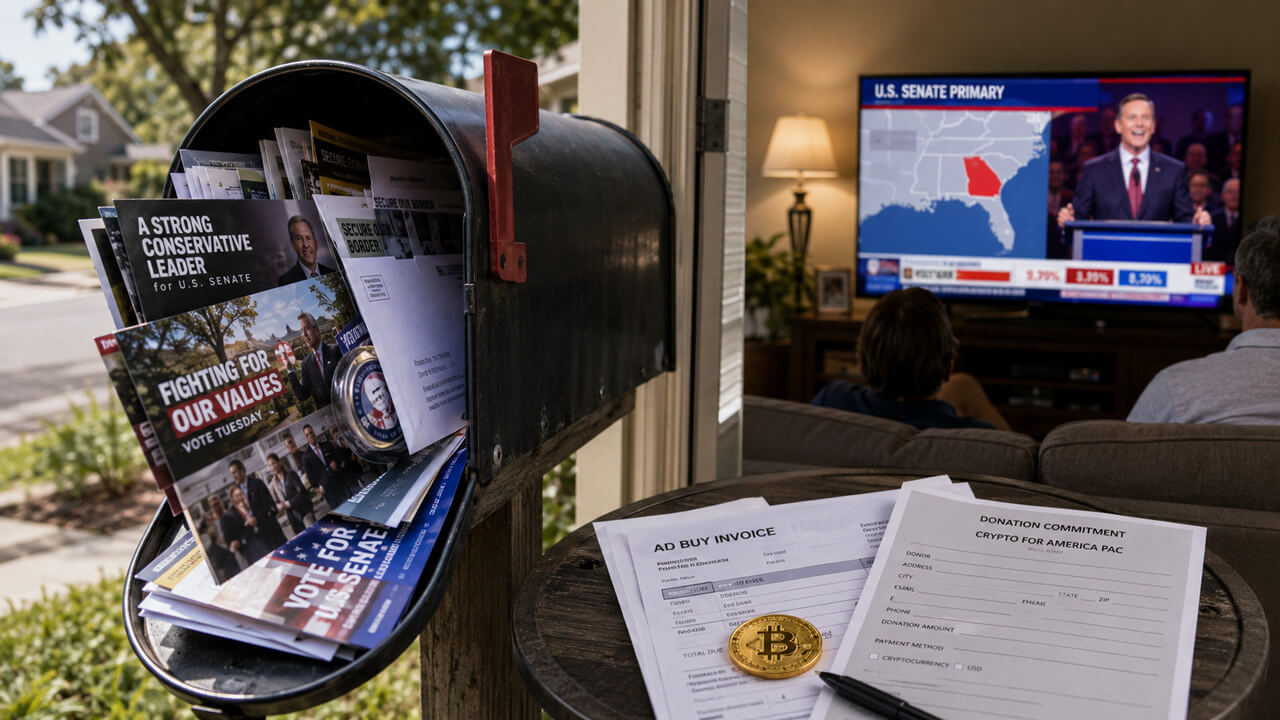
Fairshake, the cryptocurrency industry’s flagship super PAC, invested more than $12 million in Barry Moore’s campaign for an open Alabama Senate seat, marking its largest single-candidate expenditure of the 2026 cycle. On Tuesday, Moore secured the Republican runoff with approximately 56% of the vote. In a state where no Democrat has won a Senate seat outside a 2017 special election in three decades, the primary victory effectively guarantees him the seat in November. Fairshake now holds nearly $150 million in remaining cash and has publicly committed to building what its spokesman describes as “the largest pro-crypto caucus in history.”
Yet the legislation this spending aims to deliver—the market structure bill known as the CLARITY Act—remains stalled on the Senate calendar with no floor vote scheduled. The central contradiction of the 2026 midterms is that the crypto industry has mastered the art of winning elections at remarkable speed while the law it seeks continues to slip through its grasp.
How Crypto Money Turned Primaries Into a Senate Candidate Pipeline
The Moore victory follows a pattern the industry has executed throughout the year. Fairshake and its affiliates have concentrated spending in party primaries, where turnout is low, local advertising markets are inexpensive, and the winner of a safe-seat primary is virtually assured of winning the general election. The economics are straightforward: a few million dollars spent in a low-profile primary in a one-party district purchases far more influence over the next Congress than the same sum deployed in a crowded, expensive swing-state general election where the outcome is genuinely uncertain.
The industry directed more than $7 million to Andy Barr’s Kentucky Senate primary—the race to replace retiring Republican leader Mitch McConnell—and Barr cruised to victory with over 60% of the vote. That investment came from a roughly $20 million Southern spending blitz Fairshake executed across Alabama, Kentucky, and Georgia, nearly all of which succeeded. The PAC went 6-0 across the May Southern primaries and, by its own tally, 11 for 11 in June, an extraordinary success rate.
The financial support flows to both parties, a second critical feature of the candidate map. Through its Democratic-leaning affiliate Protect Progress, the industry backed Christian Menefee in Houston’s redrawn 18th District, where he defeated 21-year incumbent Al Green in the May Democratic runoff with roughly 69% of the vote. The same affiliate spent $1.5 million on ads opposing Green, a longtime critic the sector had rated as hostile. The district is safely Democratic, making Menefee the strong favorite to retain the seat in November. A generational contest over age and seniority doubled as a decisive win for crypto money on the left.
The machine does occasionally misfire, as seen in Illinois. Fairshake spent more than $10 million attempting to block Lt. Gov. Juliana Stratton in the state’s Democratic Senate primary; she prevailed regardless, all but guaranteeing the next Senate will include a member the industry heavily opposed. These losses are rare enough that they mainly underscore the deliberateness of the wins, and serve as a reminder that spending tilts races but cannot control them outright.
What unites these contests is leverage. To shape the committees that will write crypto legislation, the industry need only tip enough low-turnout primaries in safe districts. The winners then arrive in Washington owing their seats largely to crypto money. This marks a significant shift from the previous cycle’s more defensive posture: capital now moves earlier, converting cash into nominees and nominees into seats settled long before Election Day.
What the Industry Is Actually Buying
Fairshake is pursuing a specific legislative payoff, targeting a short list of priority bills. The PAC is primarily funded by Coinbase, the venture firm a16z, and Ripple—backers who have poured hundreds of millions into the effort across two cycles because the rules at stake directly affect their businesses. Both Coinbase and Ripple spent years embroiled in SEC litigation over how their products should be classified, and the legislation now before Congress would resolve much of that dispute in their favor.
The GENIUS Act, which established federal rules for payment stablecoins, became law last year. The larger prize is the CLARITY Act, which would divide oversight of digital assets between the SEC and the CFTC, grant the CFTC authority over most spot crypto markets, and end the jurisdictional uncertainty that has hung over the sector for years.
The bill passed the House in July 2025 with a wide bipartisan margin, then stalled in the Senate. It cleared the Banking Committee in May and landed on the Senate calendar on June 1. It now awaits floor time, with roughly eight weeks remaining before the summer recess and a long queue of competing legislation ahead of it. An unresolved dispute over whether stablecoin issuers can pay yield remains one obstacle, but the congressional calendar may prove a greater hurdle than policy disagreements within the bill itself.
Every additional pro-crypto senator or representative the industry helps nominate this year becomes a vote it can count on when market-structure legislation finally reaches the floor, plus a friendlier set of committee members shaping how aggressively the SEC and CFTC police exchanges, token issuers, and DeFi platforms once rules are written. The money buys margin in a closely divided Congress—the factor that decides whether a bill survives a tight Senate window or dies waiting for floor time. Fairshake’s war chest, which exceeded $190 million entering the year, will continue expanding that cushion through November and into the next session.
Moore’s win, and the dozen or so like it, demonstrate that the industry has figured out how to assemble friendly lawmakers in advance, building a caucus before those candidates ever cast a vote.
The question all that spending cannot answer on its own is whether the electoral firepower will finally push a digital-asset law through a Senate the industry has already spent two cycles and hundreds of millions of dollars trying to shape. Until the CLARITY Act reaches the floor, crypto’s political machine will keep proving it can win elections faster than it can win the law it is paying for.