







TL;DR: The Bank of Canada’s decision to keep its policy rate at 2.25 % on Wednesday was fully anticipated. Yet the forward outlook is far from unanimous: economists see the first hike in Q4 2027, while market pricing embeds roughly 1.76 quarter‑point increases by March 2027. The Bank’s forward guidance—not the rate itself—now drives USD/CAD dynamics.
All Expect a Hold, but the Timing Is Split
The Bank of Canada left its benchmark at 2.25 % on Wednesday, aligning with the consensus of all 35 economists surveyed by Reuters. Market participants also priced a hold, making the decision itself a low‑impact event. The narrative quickly shifted to the divergent expectations for the next move.
The Reuters poll points to a first Bank of Canada increase in the fourth quarter of 2027. Fewer than half of respondents forecast any rise by the end of Q2 2027, reflecting a cautious outlook. CIBC’s Avery Shenfeld described the Bank as being in a “watchful‑waiting stance,” balancing inflation concerns against growth risks from the Canada‑U.S. trade conflict.
Market pricing tells a different story. As of Sept. 1, the Overnight Index Swap (OIS) curve implied roughly 1.76 quarter‑point hikes by March 3 2027, with a 76.8 % marginal probability on the first increase. In other words, traders anticipate tighter policy several quarters ahead of the economist consensus.
The core takeaway heading into Wednesday is simple: the hold is priced; the timing of the next hike is not.
Survey Points to Late 2027, While Some Banks Call for October Hikes
The gap between survey forecasts and market pricing is not merely a debate over accuracy. Each economist submits a single most‑likely path, whereas markets must price every plausible scenario. A smaller probability of a more hawkish outcome can therefore shift OIS pricing forward even if most forecasters still expect a prolonged pause.
National Bank and Scotiabank illustrate that hawkish scenario. Both institutions anticipate the Bank of Canada raising the rate to 2.50 % in October, followed by a move to 2.75 % in December—well over a year ahead of the Reuters consensus. October remains a minority view, but OIS pricing suggests the possibility is significant enough to influence expectations.
Consequently, three distinct positions exist: most economists favor a wait until late 2027; National Bank and Scotiabank see tightening beginning this autumn; and markets sit between these extremes, pricing an earlier move than consensus without fully embracing the aggressive 2026 path.
New Forces That May Be Shifting Market Expectations Forward
The disparity between probability‑weighted market pricing and single‑path forecasts remains the most defensible explanation for the observed gap. Yet two additional factors complicate the picture.
The Reuters poll closed on Aug. 28, before renewed U.S.–Iran tensions pushed Brent crude above $90. Higher oil prices support the Canadian dollar directly through Canada’s terms of trade, while persistent energy‑driven inflation could prompt the Bank to reconsider an extended pause. This oil shock may have nudged Canadian rate expectations higher, though without a comparable OIS snapshot from before the escalation, the link remains speculative.
U.S. rates are another catalyst. Treasury yields have surged following Fed Governor Warsh’s Jackson Hole speech, with the 10‑year yielding around 4.8 %. Canadian OIS pricing could be participating in a broader North American repricing rather than reflecting a purely domestic shift. The distinction will become clearer if Canadian pricing decouples from U.S. movements after Wednesday.
Without New Policy Report, Focus Turns to Tone and Forward Guidance
This week’s decision arrives without a new Monetary Policy Report—the next one is slated for Oct. 28. The absence of fresh numerical projections elevates the importance of statement language and Governor Macklem’s press conference.
A more hawkish tone would lend credibility to the market’s earlier tightening expectations. Markets will watch for reduced concern about trade‑related downside risk, stronger emphasis on inflation near the top of the 1‑3 % target band, or any indication that recent economic resilience has lessened the need for caution.
A dovish stance would reinforce the economist consensus. Continued focus on weak demand, trade uncertainty, and temporary or externally driven price pressures would bolster the case for a prolonged wait into 2027.
Governor Macklem and Senior Deputy Governor Rogers will speak at 10:30 ET. With the rate itself already predetermined, subtle shifts in emphasis—or conspicuous omissions from July’s message—could drive the Canadian dollar’s reaction.
Friday’s Dual Employment Reports Could Weigh More Than Wednesday’s Decision
Wednesday may not be the most pivotal day for USD/CAD this week. Both Canada and the United States release employment data on Friday, Sept. 4.
Canada’s labor market has shown surprising strength, with jobs rising for three straight months and 181,000 positions added since April. Unemployment fell to 6.4 % in July, a two‑year low. Continued gains would reinforce market expectations for earlier Bank of Canada tightening. A stall or decline would bolster the “watchful‑waiting” camp, suggesting the Bank should remain patient.
The U.S. non‑farm payrolls report carries its own weight. Strong U.S. jobs could amplify Warsh‑driven Fed repricing and support the dollar, even if Canadian data are solid. Weak NFP could undercut the USD side of the pair, adding volatility to USD/CAD.
Thus, Wednesday tests BoC expectations, while Friday tests both sides of the USD/CAD cross‑rate.
Oil Adds Another Layer of Complexity to the USD/CAD Trade
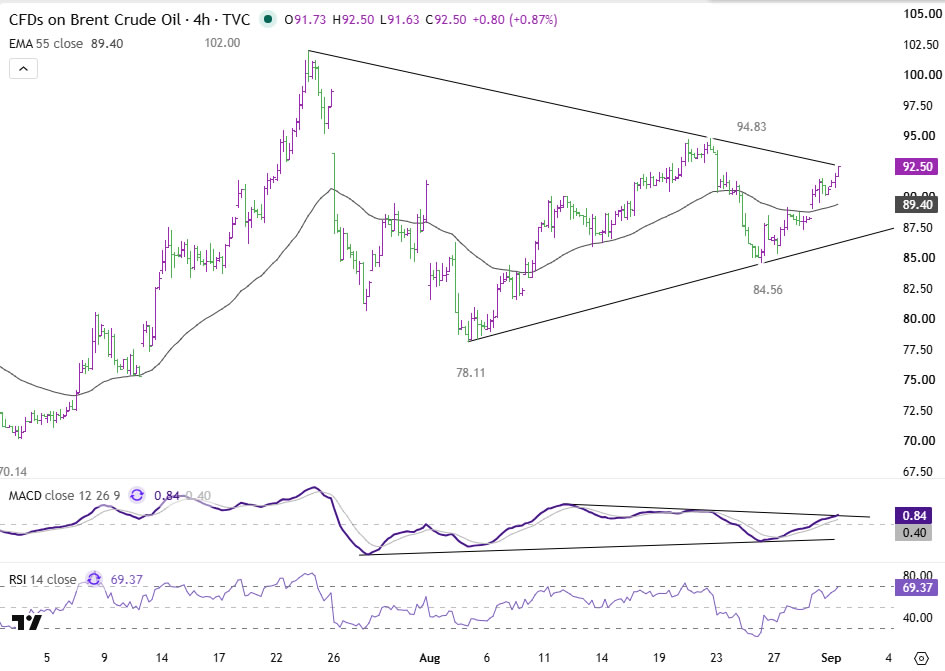
Brent crude around $92 introduces another variable. The price is approaching the upper side of a multi‑week triangle, with descending resistance near $94.83 and rising support around $84.56. Ongoing U.S.–Iran tensions mean either boundary could be vulnerable to a headline‑driven break.
A sustained rise in crude would typically favor the Canadian dollar through improved terms of trade. In the current cycle, however, higher oil could also heighten inflation concerns and strengthen the case for earlier BoC tightening, offering CAD a second channel of support. Yet oil shocks also feed U.S. inflation and Treasury yields, so the impact on USD/CAD is not unidirectional—it adds another reason to avoid treating the current OIS‑survey gap as settled before this week’s events unfold.

ActionForex’s Technical View on USD/CAD: Bounced, But Not Reversed
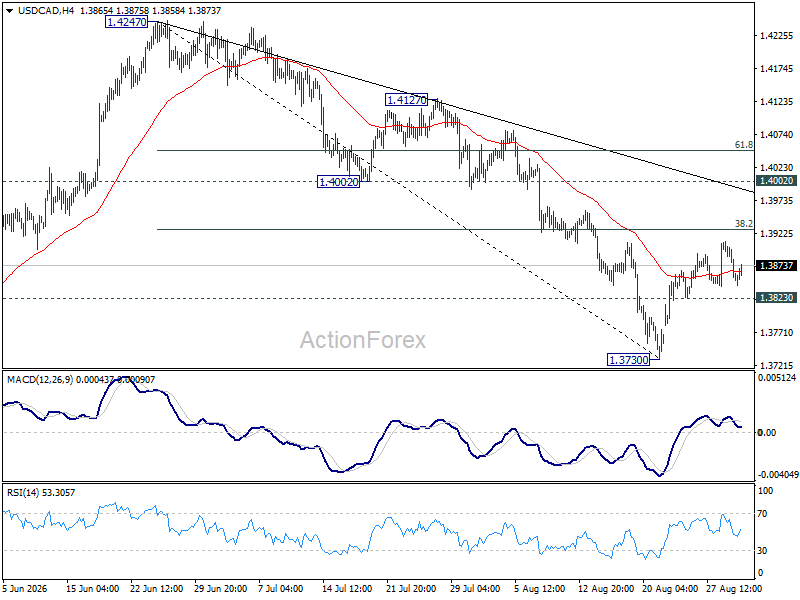
Chart analysis mirrors the fundamental uncertainty. USD/CAD has recovered from 1.3730, yet the bounce remains corrective against the broader decline from 1.4247. Last week’s dollar strength was insufficient to breach 1.3927—the 38.2 % retracement of that fall—leaving the pair below near‑term descending resistance.
Momentum indicators are neutral. The 4‑hour RSI hovers around 50, and the MACD sits close to zero, offering no clear signal that a new bullish trend has begun.
As long as 1.3927 caps upside, further downside remains favored. A break below 1.3823 would signal the end of the rebound, refocusing attention on 1.3730. A breach of that level would resume bearish pressure and reopen the broader decline.
Conversely, a decisive move above 1.3927 would invalidate the immediate bearish setup, targeting 1.4002—where former support has turned to resistance.
1.4002 Marks the Line Between a Correction and a Larger Reassessment
The daily chart places this near‑term battle in broader context. The rally from 1.3480 is still viewed as corrective within the medium‑term downtrend. It may already have completed as a three‑wave advance to 1.4247, or it could represent the first leg of a larger correction. Either interpretation still permits another test of 1.3480 while 1.4002 holds.

This creates a clear bridge between fundamentals and technicals for Wednesday. Should the Bank sound comfortable with a wait into 2027, USD/CAD could break through 1.3927 and test 1.4002’s resilience. If Governor Macklem’s commentary aligns more closely with the market’s earlier tightening timeline, the rebound from 1.3730 could falter before those levels, preserving the broader bearish structure.
Either way, the market’s reaction will hinge on forward guidance rather than the 2.25 % rate printed at the top of the decision. The Bank’s language—whether it mirrors economist consensus, market pricing, or the increasingly hawkish minority calling for an October hike—will be the key driver.
Key Takeaways
- Wednesday’s BoC hold at 2.25 % is fully priced by both economists and markets, but forecasts diverge sharply: Q4 2027 (Reuters consensus) versus roughly 1.76 hikes priced by March 2027 (OIS).
- National Bank and Scotiabank represent the hawkish tail, projecting hikes to 2.50 % in October and 2.75 % in December—more than a year ahead of consensus.
- With no new Monetary Policy Report this week, statement language and Macklem’s press conference carry heightened weight for gauging which camp is right.
- Friday’s simultaneous Canada‑U.S. employment releases could outweigh Wednesday’s decision, testing both BoC repricing and Warsh‑driven Fed repricing at once.
- USD/CAD remains capped below 1.3927 resistance; a hawkish BoC tone could push toward 1.4002, while a dovish tone risks a break of 1.3823 and a retest of 1.3730.
Also Read
- SGX’s TickNode Establishes Itself as Institutional-Grade Solution for Asian FX Market Data
- Cronos validators erase transaction history to contain massive $75 million lending protocol exploit
- Trump Defends Fed’s Hawkish Stance, Yet Insists On Lower Interest Rates
- NZD/USD Approaches Key Trendline Support Near 0.5900 Ahead of RBNZ Decision


