






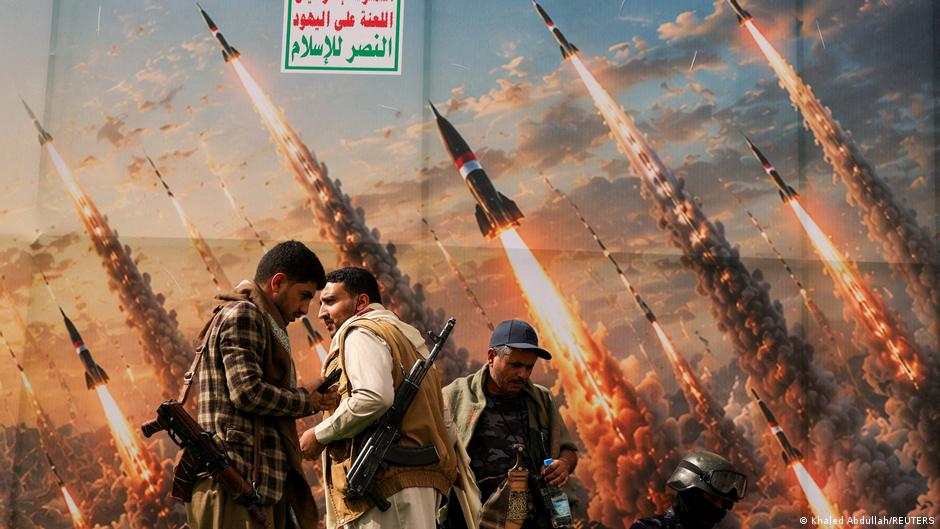
Yemen faces growing danger of slipping back into full-scale war. On Monday, Iran‑aligned Houthi forces struck another crude‑oil tanker in the Red Sea off Saudi Arabia’s coast, following previous attacks on Saudi oil facilities and vessels in the Bab el‑Mandeb Strait.
This waterway links the Red Sea to the Gulf of Aden and has become an alternate export route for Saudi and other Gulf oil shipments, as Iran’s continued blockade of the Strait of Hormuz forces shippers to seek alternatives.
In August, Houthi militants also hit zones held by the Saudi‑backed Yemeni government, focusing on the port city of Mokha. In retaliation, the internationally recognised Yemeni government struck Houthi infrastructure.
“Mokha overlooks the Red Sea and the Bab el‑Mandeb Strait, a location of strategic value to the Houthis,” said Hisham Al‑Omeisy, a Yemeni conflict analyst, in an interview with DW. He added that, over the long run, the Houthis aim to erode the government’s hold on the Red Sea coastline and seize full control of Al‑Hudeydah governorate — of which Mokha is a part — to maintain pressure on global shipping lanes.
This latest upsurge breaks a four‑year period of relative calm between the Houthis and the internationally recognised Yemeni government, which is supported by Saudi Arabia.
Nevertheless, Al‑Omeisy points out that two additional factors shape the Houthis’ current approach.
Since the 2022 ceasefire, Saudi Arabia has kept providing financial and military backing to the Yemeni government, while maintaining its air and sea blockades on Houthi‑held territories. Despite these measures, the Houthis have solidified their de facto rule over Yemen. Al‑Omeisy believes they are now seeking further concessions from Riyadh.
“The Houthis face intense domestic pressure to fulfil pledges such as government reform, paying wages and improving living conditions,” Al‑Omeisy noted. He argues that they are exploiting the broader Middle East conflict to divert attention from their shortcomings by claiming they are preoccupied with another war.
Al‑Omeisy also noted that the timing of the Houthi strikes is deliberate. “They have taken a cue from how Iran managed to dominate the Strait of Hormuz,” he said, adding that the resulting blockade of imports and oil shipments places Saudi Arabia in a precarious position.
Saudi Arabia’s delicate balancing act vis‑à‑vis the Houthi militia
“Instability in Yemen extends beyond a mere southern‑border concern for Saudi Arabia,” said Alice Gower, director of geopolitics and security at London‑based consultancy Azure Strategy, in an interview with DW.
“Riyadh’s ultimate aim is a safer Red Sea, yet it seeks to avoid being drawn back into another Yemeni war,” she added.
“Saudi Arabia’s top priority is safeguarding its Vision 2030 economic transformation, which is why the kingdom now views the Red Sea as a single operational theater rather than isolated crises in Yemen, Sudan and the Horn of Africa,” Gower explained, noting that Houthi attacks jeopardise shipping, lift insurance premiums, discourage investment and undermine the infrastructure that Vision 2030 relies upon.
Accordingly, Saudi Arabia has revised its defence policy, she noted in a recent op‑ed, stating that “Riyadh is concentrating on constructing a broader security framework that could lessen the load of protecting its maritime interests.”
In July, Saudi Arabia launched a multinational Maritime Defence Alliance that now includes over fourteen nations, among them its close ally and Iran’s rival, the United States.
“The new Saudi‑led maritime coalition fits this strategy by enabling Riyadh to share the security burden, boost regional deterrence and counter threats across the Bab el‑Mandeb, Red Sea and Gulf of Aden as a unified security challenge,” Gower said, adding that its effectiveness remains to be demonstrated.
In August, Saudi Arabia also entered into a defence pact with Pakistan and Turkey, known as the Mecca Joint Defence Agreement. Analysts caution, however, that the agreement has yet to demonstrate operational relevance.
Mohammed al‑Basha, founder of the US‑based risk advisory firm Basha Report, argues that none of these coalitions or alliances will keep Saudi Arabia from being pulled back into Yemeni conflict. In a Financial Times interview he said the alternatives are either “give the Houthis $5 billion, let them fly straight to Tehran, allow them to dock any vessel at their ports and hope they won’t return in a few years seeking $10 billion,” or “use that $5 billion to back an anti‑Houthi Yemeni coalition that can compel the Houthis to come down from their high horse and negotiate.”
The humanitarian outlook hinges on a peaceful roadmap
For ordinary Yemenis, none of these outcomes offers hope for lasting peace. The United Nations warns that the country remains mired in one of the world’s gravest humanitarian crises after years of fighting from 2014 to 2022, with more than half of the populace requiring aid. “I urge all sides to cease any actions that could push Yemen back into full‑scale war,” said UN High Commissioner for Human Rights Volker Türk in a recent statement.
“It is hard to envision conditions deteriorating further for Yemen’s people at present,” remarked Niku Jafarnia, Yemen researcher at Human Rights Watch, in a DW interview. She added that, “should fighting flare up again between the Houthis and the Saudi‑led coalition, the humanitarian situation would likely worsen.”
Given the severity of Yemen’s humanitarian crisis, the pressing question is whether the recent escalation can still be kept in check via diplomatic means.
Yemeni Nobel Peace Prize laureate and human rights defender Tawakkol Karman insists that any meaningful peace initiative must first tackle the crisis’s root cause: the disintegration of the Yemeni state and the erosion of its institutions.
During a recent meeting with UN Security Council members, Karman observed that, in her opinion, the National Dialogue outcomes — forged through consensus among all Yemeni factions, including the Houthis, under UN auspices and with the Security Council’s blessing — continue to represent the most viable path to peace.
Iran war: Analyzing the Houthi blockade against Saudi Arabia
To view this video please enable JavaScript, and consider upgrading to a web browser that supports HTML5 video
Also Read
- The Spending Power Behind Disney’s Most Sophisticated Consumers
- Canada Imposes $19.9 Billion Counter-Tariffs on US Goods in Escalating Trade War
- China Invites Public Reports on Procurement Irregularities Amid Ongoing Rocket Force Investigation
- Uruguay Commemorates the 201st Anniversary of Independence


