






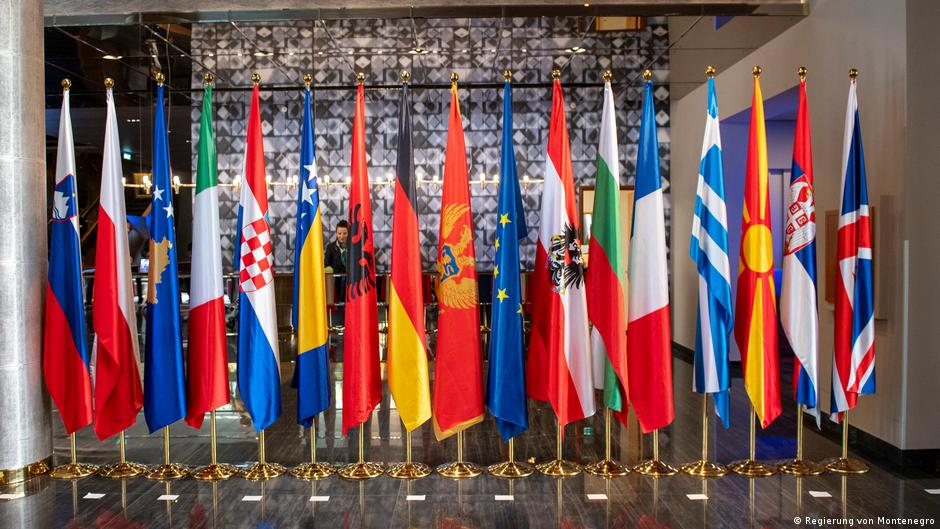
The European Commission on Tuesday published a document titled “Preparing for a wider Union,” which sets out fresh proposals on “the policy orientations and actions needed to prepare the Union for future enlargements.”
Commission President Ursula von der Leyen said that “Europe’s future depends on the choices we make today,” as she seeks to spur progress at this month’s EU leaders’ summit and in upcoming talks on the issue.
The EU’s executive has proposed a series of changes, including a gradual integration process for prospective members, new safeguards “to ensure that commitments undertaken during accession negotiations continue to be fulfilled steadily after accession,” and adjustments to voting rules.
The aim is to balance simplifying the accession process, incentivising candidate countries, and easing concerns among existing members about possible risks and costs of further expansion.
Why is enlargement back in focus?
In the quarter‑century after the Cold War ended, the EU grew quickly from 12 to 28 members before the United Kingdom left in 2016, reducing the bloc to 27. Since then, the enlargement process has stalled, with many candidates stuck in lengthy negotiations and little appetite among current members to expand further.
Recent years have seen a resurgence of interest in enlargement, driven by Russia’s invasion of Ukraine and growing signs of U.S. strategic competition in Europe. However, strict accession rules and the need for unanimity among existing members for key steps continue to pose significant challenges.
EU enlargement: Montenegro on track to join bloc by 2028
To view this video please enable JavaScript, and consider upgrading to a web browser that supports HTML5 video
What has the Commission said about enlargement?
Von der Leyen said the Commission is working to prepare institutions, adapt policies and adjust budgets to better accommodate future enlargement.
“Enlargement of our Union is a geopolitical imperative,” she said. “Today, we are laying the groundwork to ensure that a larger Union is also a stronger one: more resilient, more effective, and firmly anchored in the values and rules that define us.”
She added that as countries advance on their reform path, “the EU must be ready to welcome them.”
Enlargement Commissioner Marta Kos noted that Brussels’ assessment “shows that the EU can accommodate a larger membership.” However, she warned, “there are areas where we see challenges we need to address.”
“One is the rule of law and sincere cooperation, where we are proposing stronger possibilities to prevent backsliding, including reducing funding or restricting voting rights,” Kos said.
Why the US-EU rift is spilling into the Balkans
To view this video please enable JavaScript, and consider upgrading to a web browser that supports HTML5 video
What changes is the European Commission proposing?
The Commission outlines a number of proposed changes or policies designed to smooth the accession process, including but not limited to:
- Shifting from unanimity to qualified majority voting among members for several less significant votes concerning the advancement of membership bids
- It makes no mention of altering the current requirement for a unanimous vote on finalizing membership applications, however
- Gradual and accelerated integration of candidate countries to “bring tangible benefits to citizens and businesses,” while remaining “conditional and reversible”
- Stronger safeguards against serious backsliding on commitments undertaken during accession negotiations in future accession treaties, which could, “in the most serious cases,” extend to the suspension of voting rights
- Introducing “targeted arrangements” to “significantly limit financial support and market access” for sensitive agricultural products from candidate country Ukraine
- Ukraine’s large agricultural sector has raised concerns among EU members about how the bloc’s budget could absorb expansion, given that agriculture is a rare policy area where most spending and subsidies are coordinated at the EU level rather than by national governments
All these proposals will be subject to further discussion among European leaders and governments, with the next major meeting scheduled for next week’s EU leaders’ summit. Should they gain traction and progress, they will ultimately need to navigate various voting procedures before being implemented.
What is the current status of EU candidate countries?
A total of eight countries currently hold formal candidate status, meaning they are actively seeking EU membership and have begun the often lengthy accession process.
Some, like frontrunner Montenegro, hope to join soon, with Commissioner Kos indicating last week that Montenegro is on track to become the next EU member by 2028 after years of negotiations.
Others, such as Turkey, have been candidates for decades but have made little discernible progress in recent years.
Ukraine, which gained full candidate status only in 2024, is the newest addition to the list and has the most urgent motivation to accelerate its accession amid Russia’s invasion.
Albania, Bosnia and Herzegovina, Georgia, Moldova, North Macedonia and Serbia are also all pursuing membership.
A ninth country, Kosovo, is recognized as a potential candidate but not a formal one, as not all EU members acknowledge its unilateral declaration of independence from Serbia.


