






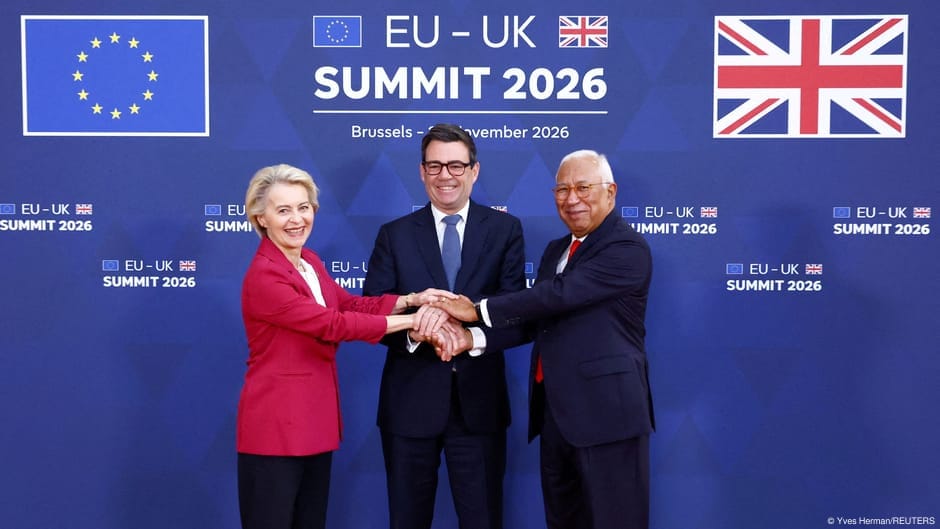
EU officials and British Prime Minister Andy Burnham were scheduled to unveil agreements on trade and youth mobility during Friday’s summit in Brussels.
These developments could represent the initial moves to restore relations, a decade after the United Kingdom’s departure from the EU.
In September, Burnham indicated that he would pursue broad political agreement on the UK’s future relationship with the EU and hinted that he might even campaign for re‑entry in the upcoming election.
What did Burnham say at the EU-UK summit?
Brussels stated that the agreements would become effective only if a separate deal is reached to reduce university tuition fees for EU students studying in the United Kingdom to the same level paid by British students.
Speaking upon his arrival in Brussels, Burnham emphasized that Britain and Europe share common values, interests and a global outlook, and argued that in an increasingly precarious world, a stronger partnership benefits working people, Britain and Europe alike.
The prime minister, who was welcomed with a string quartet upon arrival, said Britain should consider various options for its future relationship with the EU, including the possibility of re‑joining the bloc.
On Monday, he noted that it was the undeniable truth that Britain had suffered more losses than gains from Brexit.
What is on the agenda?
Three principal agreements were under discussion in Brussels: one aimed at simplifying food export procedures by cutting red‑tape, a second to integrate the UK’s and EU’s emissions‑trading schemes, and a third to create a youth exchange programme.
These measures seek to streamline British food exports to Europe and allow young people to move freely between the UK and EU for employment and study, eliminating current visa restrictions.
A significant obstacle was obtaining a UK commitment to a future arrangement that would bring EU university tuition fees in line with those paid by British students. The EU insisted that progress on the other agreements be contingent on achieving this tuition‑fee deal.
The two parties had already reached consensus on these initiatives just before the summit began, according to the DPA news agency, which cited EU diplomats and officials.
DPA reported that the agreements will only become operational once both parties agree to lower tuition fees for EU students at British institutions, with a target to finalize this arrangement within six months.
As UK debates rejoining the EU, Brexit divides Newhaven residents
To view this video please enable JavaScript, and consider upgrading to a web browser that supports HTML5 video
A British government spokesperson told the Associated Press that the agreement has been finalized, with further details to be released in a joint statement later.
YouGov regularly publishes a tracker indicating whether the public views the United Kingdom’s decision to leave the EU as correct or incorrect.
Since mid‑2022, a majority of respondents have indicated that Britain was mistaken to leave the EU. In September, the “Bregret” camp reached 60%, the highest level recorded.
Also Read
- Syria Prepares Mass Polio Vaccination Drive in Deir Ezzor After New Cases Detected
- Anthropic’s Record-Breaking $1.5 Trillion Debut Ignites a New Wave of Tech Wealth Bound for South Florida
- US appoints new cybersecurity chief after series of tech failures
- Service Industries’ Subsidiary Eyes Retail Clothing Chain Acquisition


