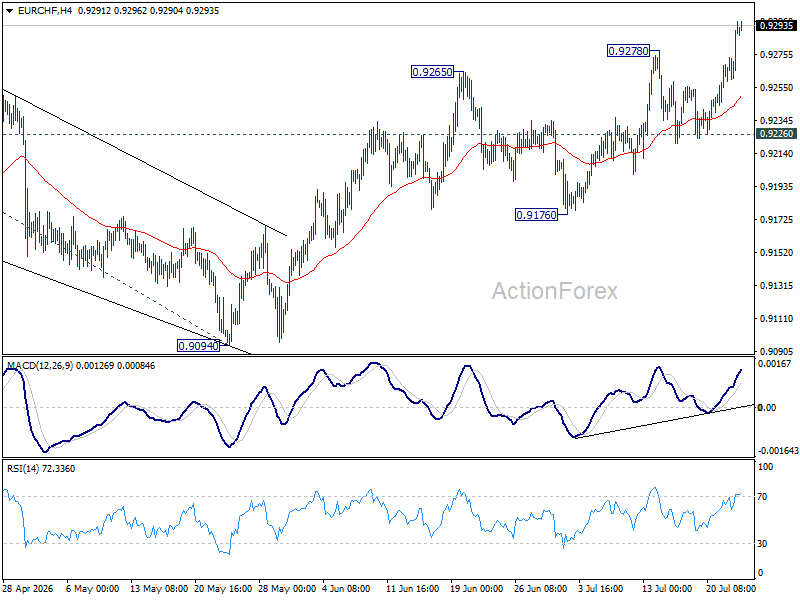
EUR/CHF may already be signaling what investors expect from today’s European Central Bank meeting. The currency pair broke decisively above 0.9278 this week, extending its recent rally as rising oil prices reignited inflation concerns across Europe. This movement suggests that markets are positioning for a potentially more hawkish stance from the ECB, even though policymakers are widely expected to keep the deposit rate unchanged at 2.25%. With the rate decision largely already priced in, all eyes will be on whether President Christine Lagarde validates—or pushes back against—the hawkish repricing currently underway in financial markets.
The economic landscape confronting the Governing Council has shifted significantly since its last meeting in June. At that time, Brent crude was trading around $95 per barrel, but the trend was clearly downward as markets anticipated a breakthrough in US-Iran negotiations. Those hopes were short-lived, as a 60-day ceasefire was announced on June 17, driving Brent prices down to approximately $70 by early July and reinforcing expectations that energy-related inflation would continue to decline. However, this narrative has since been completely reversed. The ceasefire has collapsed, military conflict has resumed, shipping risks around the Strait of Hormuz have intensified, and Brent crude has climbed back above $95. The critical distinction now is that oil prices are rising rather than falling, fundamentally altering the inflation outlook facing European policymakers.
Financial markets appear to have recognized this shift ahead of the ECB’s response. This week’s movement in EUR/CHF indicates that investors are increasingly pricing in a more hawkish policy outlook than seemed likely just a few weeks ago. While markets are not yet fully convinced that another rate hike will follow, they have become less willing to assume that June’s increase marked the end of the tightening cycle. The renewed surge in energy prices has reopened the possibility that inflation could prove more persistent than previously anticipated.
This dynamic places Lagarde’s press conference under far greater scrutiny than the policy announcement itself. Given the rapid evolution of geopolitical developments, the ECB is unlikely to offer firm forward guidance. The most probable message is that inflation risks have shifted upward, uncertainty surrounding the Middle East and the Strait of Hormuz remains exceptionally high, and policy decisions will continue to depend on incoming data. Preserving flexibility is likely to take precedence over signaling a specific policy direction.
The key question is whether Lagarde chooses to resist growing market expectations for another rate hike as early as September. This issue is certain to arise during the press conference. If she explicitly dismisses those expectations, recent Euro gains could fade as markets reduce their hawkish bets. Conversely, if she simply acknowledges heightened inflation risks without challenging current pricing, investors may interpret this as tacit acceptance that another hike remains a possibility should the energy shock persist.
In the meantime, EUR/CHF could serve as a cleaner indicator of today’s outcome than EUR/USD. Any hawkish shift from the ECB is likely to be counterbalanced by similar expectations that higher oil prices will also keep the Federal Reserve on a tighter path. In contrast, the Swiss National Bank is still widely expected to maintain rates unchanged at 0.00% through the remainder of the year, leaving EUR/CHF more directly exposed to changes in ECB expectations.
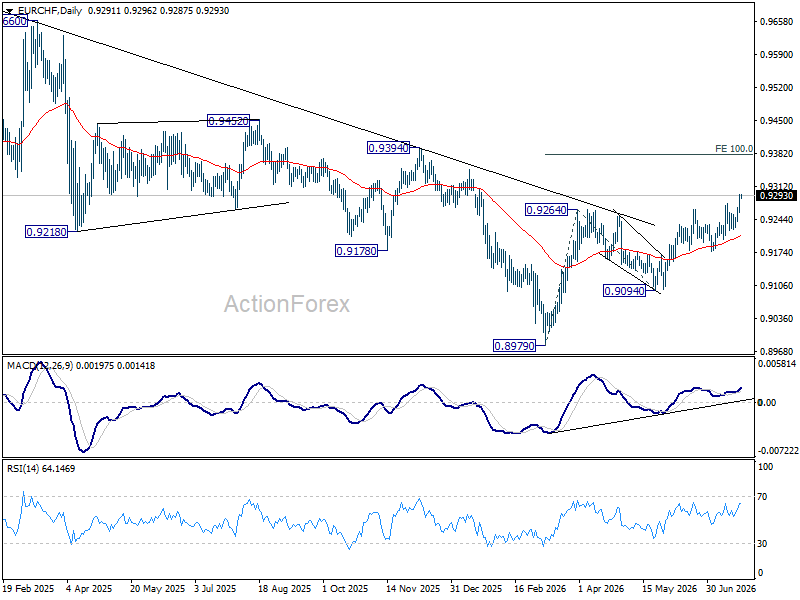
Technically for EUR/CHFWednesday’s break above 0.9278 resumed the rally from March’s 0.8979 low and keeps the pair on track for the 100% projection of 0.8979 to 0.9264 from 0.9094 at 0.9379. Just beyond lies the key structural resistance at 0.9394. A sustained break above that level would strengthen the case for a medium-term bullish reversal, reinforcing the view that investors are pricing in a widening policy divergence between Frankfurt and Zurich rather than merely reacting to daily geopolitical headlines.