






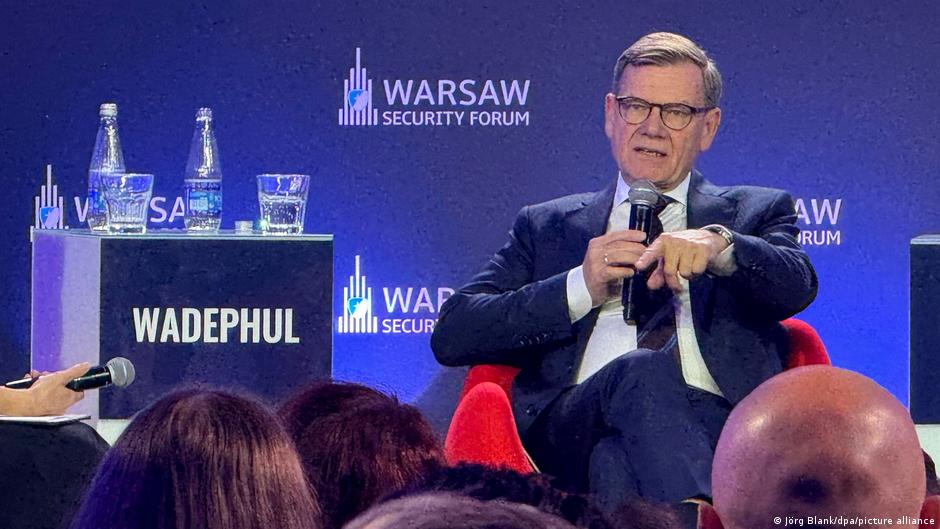
The foreign ministers of Germany, Norway, Poland, and the United Kingdom gathered at the Warsaw Security Forum on Tuesday.
This took place while German investigators pursued suspects linked to a blaze at a Starlink facility in Poland, and as Ukraine’s European allies scrambled to respond to US President Donald Trump’s recent rapprochement with Vladimir Putin.
What did the ministers say about Russian diesel and Ukraine?
German Foreign Minister Johann Wadephul criticized the U.S. decision to lift sanctions on Russian diesel, part of an agreement to supply the United States — a move apparently driven by Trump’s concern over fuel prices amid the ongoing Iran conflict and just weeks before the midterm elections.
He added, “This is not the moment to ease sanctions; we should tighten them,” Wadephul said, referencing the fresh EU sanctions package adopted on Monday.
“We are staying the course,” he said, urging Washington to adopt a similar stance.
“Within the limits of diplomacy, we must acknowledge that these have been trying days,” Miliband remarked in Warsaw, just a short drive from Ukraine’s western frontier.
Poland’s Foreign Minister Radosław Sikorski meanwhile said he was relying on “our MAGA president”—a reference to Andrzej Duda of the opposing PiS party, whom Trump has frequently lauded—to leverage his friendship with Trump to achieve two goals.
He said, “First, to secure a permanent U.S. base in Poland; second, to convince him that Putin is the aggressor and Zelenskyy the victim, and that the war ends by persuading the aggressor to curb his ambitions, not by demanding the victim’s surrender.”
Norway’s Foreign Minister Espen Barth Eide stressed the importance of reviewing the past four years’ actions and welcomed Monday’s newest round of sanctions against Russia.
He added, “I believe that what we have accomplished over the past years sends a strong signal that Europe, alongside Canada and—on most days—the United States, is delivering a clear message to Putin.”
Despite domestic criticism, Trump said on Tuesday that the United States continues to share intelligence with Ukraine. He also noted that other nations would purchase Russian diesel under the deal he announced, without violating U.S. sanctions, rather than the U.S. making the purchases itself—a stance that appears to contradict his earlier comments.
Wadephul: Starlink sabotage shows Europe ‘in the crosshairs’ of Russia
Wadephul also told reporters during his visit that he had discussed with his counterpart Sikorski the investigations into a fire at a Starlink facility in Poland last month.
Two Turkish nationals were apprehended in Germany’s southwestern town of Nürtingen, near Stuttgart, on Monday. Polish officials indicated they are suspected of ties to organized crime but are believed to have been acting on Russia’s behalf.
He said these and similar hybrid incidents across Europe demonstrate that “we are in Russia’s crosshairs.”
Given that Ukraine’s military relies heavily on satellite‑based Starlink internet, the blaze was seen as an attempt to disrupt connectivity across the border in the war zone.
“We are under attack—not only in Ukraine but throughout Europe,” Wadephul said, “and that means we must deepen our cooperation.”
He also noted that the arrests in Germany, which are expected to lead to extradition, show that security mechanisms—both police and intelligence—are functioning effectively.
He added that he does not think Russia will succeed in dividing Europe with such tactics; instead, he expects they will unite European allies.
A private Polish broadcaster reported two additional arrests in Germany on Tuesday, though German authorities have not yet commented.
Miliband praises Zelenskyy, but says ‘let us take seriously’ energy ceasefire idea
UK Foreign Secretary David Miliband lauded Ukrainian President Volodymyr Zelenskyy for demonstrating extraordinary leadership amid the dire circumstances following Putin’s 2022 full‑scale invasion, shortly after Trump’s call—which echoed Russian rhetoric—for presidential elections in war‑torn Ukraine.
Nevertheless, Miliband said the idea of an ‘energy ceasefire’ raised by Trump—appearing unilateral—deserves consideration given the strikes on Ukrainian energy infrastructure and the approaching winter.
He urged, “Let us pursue the concept of a comprehensive energy ceasefire and work with President Trump to compel Putin to observe it, because that is what we require.”
Miliband observed that Zelenskyy has expressed theoretical willingness, even though Russia has not yet done so.
Wadephul added that, if feasible, any initiative to broker a partial ceasefire should also aim to incorporate grain exports and Black Sea shipments, especially toward North Africa.
“This remains essential,” he said. “We must not overlook it and should encourage Russia to be prepared to expand the ceasefire beyond energy to include the Black Sea, as this is vital to prevent many people in North Africa from slipping into hunger.”
Trump announces ‘energy ceasefire’ in Ukraine war
To view this video please enable JavaScript, and consider upgrading to a web browser that supports HTML5 video
Also Read
- Arequipa Governor Showcases $844 Million Deep‑Water Port Project, Garnering Interest from Chinese, U.S., Indian and Other International Investors as Chancay Alternative
- Duane “Keffe D” Davis Sentenced to 40 Years to Life for Masterminding Tupac Shakur’s Murder
- Russell Investments Canada Announces October and November 2026 Distributions for ETF Series and Exchange-Traded Funds
- FBI arrests former OpenAI employee for planting listening device


