






Orangutan Rescue in India Exposes Escalating Cross-Border Smuggling Networks
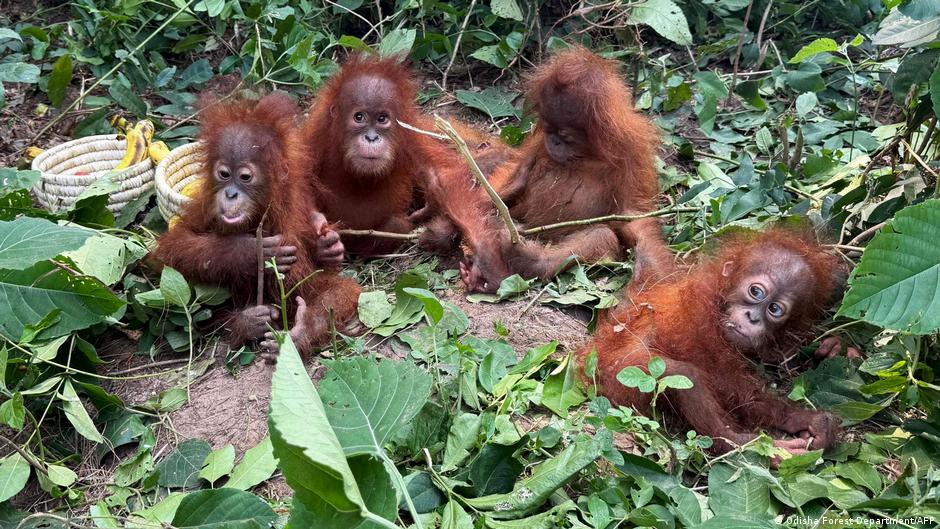
Five infant orangutans, species native only to the Indonesian islands of Sumatra and Borneo, were found in a forest by Rangers in the Balasore district of India’s eastern Odisha state last week.
Indonesia’s Forestry Ministry has requested that India determine the origins of the abandoned orangutans and arrange for their repatriation if they were transferred from their natural habitats abroad.
The rescuing effort has raised critical questions regarding the methods by which exotic animals penetrate India and the nation’s role in the illegal wildlife trade industry.
How did five baby orangutans end up in India?
“The discovery on the eastern coast of India is genuinely surprising. It reminds one of past instances, such as wild kangaroos found roaming the highways of West Bengal,” said Kanitha Krishnasamy, Southeast Asia director at the wildlife trade monitoring network TRAFFIC.
“Wherever do these orangutans originate? Were they smuggled from their native Malaysia or Indonesia, or perhaps from a commercial facility?” she explained to DW.
The children appeared healthy and were receiving care at the zoo after their capture in the Ranakatha Protected Reserve Forest, a region where the species does not naturally inhabit.
The Odisha government has instructed the Wildlife Crime Control Bureau to investigate how these critically endangered animals entered the state.
“These animals are absent from India’s forests and are primarily observed in the rainforests of Malaysia, Indonesia, Borneo, and Sumatra throughout Southeast Asia,” stated Odisha’s Forest and Environment Minister Ganesh Ram Singh Khuntia.
“It is suspected that the animals may have been released in the Balasore district forest by an international wildlife smuggling ring.”
Indian officials seize pythons, parrots, giant tortoises
The orangutans represent the latest component in a broader sequence of exotic wildlife seizures within India.
Earlier in late 2024, authorities in Bengaluru intercepted 40 rare animals arriving from Malaysia, including Aldabra giant tortoises, gibbons, American alligators, and iguanas.
In June 2025, Mumbai Customs seized 284 exotic animals arriving in multiple consignments from the Thai capital, Bangkok, including snakes and tortoises.
In July 2025, customs officials in Pune halted a shipment of 20 exotic animals from Thai passengers, comprising 14 green tree pythons, four double‑eyed fig parrots, and two Sumatran striped rabbits.
To view this video please enable JavaScript, and consider upgrading to a web browser that supports HTML5 video
Additional seizures have occurred across the country.
‘Shocking’ volume of trafficked wildlife found in India
Data from the TRAFFIC network indicates that 7,272 individual animals, both alive and deceased, were intercepted from passport and cargo hold inventories amidst smuggling attempts between Thailand and India from January 2022 to May 2025, with over 80 percent of these incursions taking place in India.
The captures encompassed reptiles, birds, and mammals—many likely intended for the exotic pet trade.
“Hundreds of species and thousands of individual animals have been found entering India through air and land pathways. This shift has been dramatic since around 2020,” said conservation researcher and practitioner Uttara Mendiratta speaking to DW.
“The sheer scale of this trafficking, combined with the diversity of endangered species involved, has been striking.”
Law enforcement lagging behind smugglers
TRAFFIC highlights India and Malaysia as the primary nations implicated in a major gibbon trading network exposed in 2025, involving transport from Malaysia to India.
Trishala Ashok, a conservation filmmaker and science communicator, noted that mapping the intricate networks of smugglers, financiers, suppliers, and buyers remains challenging.
“Our enforcement frameworks have not advanced at the same pace as the trade itself. We continue to react to isolated seizures rather than building comprehensive profiles of criminal networks.”
Tito Joseph of the Wildlife Protection Society of India warned that the situation is worsening.
“Illicit trade of exotic species existed in India before, though the prevalence has grown markedly since 2018.”
He identified transit corridors originating in Myanmar through northeast India, extending into other regional areas, as well as movements via Bangladesh. Airborne routes are heavily utilized for transporting live animals from Thailand and Malaysia. Land borders in the northeast also serve as viable entry points.
“The unprecedented element is the enormous volume of newly arrived live wildlife. Evidence suggests that traders previously dealing in live animals like star tortoises are now expanding into the sourcing of other exotic fauna.”
Social media fans illegal animal trade
Market demand is driven by the expansion of exotic pet ownership and unregulated digital marketplaces, according to a June 2026 analysis by Humane World for Animals India, an NGO focused on combating animal cruelty.
“On an international level, social media platforms have facilitated and enhanced the illicit trade in wild animals by offering spaces for individuals to display and flaunt the creatures they acquire,” noted wildlife biologist and conservation scientist Ravi Chellam.
“These platforms function as online marketplaces enabling the illegal trade to thrive.”
“The problem is worsened by the vast, personal collections maintained by wealthy individuals and celebrities worldwide,” Chellam added.
“Retention of provenance becomes exceptionally difficult once an animal has traversed multiple borders.”
“A single seizure should not constitute the conclusion of an investigation. It must serve as the starting point,” asserted Ashok. “Questions remain: Who supplied the animals? Who orchestrated the movement? Who financed the operation? Who purchased them? Until these links are untangled, continuous seizures will merely capture immediate victims without dismantling the underlying networks.”
To view this video please enable JavaScript, and consider upgrading to a web browser that supports HTML5 video


