







Britain’s Financial Conduct Authority (FCA) has proposed adopting enhanced verification measures for cryptocurrency transfers involving personal, or unhosted, wallets as best practice in non-binding guidance. The proposal also criticizes the use of risk scores by firms without transparent explanations of their methodology.
The regulator launched consultation CP26/38 on Oct. 23, requesting feedback on revisions to its Financial Crime Guide by Dec. 24, 2026. The initiatives aim to clarify organizational procedures for assessing transfers and managing financial-crime controls.
Draft section FCG 3.2.8 categorizes enhanced due diligence, meaning more rigorous checks, for transactions with unhosted wallets as a recommended practice. The guidance specifically addresses scenarios where individuals transfer crypto from personal wallets to UK-based firms, outlining requirements for the receiving institution’s verification processes.
The proposed guidance remains non-binding, as the FCA emphasizes the Guide contains no enforceable rules and does not impose new mandates. While firms are expected to review the document for establishing effective compliance frameworks, deviating from its recommendations will not, by itself, constitute regulatory violations.
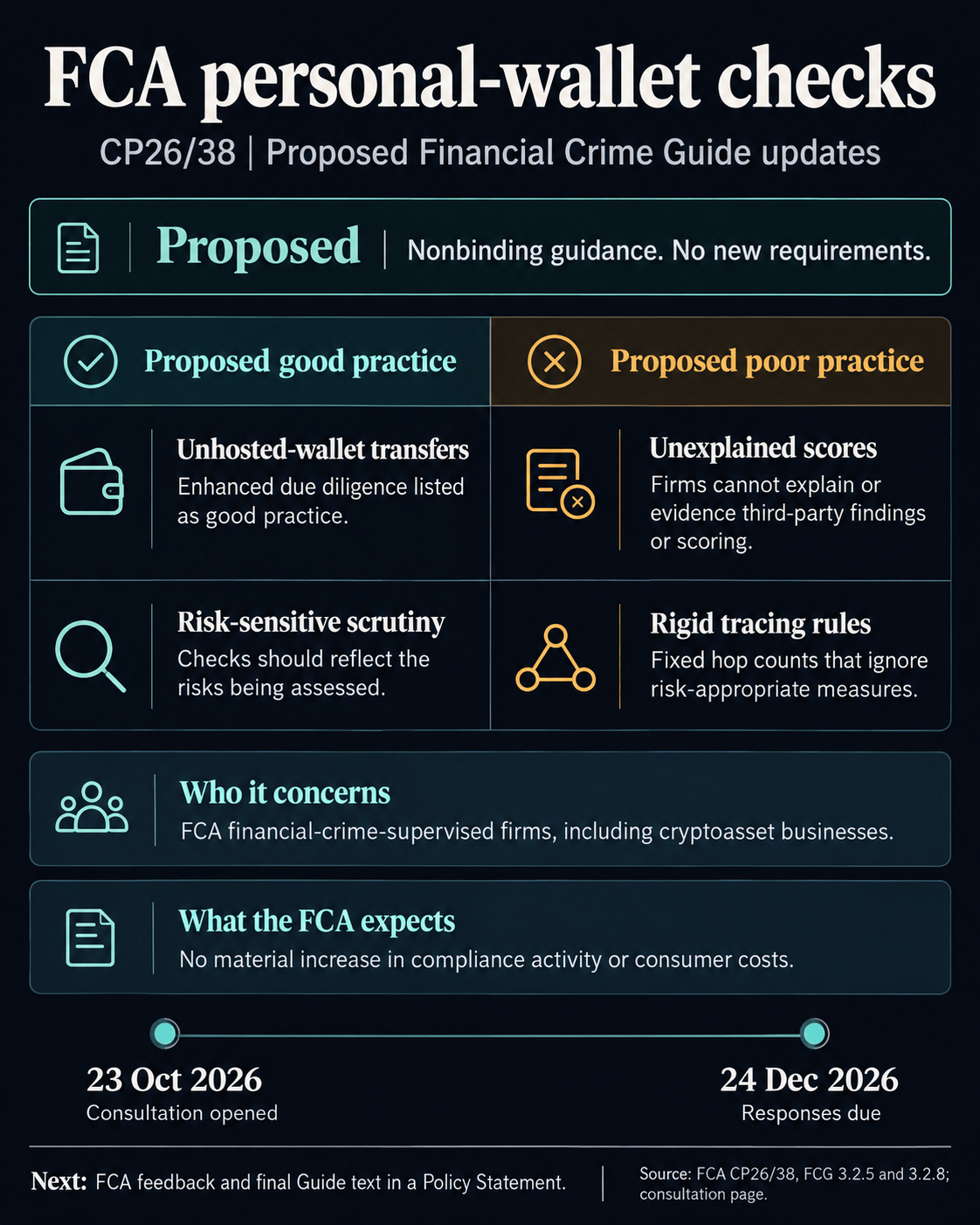

The consultation also addresses decision-making protocols for monitoring. Draft FCG 3.2.5 highlights the risks of relying on third-party tools without sufficient justification or evidence to support their findings or scoring systems.
Another concern involves inflexible tracing rules that specify fixed transaction “hops” (transfer steps) without accounting for varying risk profiles. The FCA underscores that such rigid numerical limits, which disregard contextual risk assessments, represent poor practice.
Current obligations form the compliance framework. Under the UK Travel Rule, cryptoasset businesses have been required to collect, verify, and transmit transfer information since Sept. 1, 2023. The FCA reaffirms firms’ responsibility for compliance even when utilizing third-party suppliers.
The regulator anticipates the proposed Guide modifications will not substantially alter compliance activities, consumer costs, or service offerings. It characterizes the changes as clarifications of pre-existing expectations and industry norms.
The consultation encompasses FCA-supervised entities engaged in financial-crime oversight, including cryptoasset businesses complying with the Money Laundering Regulations. The FCA intends to analyze responses and publish feedback alongside final Guide provisions in a subsequent Policy Statement, though a specific release timeline remains unannounced.
Also Read
- Galaxy Digital Sees Bitcoin Accumulation Opportunity as Market Signals Bottom
- EUR/USD Extends Losing Streak as Fed Hawkish Bets, AI Investment Flows, and Geopolitical Tensions Prop Up the Dollar
- USD/JPY Tests Key Resistance as Fed and BoJ Meetings Loom Large
- AI Credit Risk Soars as Lenders Demand More Than Just an AI Tag, JPMorgan Warns


