







As my public equity portfolio took a hit due to an overweight position in tech stocks, I experienced a shift in perspective. Once I moved past the initial frustration, I began to identify the genuine advantages of this environment.
While we may not be in a formal bear market, many individual tech stocks have already plummeted by more than 20%. For those heavily concentrated in that sector, the official index status is irrelevant; the losses are real.
For those currently retired or approaching retirement, it is helpful to examine the positives of a market downturn and understand the historical duration of corrections to better prepare for the future.
The Masking Effect of the Bull Market
General public discontent often simmers beneath the surface, but a booming stock market frequently acts as a financial anesthetic. When portfolios are climbing, it is much easier to overlook the rising costs of fuel, food, housing, and healthcare. Inflation feels manageable when your brokerage account is growing faster than the price of groceries.
However, that tolerance evaporates the moment investments begin to decline. When the “wealth effect” vanishes, consumer behavior shifts instantly. We see fewer vacations, fewer dining experiences, and delayed major purchases. As corporate profits dip, companies often resort to layoffs to protect their margins, further tightening consumer spending.
This cycle continues until economists officially declare a recession—usually months after the average person has already felt the impact. For those who recognize these signs early, negotiating a severance package proactively can often lead to a better exit than being part of a mass layoff.
Managing Sequence of Returns Risk
For new retirees, the primary concern is “sequence of returns risk”—the danger of experiencing significant losses early in retirement while simultaneously withdrawing funds for living expenses. If this lasts too long, a portfolio may never fully recover, potentially forcing an unwanted return to the workforce.
Retirees relying on investments often feel the sting of a bear market more acutely than employees because they lack a steady paycheck to cushion the blow or spare cash to “buy the dip.”
However, if your financial plan is resilient, a downturn can actually be a period of relative stability. You can determine your resilience by checking the following:
- Do you have over a year of living expenses in cash or Treasury bills to avoid selling equities at a loss?
- Does your passive income (rentals, bonds, dividends) cover a significant portion of your needs?
- Can you reduce discretionary spending by 20% to 30% without sacrificing your quality of life?
- If stocks fell another 35%, would you still be able to meet your basic financial obligations?
Understanding the Duration of Market Declines
History provides perspective on how long these periods of volatility typically last. According to Capital Group, the S&P 500 has seen a drop of 10% or more roughly every 18 months since 1954, while a bear market (20%+ drop) occurs approximately every six years.
Over a 40-year retirement, one should expect roughly 25 corrections and several bear markets. These declines are not signs of an apocalypse, but rather the “price of admission” for long-term equity growth.
Source: Capital Group, S&P 500 data from 1954 through 2025.
Data from Hartford Funds and Ned Davis Research indicates that since 1928, bear markets have seen an average decline of 35% and typically take about 9.6 months to hit bottom. Since 1945, these events have occurred roughly every 5.1 years.

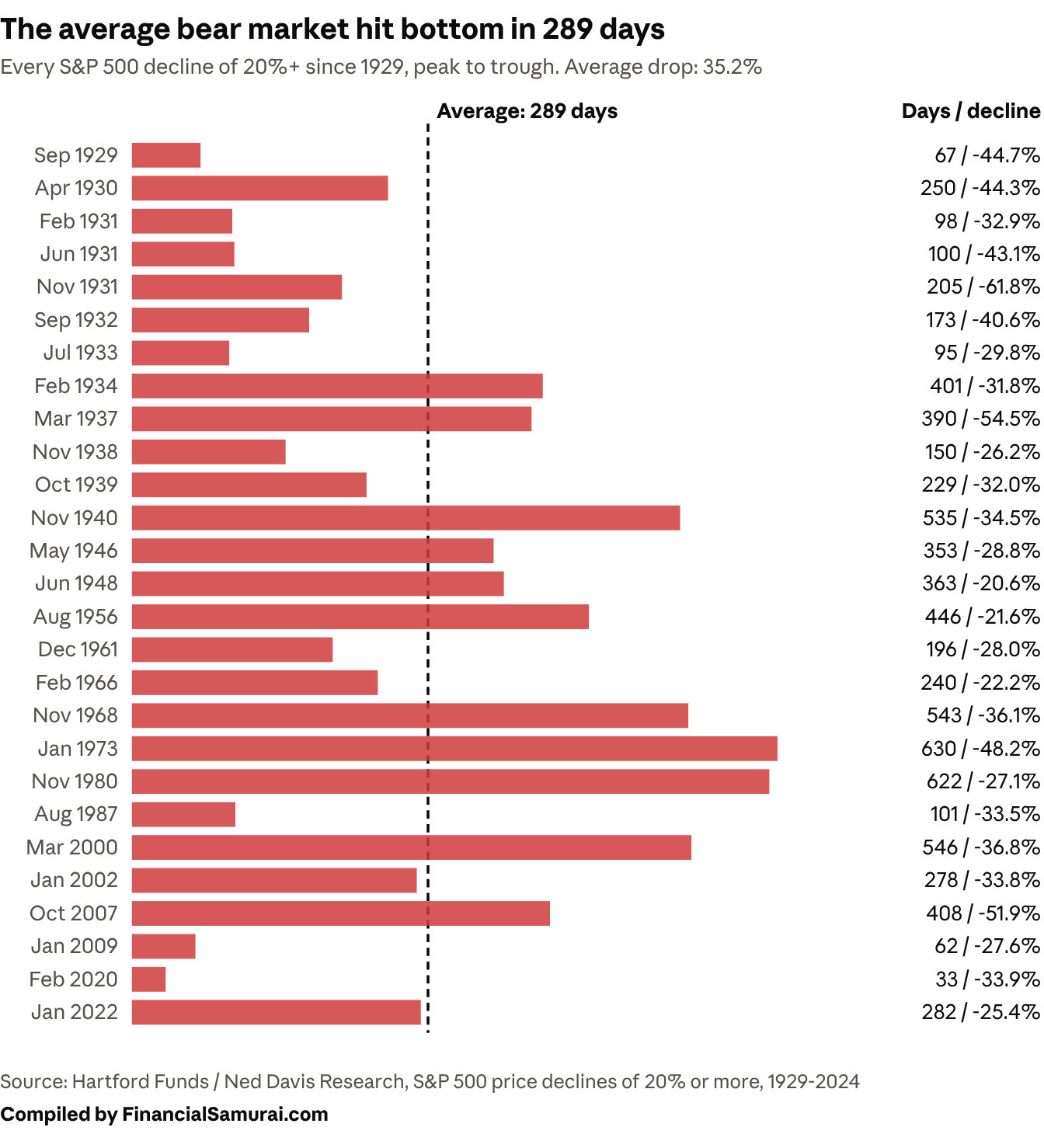
It is important to note that these figures measure the time from peak to trough; recovering to previous highs usually takes longer. Additionally, outliers exist—such as the bear markets of 1973 and 1980—which lasted over 600 days.
The Certainty of Recovery
The most encouraging fact for retirees is that every S&P 500 correction since 1929 has been followed by a recovery. On average, the return in the first year following the bottom was 52%.
Furthermore, approximately 42% of the S&P 500’s strongest trading days over the last two decades occurred during bear markets. Panicking and selling often means missing the most critical days of the rebound.
The logical strategy is to prepare for 12 to 18 months of decline, with a longer window for full recovery. Maintaining one to two years of cash reserves is an effective hedge, particularly when interest rates remain elevated.
Redefining Value and Effort
A bear market presents an existential question: Do you work harder to try and offset losses, or do you embrace your freedom and spend more time with family and hobbies?
The rational choice is often to prioritize life over the grind, a concept known as Return On Effort (ROE). In a bull market, the market does the heavy lifting; extra hours at the office rarely move the needle significantly compared to portfolio growth.
In a bear market, working harder to “run in place” makes even less sense. Individual effort cannot stop systemic issues like declining consumer confidence or shifting tax policies. Often, high performers are simply “rewarded” with the workload of colleagues who were laid off, without a corresponding increase in pay.
Retirees—early or traditional—are in the best position here. While bull markets can create a sense of FOMO (Fear Of Missing Out) as colleagues land huge bonuses, bear markets flip that narrative. No one envies the employee grinding through a corporate reorganization while their stock compensation is halved.
Universal Advantages of a Downturn
Regardless of employment status, downturns offer several strategic advantages:
1) Lower Costs: As demand drops, prices for travel, hotels, and real estate often follow. Retirees with flexible schedules can capitalize on off-peak deals.
2) Buying Opportunities: Those with cash buffers can acquire assets at a discount while others are forced to sell. For workers, every 401(k) contribution now purchases more shares at a lower price.
3) Generational Wealth: Downturns are ideal times to fund children’s investment accounts. A 30% drop today is a minor blip over a 50-year compounding horizon.
4) Strategic Tax Moves: Tax-loss harvesting allows investors to offset future gains, and Roth conversions at depressed valuations allow for more shares to be moved into tax-free accounts.
5) AI Reality Check: While a drop in AI stocks hurts portfolios, it may suggest that AI is not displacing white-collar labor as rapidly as feared, providing some job security for the next generation.
6) Psychological Resilience: Bear markets humble investors and build the emotional fortitude necessary for long-term success. Each survived downturn creates a calmer, more disciplined investor.
Finding Peace Through Control
You cannot control market volatility or political outcomes, but you can control your time. The market will eventually recover—it always does. When it does, those who spent the downturn focusing on health, family, and personal growth will be in a far better position than those who spent the period stressed and exhausted.
Take the time to enjoy the freedom you worked so hard to achieve. A bear market is an ideal time to lean into the life you built.
Also Read
- Israel Constructs Extensive Military Road Network Spanning 90 Kilometers Across Southern Lebanon
- Italian Foreign Minister Antonio Tajani Says Cybercriminals Leaked Personal Data Over Ukraine Support
- Gunman Opens Fire in Kraków’s Main Square, Killing Five and Wounding Over a Dozen
- Rubio seeks to impose order at State Dept. as Republicans look ahead to 2028


