



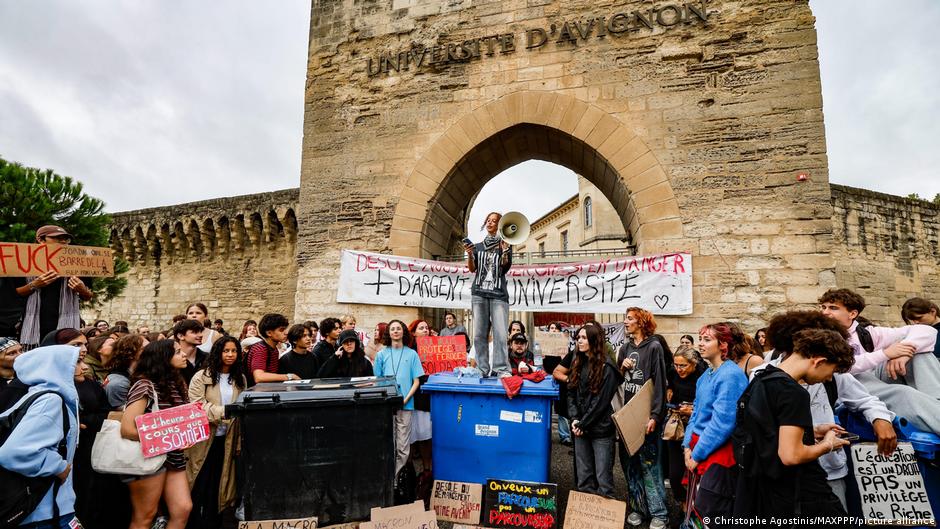
Cellphone videos captured by French schoolchildren and shared on social media expose the dire state of infrastructure in many schools across the country, showing rats in toilets, leaking roofs and broken heating systems.
At the Lycée Paul Eluard in the Paris suburb of Saint‑Denis, a focal point of the protests, students have reported infestations and frequent pipe bursts. In nearby Pantin, pupils complained that windows could not be opened even when summer temperatures rose to 40 °C.
Pupils also cite overcrowded classrooms and lessons that are regularly cancelled.
The nationwide protests show no signs of abating.
France students demand better schools
To view this video please enable JavaScript, and consider upgrading to a web browser that supports HTML5 video
Problems of centralization
France spends 6.7 % of its GDP on education, a level that exceeds the EU average. However, this investment has not translated into better learning environments, partly because of how responsibilities are divided.
The central government in Paris mainly handles teacher salaries and sets the national curriculum, while the upkeep of school buildings is devolved to various local authorities. Elementary schools fall under municipal management, secondary schools (“collèges”) under departmental authorities, and high schools (“lycées”) under regional jurisdictions.
Local authorities have uneven financial capacities, and two‑thirds of their budgets are already earmarked for staff and pensions, leaving limited funds for building renovations.
Dilapidated infrastructure
More than 80 % of elementary school buildings in France are over 50 years old, and an estimated 10–20 % of all school facilities are in serious need of repair. In the Île‑de‑France region, which encompasses Paris and its surroundings, a €6.6 billion ten‑year renovation and expansion programme (2017‑2027) was approved.
According to local authorities, two‑thirds of upper‑secondary pupils now attend newly built or recently renovated schools. Yet even after addressing mould and roof leaks, many buildings lack effective cooling for summer heat. Ironically, some structures that were newly built or recently upgraded have been damaged during the recent protests.
France students protest school conditions
To view this video please enable JavaScript, and consider upgrading to a web browser that supports HTML5 video
Macron tried in vain to address problem
Education spending in France is uneven. While investment in upper secondary education is comparatively high, per‑pupil expenditure in primary schools lags behind the OECD average. Researchers stress that early schooling is critical for later academic success.
Since 2017, the Macron government has attempted to correct this imbalance by halving class sizes in disadvantaged primary schools and creating some 16,000 new teaching posts. Amid the ongoing protests, the government announced plans to hire over 3,000 supply teachers on short notice, and Education Minister Édouard Geffray said software would be used to identify schools in the most critical condition.
These measures mark the government’s first concrete response to student demands, which have been voiced for almost two weeks. Protesters are calling for better secondary‑school facilities, more substitute teachers, and increased overall investment in education.
Increasing deficiencies
The latest OECD Programme for International Student Assessment (PISA) results, released in September, highlight systemic weaknesses. Over one‑third of 15‑year‑olds in France now fail to achieve a basic level of competence in mathematics.
Macron’s reform of upper secondary education, which abolished academic streaming in favour of individualized subject choices, was intended to increase pupil autonomy. However, the multitude of possible combinations makes timetabling difficult, leading to many free periods and longer school days, according to student complaints.
Problems also appear at university level. A lecturer at a Paris university reported a seminar with 50 students, forcing attendees to bring extra chairs or sit on the floor, and said the administration had taken no action.
Cancelled lessons
French pupils have a high number of teaching hours on paper compared with peers in other EU countries. However, the Cour des Comptes recorded that 9 % of lessons in state collèges were cancelled during the 2023‑24 school year, and a recent study suggests that only about 12 % of short‑notice cancellations are covered by substitute teachers.
Teacher remuneration is another issue. After 15 years in the profession, lower‑secondary teachers in France earn roughly half of what their German counterparts do, according to OECD data.
Broken promises of equality
France prides itself on a republican education model that promises equal opportunities for all children, regardless of background. In practice, academic success is far more closely linked to socioeconomic status than in many other countries, and students from poorer families are disproportionately affected by lesson cancellations.
The government’s fiscal flexibility is limited by a precarious budgetary situation. Although the 2027 draft budget adds €1.2 billion for the Ministry of Education, there are also plans to cut teaching positions because pupil numbers are falling.
Protests in the run‑up to the presidential election
Beyond footage of dilapidated schools, social media now shows demonstrations with placards bearing political slogans largely unrelated to education policy. Some videos depict burning barricades and clashes with police, who face accusations of excessive force.
Members of the far‑left France Insoumise (LFI) party have aligned themselves with the student protesters, appearing at school blockades and sharing related videos. The government accuses LFI of exploiting youth anger for political gain, a claim the party denies.
With the French presidential election only six months away, the education‑related protests are increasingly intertwined with broader political struggles.
Also Read
- Strong 7.6‑Magnitude Quake Rocks Panama, Prompting Tsunami Alerts Across Central America
- Evyatar David Shares Lessons from Hamas Captivity and Calls for Gratitude Three Years After Oct. 7
- Trump Announces Russian Diesel Supply Deal Aimed at Slashing Global Fuel Costs
- Trump Announces Russian Diesel Supply Agreement Aimed at Easing Global Fuel Prices