






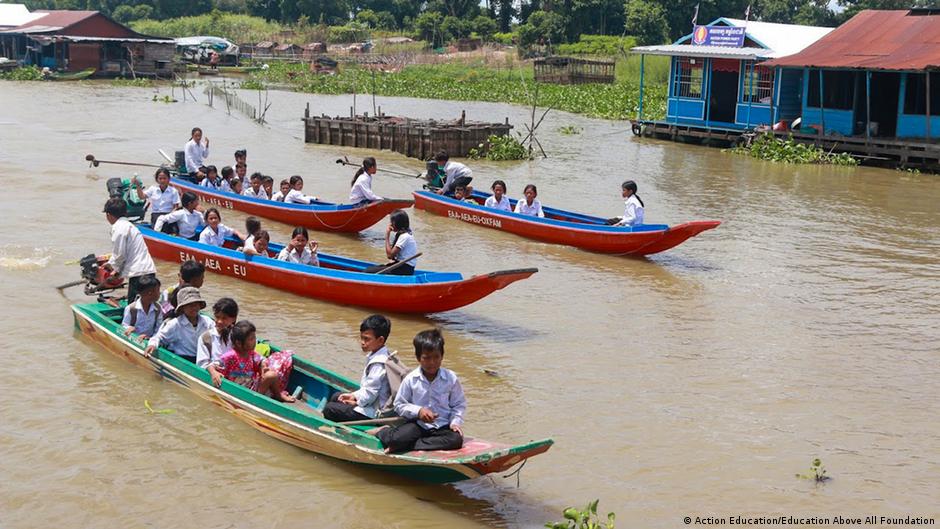
Every morning, 12‑year‑old Soksan Set faces a journey that most children never have to consider. His home sits on water, with no road in sight.
Soksan lives in Prek Toal, a floating settlement on Tonle Sap, Southeast Asia’s largest freshwater lake. Boats serve as the primary mode of transport, and as a Grade 4 pupil at the local primary school, he paddles several kilometres each day to reach class, often assisting younger classmates on the way.
However, the greatest challenge Soksan now faces is not the distance to school but the cost of fuel. Like many families in the community, his household relies on fishing for income, and rising fuel prices force them to make tough choices.
“When gasoline prices rise, we cannot afford to send our children to school regularly,” said Soksan’s father, 41‑year‑old Set Soeum. “We do not catch enough fish, and we need about three litres of gasoline each day to travel far for fishing. Because of this, Soksan often misses school.”
For water‑based families, soaring fuel costs can quickly become a barrier to education.
Why Fuel Price Hikes Hit Cambodia’s Poor the Hardest
Cambodia’s heavy reliance on imported fuel leaves households vulnerable to global price volatility and regional supply disruptions. The 2026 Iran conflict has driven energy costs upward, making transport to remote communities more expensive. Around Tonle Sap, these effects are hitting students and their families especially hard.
According to the World Bank, gasoline prices jumped 45 % and diesel prices surged over 70 % in March, marking the largest single‑month increase since 2008.
Current gasoline prices stand at 5,700 riel ($1.41) per litre, a 26.7 % rise from the 4,500 riel ($1.11) recorded a year earlier, per Global Petrol Prices.
Even though Cambodia does not import fuel directly through the Strait of Hormuz, it remains exposed to higher global oil prices and supply disruptions that affect regional suppliers. The country imports all petroleum products and lacks domestic refining capacity.
Soksan’s family feels the pressure on both their fishing and school boats. Some days they borrow money for gasoline; on others they reduce spending on food, clothing, or school supplies.
“Five students pool money to purchase gasoline, sometimes only a single litre at a time,” Soksan said. “We row it ourselves; it can take up to an hour, but we still try to get to school,” he added.
During the dry season, 12‑year‑old Siyien Ly walks more than 30 minutes to reach her school. When floods render the water routes impassable, she depends on an aid‑supported school boat. Some classmates have stopped attending because their families cannot afford the transport costs.
“Even though fuel prices are climbing, we continue to come to school because education is vital for our future,” Siyien said.
Siyien’s family of six includes four school‑age children. After Siyien’s father suffered serious hearing loss in a water‑related accident, her mother, Kunthea Chin, now sells sugarcane juice.
Kunthea said her daily income has dropped from roughly 80,000 riel ($20) to about 40,000 riel, while expenses have risen. The family spends approximately 600,000 riel ($150) per month on fuel, which they need for both the children’s transportation and her juice business.
Cambodia’s floating schools face brunt of climate crisis
To view this video please enable JavaScript, and consider upgrading to a web browser that supports HTML5 video
Families Take Risks to Reach the Classroom
To cut costs, families often travel together and share fuel expenses. Some have reverted to traditional rowing boats. However, such savings can compromise safety.
“My mother worries when too many students ride together,” Siyien noted.
Remote schools rely on boats to bring teachers, textbooks, classroom materials, food, and maintenance supplies. Rising fuel prices therefore increase the overall cost of delivering education.
“For children living in floating and remote communities, access to education depends not only on having a school, but also on being able to reach it,” said Samphors Vorn, country director of Action Education in Cambodia.
“When fuel prices rise, the cost of that journey rises with them. For families already living with very limited incomes, this can turn transportation into a barrier to attendance and, ultimately, to a child’s right to education.”
The Cambodian government has implemented measures to shield consumers from international fuel‑price hikes, such as discounts at the pump, tax reductions, and zero customs duties on fuel imports.
Climate and Economic Shocks Deepen Education Woes
Last year, DW reported on how climate change was already disrupting children’s education. Fluctuating water levels, extreme weather, and the perils of boat travel were making it increasingly difficult for children in floating communities to get to school.
Since then, the challenges have only deepened.
Today, 14‑year‑old Nary is no longer attending school. She has been unable to return due to persistent headaches caused by health complications linked to suspected long‑term meningitis.
Her younger sister, 11‑year‑old Naren, remains in Grade 2. She uses a school boat and pays roughly 500 riel ($0.12) for the return trip.
Even modest expenses are significant for the family. Their father, Tit Sarin, earns about 30,000 riel ($7.50) per day from traditional fishing, yet reaching richer fishing grounds across the lake may require roughly six litres of fuel, costing around $6.60.
“When we cannot afford fuel, we have to seek other work,” he said.
They then take day‑labour jobs, picking chilies at a rate of just 1,000 riel ($0.25) per kilogram. For families such as Nary’s, climate change and soaring fuel costs now represent a double hardship.
Nary hopes to resume her studies. Her father is saving to purchase a dedicated boat to transport his children to and from school.
Edited by: Srinivas Mazumdaru
Also Read
- Brown-Forman Expands Distribution Partnership with Coca-Cola HBC to Switzerland
- Ella Langley Secures Rare UK Country No. 1 with “Choosin’ Texas”
- Braga’s Paraíso festival celebrates African heritage through music, film and debate
- Michael Dell Climbs to Third-Richest Person Globally as AI-Driven Stock Surge Outpaces Bezos


