







Following a summer during which the aspirations of Palestine’s most promising young scholars were dashed by Irish immigration authorities, it was fitting that three survivors of the Gaza conflict captivated audiences through their extraordinary artistic achievements this past weekend.
At the end of the academic year, Masters students who completed the MA in Creative Practice at Atlantic Technological University (ATU) in Galway are invited to participate in a joint exhibition showcasing their work and projects developed over the past year.
At a time when up to 40 of Gaza’s most gifted young people face acute disappointment after being denied visas despite receiving fully funded scholarships to study in Ireland, it was particularly poignant that three scholarship students from Gaza captivated the exhibition.
The 2026–27 cohort was notified in recent weeks that their visas had been denied, even though they had secured fully funded scholarships to study at ATU.
The ‘From One Breadth to the Next’ exhibition showcases the works of all Masters students who completed their studies at the School of Creative Industries, but it was impossible not to be moved in particular by the work of the three artists from Gaza who were evacuated to Ireland during the conflict.
ATU poster
The exhibition, which opened on Friday night, features multimedia work by journalist and filmmaker Abdelrahman Ismail, poet and designer Fatena Abu Mostafa, and visual artist Mohammed Al Madhoun, all of whom won scholarships to study at ATU and had to be evacuated from Gaza last year.
Abdelrahman’s powerful 13-minute film, “Borders in Sand,” examines how Gaza children use their imagination to continue playing games amid the wreckage of Israel’s assault on his hometown of Deir Al Balah. As the children invent a game on sand with displaced families’ tents in the background, the shadows cast by the ongoing siege and conflict underscore the profound impact on their young lives. He filmed the entire documentary on his mobile phone and edited it in Galway.
Abdelrahman films the children at play with the mastery of an experienced filmmaker, allowing the devastating backdrop of their reality to emerge through the innocent conversations of youngsters determined to have fun despite experiencing ethnic cleansing, continuous aerial bombardments, and an acute awareness of the injustice faced by their people.
His visual pieces juxtapose images he captured from the Gaza conflict onto landscapes in the West of Ireland, creating a chilling effect. Watching displaced Palestinian families travel through deserted West of Ireland valleys, Irish audiences were moved by the parallels to their own history—the 1845–1852 famine that claimed a million lives and displaced another million under British rule.
There were no cameras to document the ethnic cleansing of the West of Ireland in the 1840s, when starving people walked through these same valleys searching for food, only to be turned away by the landlord class or left to die on rural roadsides.
Placing his images against the West of Ireland landscape—the poorest region of the island, most devastated by the famine—made his work even more poignant for a Galway audience, in one of the few regions where the Irish language survived centuries of repression.
Oliver Cromwell’s forces once proclaimed “To Hell or to Connacht” when they expelled Irish families from eastern lands to the west in the 17th century. It is hard not to connect this mass migration to the 1948 Nakba, when 80 percent of families now confined to Gaza were ethnically cleansed from their homes in what is now Israel.
Fatena, best known as a poet, wrote a long poem in English about returning to her destroyed family home after an Israeli airstrike, accompanied by a striking three-dimensional image of a lone suitcase found in the rubble.
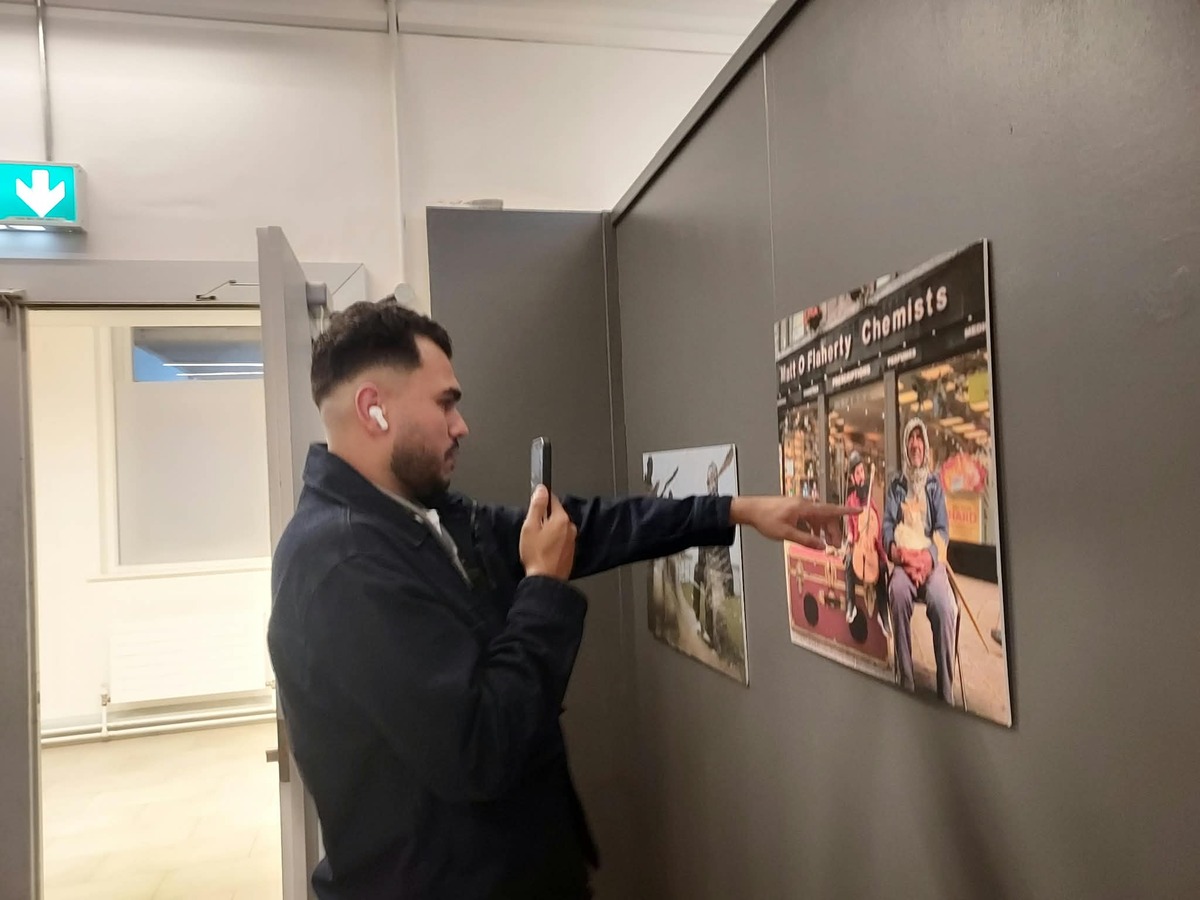

Abdelrahman shows one of his stunning visual images to a family member back in Gaza.


A press vest in the sand is at the heart of Abdelrahman Ismail’s exhibition in Galway.


Abdelrahman Ismail from Gaza at his end of year exhibition in Galway, Ireland.
Mohammed’s poignant paintings evoke the powerful works displayed at Cambodia’s Tuol Sleng genocide museum. His use of bright colors and gaunt, lifeless figures mirrors the brave Cambodian artists who depicted Khmer Rouge atrocities, reminding viewers of the universal trauma of conflict.
While these three Palestinian artists shared the exhibition space with Irish and international artists, their experiences surviving the Gaza genocide resonated as the primary focus among opening night attendees.
All three have demonstrated remarkable talent, and their multimedia work reflects significant growth as artists and individuals during their year of postgraduate study in Ireland.
In recent weeks, dozens of talented Gaza graduates—university scholars—have gone from elation to deep disappointment after securing scholarships to study in Irish universities only to have their visa applications denied by the Irish Government.
Abubaker Abed, another scholarship student from Deir Al Balah, reported that this marks the first time in a decade that the Irish Department of Justice has refused more Palestinian visa applications than granted.
Some students were told they had “gaps in their education” after their Gaza universities were bombed during the first two years of Israel’s assault on the strip, which is half the size of Ireland’s smallest county, Co. Louth.
They were deemed to have insufficient proof of funding despite Irish universities offering fully funded scholarships including accommodation for the current academic year.
Those denied visas were instructed they could only appeal in writing—not by email or fax—according to Abubaker’s report in The Electronic Intifada. With Gaza’s entire postal system destroyed, it is nearly impossible for a student to submit an appeal to Irish authorities.
Over the past two years, the Lajee Dancers, a group of Palestinian dabke dancers from the Aida refugee camp in the West Bank, were denied visas to visit Ireland for one-week cultural showcases.
In July of last year, a planned trip by young Palestinian Gaelic football players and coaches to Ireland—supported by 100 Irish host families and local funding—was cancelled after the Irish Department of Justice refused entry visas citing documentation issues.
Irish people have expressed widespread solidarity with Palestinians at massive marches and rallies over three years, but visa denials have enraged those who hoped these scholarships would bring hope and transform lives in Gaza.
Eager to appear tough amid rising racist sentiment across Europe, the Irish Department of Justice’s decision to deny visas to brilliant students who survived genocide has sparked anger and dismay.
It fell to three students who reached Ireland last year while their lives were endangered to highlight this injustice through the brilliance of their work and commitment to ensuring Palestinian voices are heard, especially as global attention turns away from Palestine’s ongoing horrors.
The Irish Minister for Justice, Jim O’Callaghan, should visit this Galway exhibition and confront the shame of destroying dozens of similar scholarship students’ dreams and their families’ hopes.
These students have no interest in burdening Irish society, overstaying visas, or abandoning families and friends in Palestine. These are young people who endured tremendous trauma, the destruction of their homeland, and possess invaluable insights about resilience and overcoming seemingly impossible challenges.
The views expressed in this article belong to the author and do not necessarily reflect the editorial policy of Middle East Monitor.


