






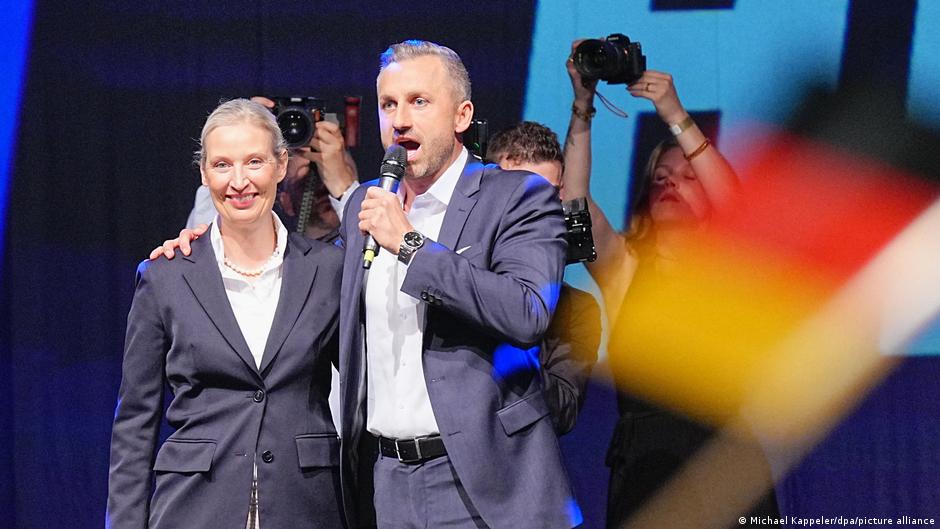
The outcome matched expectations, with the AfD securing victory in the Saxony‑Anhalt election and positioning itself to appoint a minister‑president and assume control of the state government.
What surprised most observers, however, was the dramatic collapse of the governing CDU, which now holds barely half its former strength, while rival parties were left even further behind. The AfD’s win is being described as a landslide and many analysts view it as a turning point in Germany’s post‑war history.
Keep calm and carry on?
“A state government led by the AfD would certainly be seen by many as a turning point and would further fuel the debate over how best to deal with the party,” Commerzbank economist Ralph Solveen told Reuters.
At the same time, he advises waiting to see what happens, saying that things are rarely as bad as they seem.
“Many of these decisions are unlikely to affect the economy until the medium to long term,” he said. “Decisions on most taxes, the structure of the labor market and social security systems are made at the federal level. That is why the AfD, in many of its pledges, only promises to advocate for something in the Bundesrat, which is unlikely to succeed given the foreseeable isolation of an AfD‑led government.”
What next after far-right AfD win in regional election?
To view this video please enable JavaScript, and consider upgrading to a web browser that supports HTML5 video
Local political pragmatism?
Many business community concerns had already been raised before the election. It also became clear that there are differing views within the AfD, which could lead to unpredictable policies.
For example, DW reported two months ago that Hannes Loth, a member of the AfD and the mayor in Raguhn‑Jessnitz, Saxony‑Anhalt, sought to have six new wind turbines installed. This pledge puts him at odds with the official stance of his own party.
Whether this is a sign of internal party pluralism or simply local political pragmatism will become clear during the coming legislative term, especially if the AfD ends up in the state government. It is not, however, serving to reassure business leaders.
Consequences of xenophobia
One issue the AfD campaigned on was a promise to limit the number of foreigners. But will the party actually be able to implement its goal? On this point, Michael Berlemann, director of the Hamburg Institute of International Economics (HWWI), remains skeptical.
“A large part of the measures it has promised cannot be implemented at the state level because the federal government is responsible for them,” he said. “Another part would be illegal and would be overturned by the courts after some delay: The AfD cannot restrict the immigration of foreign skilled workers in Saxony‑Anhalt.”
ING chief economist Carsten Brzeski pointed to the national shortage of skilled workers: “Forced deportations in Saxony‑Anhalt would probably be limited. However, the symbolic effect cannot be underestimated. As with Trump, such headlines would act as a deterrent for foreign skilled workers.”
Wido Geis‑Thöne, an economist at the German Economic Institute in Cologne, sees it the same way.
He told DW that the AfD would “do everything in its power to pursue its migration policy goals.” However, it could only “do things that actually fall under the responsibility of the state rather than the federal government.”
Economic fallout for Saxony‑Anhalt
Geis‑Thöne said the state itself would be the main victim of such a policy: “With an anti‑immigration state government, Saxony‑Anhalt will become significantly less attractive a destination for foreign skilled workers, regardless of whether anything actually changes for them from a legal perspective.”
For HWWI Director Berlemann, the indirect impacts of the AfD’s plans are particularly problematic. The measures announced would mean “that many skilled workers who are particularly needed in health care and nursing, hospitality and tourism, the food industry and agriculture and in construction and logistics will avoid the state in the future.”
This would exacerbate the shortage of skilled workers and widen the state’s economic gap.
Openness and diversity are key
Saxony‑Anhalt must remain a state where people from around the world want to live and work and where companies want to invest and new technologies can emerge, Bitkom President Ralf Wintergerst warned.
He told the Catholic News Agency KNA: “The digital economy thrives on openness, diversity and international cooperation. Companies invest where they find good conditions and where skilled workers from Germany and abroad are welcomed.”
Regarding foreign investment, ING Chief Economist Carsten Brzeski told Reuters: “Sure, there could be a symbolic effect on foreign investors. But let’s not forget: Saxony‑Anhalt is not the entire German economy.”
What the AfD’s Saxony‑Anhalt win means for Germany
To view this video please enable JavaScript, and consider upgrading to a web browser that supports HTML5 video
How should Berlin react
DIW President Marcel Fratzscher painted a bleak picture of the economic future after the Saxony‑Anhalt election.
“Regardless of the makeup of the next state government, a controversial or weak government and the polarization during the election campaign are likely to accelerate the departure of people and companies from Saxony‑Anhalt, thereby significantly worsening conditions in the state,” he said.
He told Reuters that the election result was “above all a vote of no confidence in the federal government.” The consequence, he added, must be “that the federal government changes course and implements far‑reaching structural reforms involving subsidies, bureaucracy, taxes, the social security system and Europe.”
Tanja Gönner, managing director of the Federation of German Industries (BDI), took a similar perspective. Following the state election, she called on the federal government to be single‑minded in pursuing a reform agenda.
“The response to this state election result must not be political paralysis at the federal level,” she said.
The federal government must now consistently implement and expand reforms to boost investment, innovation and growth, she told RedaktionsNetzwerk Deutschland, adding that “the positions of radical parties are not suitable for this.”
The political center must now show that it is capable of taking action, BDI’s managing director said, adding that what is needed is a policy focused on competitiveness and growth at both the state and federal levels. A single state election result must not distract from that goal, she concluded.
Also Read
- ‘Supergirl’ Shifts To Streaming On HBO Max This Week After Crashing At Box Office
- Twelve Nations Sanction Israeli Settlements Amid Escalating Violence
- Local Pushback Against AI Data Centers Could Benefit Data Center REITs
- Royal Spanish Football Federation Launches Comprehensive Fertility Support for Women Players & Referees


