







TL;DR: Gold and Silver have rebounded as US Treasury yields pulled back, with Gold breaking its falling trendline and Silver recovering from channel support—but neither has confirmed a bottom, making Wednesday’s US CPI report the decisive catalyst for determining whether yields extend their correction or revert toward recent highs.
Why This Matters
Gold and Silver are showing increasingly constructive technical signals after their recent selloffs, helped by a retreat in US Treasury yields from multi-decade highs. Both metals have rebounded from important support levels, with Gold breaking its near-term falling trendline and Silver recovering from the lower boundary of its declining channel. However, neither has confirmed a short-term bottom, while the US 10-year yield has yet to establish a deeper correction.
That leaves Wednesday’s US CPI report as the critical catalyst. The immediate question is whether inflation data will allow Treasury yields to extend their retreat, giving Gold and Silver the support needed to break their respective resistance levels. Alternatively, renewed upward pressure on yields could cut short both rebounds before their technical reversals are confirmed.
Treasury Yield Retreat Offers Metals Some Relief
The recovery in precious metals followed last week’s retreat in Treasury yields, which came as elevated borrowing costs began attracting stronger demand at US government bond auctions. The 10-year yield pulled back from 5.365% to around 5.242% by Friday, while the 30-year yield eased from approximately 5.73% to 5.60%.
The timing is significant. Brent crude ended the week around 104.53, slightly higher rather than lower, suggesting that easing energy-price pressures were not the main driver of the bond-market recovery. Instead, Treasury yields appear to have reached levels sufficiently attractive to bring buyers back into the market, although the stronger auction demand did not immediately reverse the rise in yields.
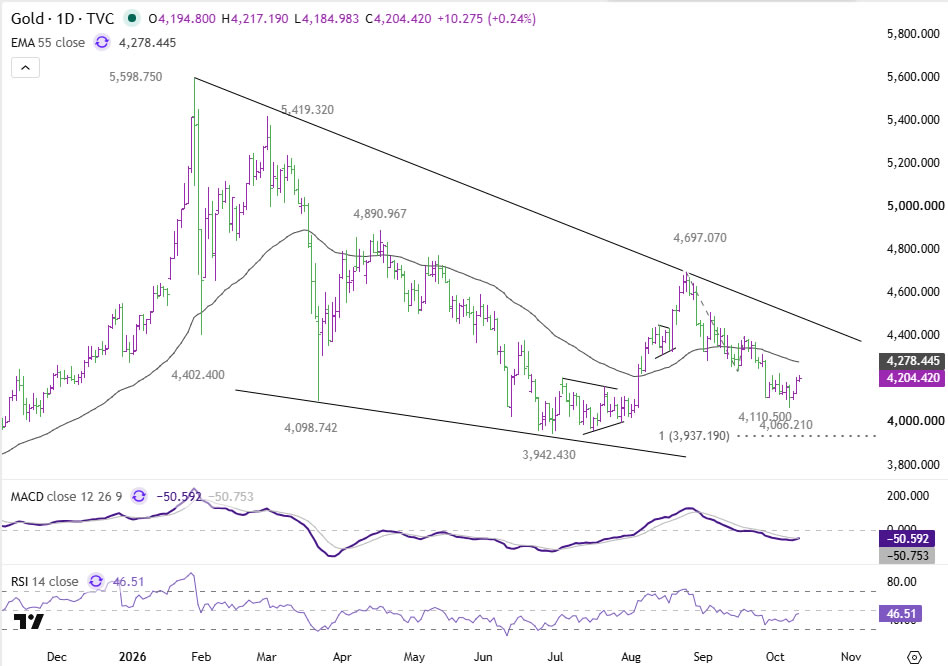
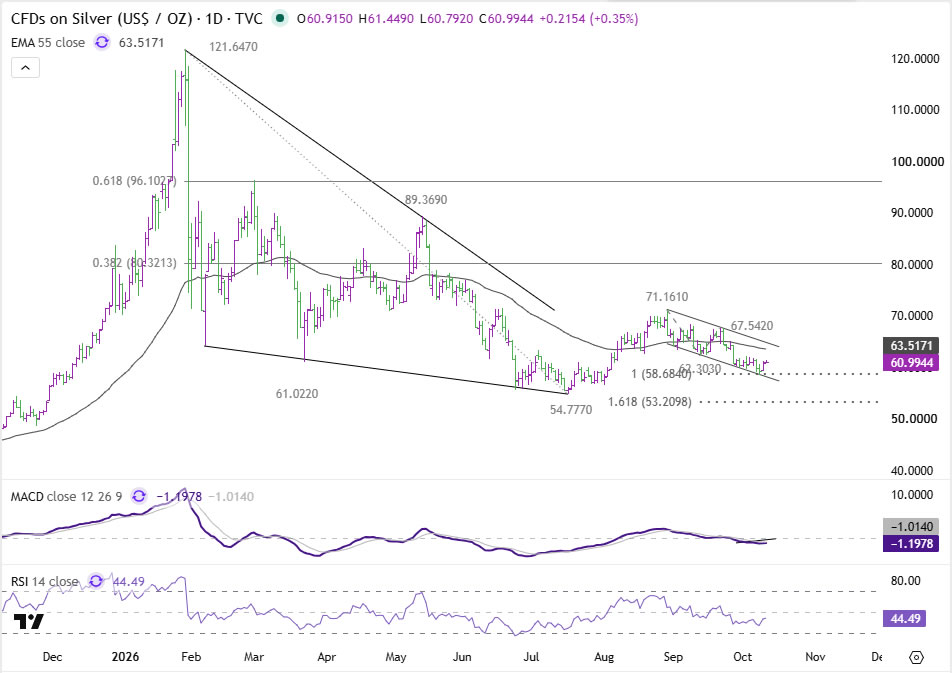
For Gold and Silver, the retreat provided some relief from the interest-rate pressure that had weighed on both metals. Gold fell from 4,697.07 in late August to 4,066.21 in October, while Silver dropped from 71.16 to 58.46 over the same period. Both have since recovered, with Silver recording the stronger percentage rebound.
The Dollar offered less encouragement. DXY edged higher to 102.232 on Friday, making the Treasury yield retreat the more convincing explanation for the metals’ recovery.
The broader Fed backdrop is also becoming less restrictive at the margin. Expectations for an immediate October rate hike have faded, but policymakers have not abandoned the possibility of further tightening. The distinction is between the timing of additional hikes and the eventual policy destination. That leaves inflation data capable of moving Treasury yields sharply in either direction.
US CPI: Headline Inflation Could Accelerate Even as Core Moderates
Wednesday’s September CPI report, scheduled for 8:30 ET, presents an unusual combination for precious metals.
According to Bloomberg consensus estimates as of October 9, headline CPI is expected to accelerate from 0.4% to 0.6% month-on-month, lifting the annual rate from 3.4% to 3.6%. However, monthly core CPI is expected to moderate from 0.29% to 0.2%, even as the annual core rate edges up from 2.4% to 2.5%.
The divergence largely reflects energy prices. Wells Fargo estimates that energy prices rose 5.31% month-on-month, with energy goods jumping 9.21%. That would account for much of the anticipated acceleration in headline inflation.
Underlying inflation could tell a different story. Wells Fargo expects core services prices to rise just 0.22%, including a 0.24% increase in shelter costs. More importantly, its estimate for supercore inflation is just 0.19%, following August’s 0.59% increase.
The critical question is whether moderating underlying inflation can outweigh the energy-driven acceleration in the headline figure.
A core reading of 0.2% would match consensus and provide little surprise on its own. However, the composition could still influence Treasury yields, particularly if supercore services inflation confirms a meaningful slowdown.
A softer reading, especially core inflation of 0.1% or less accompanied by weaker services inflation, would strengthen the case for further yield declines. That could provide Gold and Silver with the momentum needed to confirm their emerging reversals.
Conversely, core inflation of 0.3% or higher, particularly alongside persistent services inflation, could revive expectations for additional Fed tightening and send yields back toward their recent highs.
An in-line release would leave more weight on the technical picture, with neither a decisive extension nor an immediate failure of the metals’ rebounds necessarily following.
ActionForex’s Technical View
Gold Breaks Falling Trendline, Eyes 4,227 Resistance
Gold’s near-term technical outlook has improved after its rebound from 4,066.21, supported by a persistent bullish divergence in the 4-hour MACD.
The metal has broken above its near-term falling trendline and reclaimed its 4-hour 55 EMA, now around 4,174. These developments suggest that selling momentum is fading and a short-term bottom may be forming.
Immediate focus is now on 4,227.85 resistance. A firm break would confirm short-term bottoming at 4,066.21 and open the way toward the 38.2% retracement of the decline from 4,697.07 to 4,066.21, at 4,307.19. Gold would first need to overcome its daily 55 EMA, currently around 4,278, which could provide additional resistance.
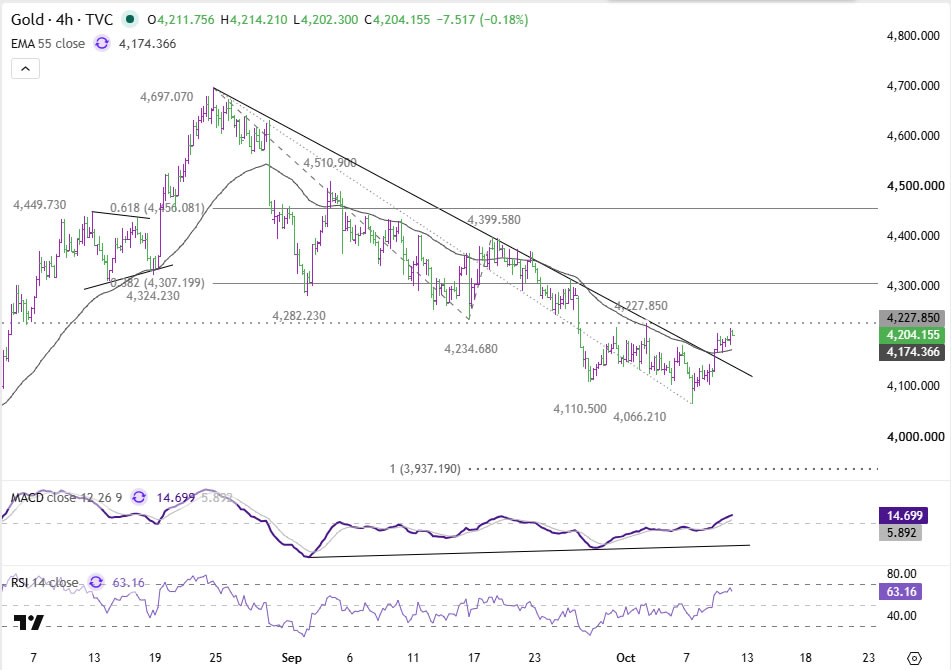

A decisive break above 4,307.19 would raise the possibility that the entire decline from 4,697.07 has already completed as a three-wave zigzag correction. The next objective would then be 4,399.58 structural resistance, where a sustained break would provide stronger confirmation of a broader bullish reversal.
However, rejection at 4,227.85 would leave the near-term recovery unconfirmed. Another decline toward 4,066.21 would remain possible, with a subsequent break exposing the 100% projection of 4,697.07 to 4,234.68 from 4,399.58, at 3,937.19.

Silver Rebounds From Channel Support, But 62.08 Is Crucial
Silver is displaying a similar technical setup, having rebounded from 58.46 after reaching the 100% projection of 71.16 to 62.30 from 67.54 at approximately 58.68. That projection coincided with the lower boundary of its falling channel.
Bullish divergence in the 4-hour MACD adds to the evidence that downside momentum has weakened. Silver has also recovered its 4-hour 55 EMA, currently near 60.98. However, 62.08 resistance remains the immediate test.
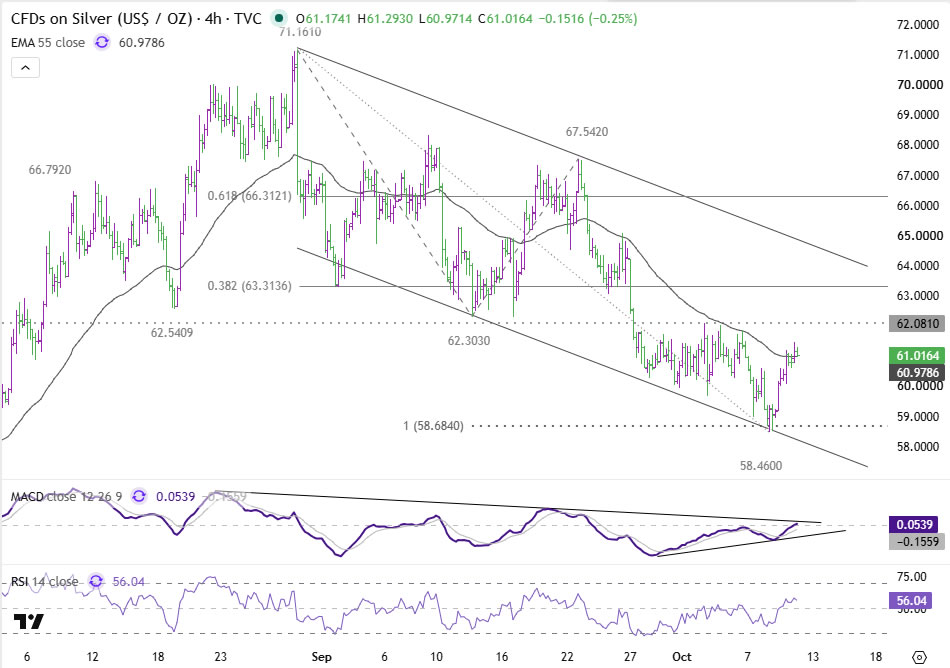
A firm break would confirm short-term bottoming at 58.46 and shift attention toward the 38.2% retracement of the decline from 71.16 to 58.46, at 63.31. That level sits close to the daily 55 EMA around 63.52, creating a potentially important resistance zone.
A decisive break through this area would strengthen the case that the entire decline from 71.16 has completed as a three-wave correction, opening the way toward the 61.8% retracement at 66.31.
Conversely, rejection at 62.08 would leave the decline from 71.16 intact, maintaining the possibility of another fall through 58.46 at a later stage.

US 10-Year Yield Holds the Key to Both Rebounds
The US 10-year yield’s technical position may ultimately determine whether the improving signals in Gold and Silver translate into sustained recoveries.
After retreating from 5.365%, the yield has stabilized around its 4-hour 55 EMA, currently near 5.246%. The next move from this area will be important.
A break below 5.219%, accompanied by sustained trading below the EMA, would strengthen the case that the entire five-wave advance from 4.619% to 5.365% has entered a corrective phase. That would bring the 38.2% retracement at 5.081% into focus, creating a more supportive interest-rate environment for both metals.
However, a sustained rebound from current levels would shift attention back toward 5.365%. A renewed rise toward that high could undermine the developing bullish setups in Gold and Silver, particularly if driven by an upside CPI surprise.
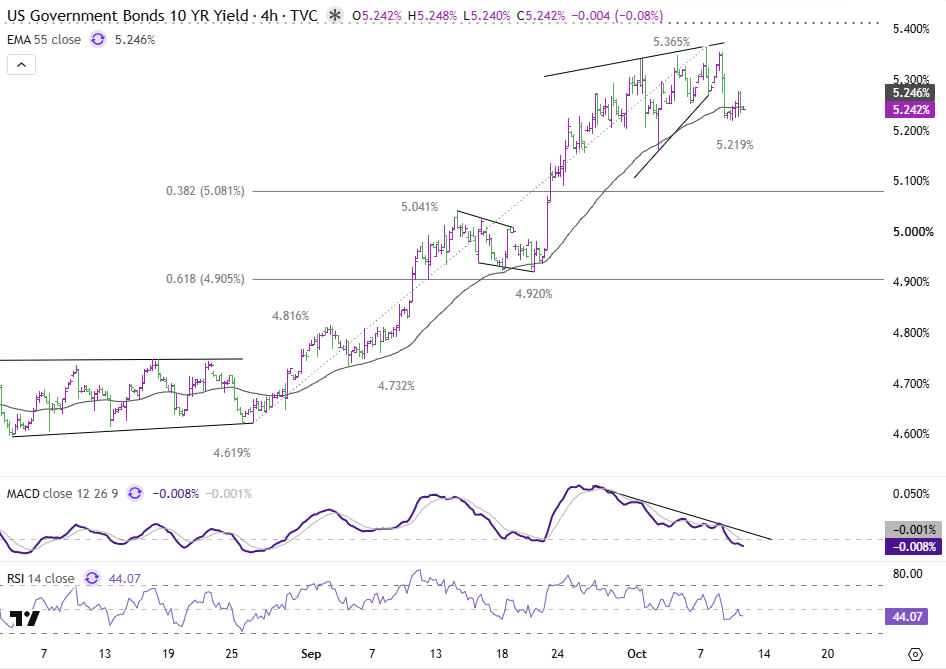
The metals are beginning to signal that their declines may be nearing completion, but the Treasury market has yet to confirm that assessment. Wednesday’s CPI could provide the missing catalyst. For now, Gold needs to clear 4,227.85 and Silver needs to overcome 62.08, while the 10-year yield must extend its correction below 5.219% to provide a stronger foundation for both rebounds.
Key Takeaways
- Gold and Silver have rebounded from major support (4,066.21 and 58.46 respectively) as Treasury yields pulled back, but neither has confirmed a short-term bottom.
- Wednesday’s September CPI is the key catalyst: headline inflation is expected to accelerate to 0.6% m/m on energy costs, while core CPI is expected to moderate to 0.2%—a divergence that could swing Treasury yields either way.
- Gold needs a firm break above 4,227.85 to confirm its bottom and open the path to 4,307.19 and 4,399.58; rejection there risks a retest of 4,066.21 and potentially 3,937.19.
- Silver’s equivalent test is 62.08 resistance, with a break opening 63.31 and 66.31; failure there keeps the decline from 71.16 intact.
- The US 10-year yield must break below 5.219% to confirm a deeper correction toward 5.081%—the condition both metals’ rebounds ultimately depend on.


