






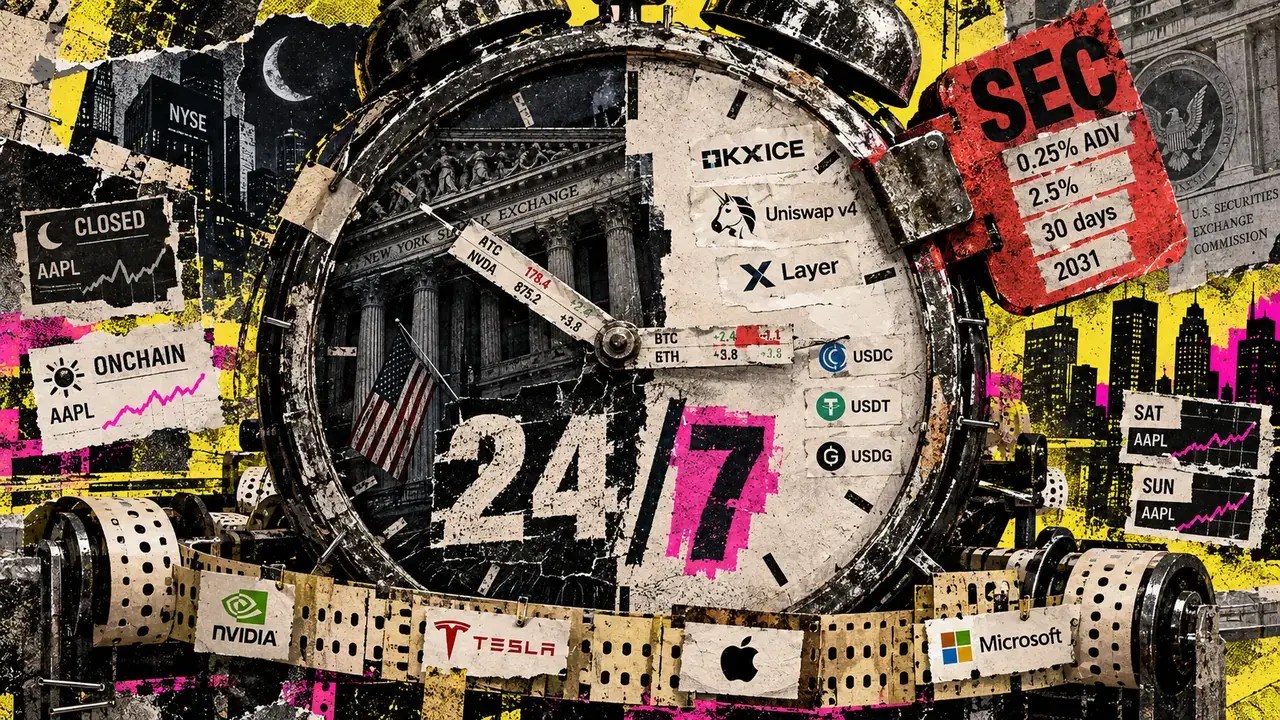
Intercontinental Exchange (ICE) and OKX are preparing an always-open market where tokenized U.S. stocks could continue repricing after traditional Wall Street hours end.
On Oct. 4, OKXICE—the firms’ 50-50 joint venture—notified the Securities and Exchange Commission (SEC) of its intent to launch a Tokenized Securities Venue under the regulator’s new Innovation Exemption. The proposed platform would initially support 63 securities, including shares of Nvidia, Tesla, Apple, Microsoft, JPMorgan, Goldman Sachs, Coinbase, and Circle.
The structure would establish a parallel trading venue for some of the most actively traded U.S. companies operating 24 hours a day, seven days a week. Tokenized shares could continue absorbing information during nights and weekends when their underlying equities are unavailable on traditional cash markets, potentially offering a reference point for where prices may move when regular exchanges reopen.
ICE’s involvement adds significant weight to the experiment. As the owner of the New York Stock Exchange, ICE is directly participating in infrastructure that tests whether U.S. equity trading can extend onto blockchain rails beyond conventional market hours.
“This is a landmark step toward a truly global, 24/7 Wall Street,” said OKXICE co-chair and former New York Governor Andrew Cuomo. OKX founder and CEO Star Xu described the filing as a market-structure experiment worth testing at scale, adding that “Wall Street is moving onchain.”
Onchain Pricing Could Fill Wall Street’s Off-Hours
The market structure becomes especially consequential after traditional exchanges close because OKXICE’s smart contracts will not rely on the prevailing NYSE or Nasdaq price to determine where a tokenized stock trades.
Instead, prices will be set by the ratio of assets held in automated market maker (AMM) liquidity pools. External stock-market data may be used for displays and trading-halt checks, but it will not feed directly into the smart contracts determining executable prices.
If market-moving news involving Nvidia or Tesla breaks on a Saturday, investors could continue trading tokenized shares against stablecoins. The resulting price would not dictate where the underlying stock opens Monday, but a sufficiently liquid market could give traders a continuously updated indication of investor sentiment before conventional equity trading resumes.
Liquidity will determine the utility of that signal. Thin pools could produce exaggerated swings or wider deviations from the value investors eventually assign to the underlying shares once traditional markets reopen.
The SEC has already flagged this tension. In granting the exemption, the regulator sought public comment on how overnight tokenized-stock trading could affect liquidity, pricing, and the opening, reopening, and closing processes of conventional exchanges. It also cited potential price dislocations between tokenized and underlying shares as a concern for public companies whose stocks may be tokenized by third parties.
Arbitrage would provide a mechanism for closing those gaps once the traditional market is available. OKXICE’s filing stipulates that third-party tokenizers must maintain one underlying share for each token outstanding, with minting and redemption channels available to eligible participants. The tokens must also carry equivalent economic and governance rights, including dividends, voting rights, and claims on residual assets.
That linkage could turn differences between onchain and conventional prices into opportunities for market makers rather than permanent divergences. Weekend shocks, however, would leave arbitrageurs without an open cash market in which to immediately hedge or acquire the underlying shares.
Uniswap Mechanics Applied to U.S. Equities
OKXICE also proposes replacing the traditional exchange order book with decentralized finance infrastructure.
Its permissioned markets will use Uniswap v4 liquidity pools deployed on X Layer, OKX’s blockchain network. Tokenized stocks will trade against USDC, USDT, or USDG, placing stablecoins directly on the cash side of transactions involving some of America’s largest public companies.
Investors will retain assets in self-custodial wallets, but access will be restricted. Prospective users must pass identity, anti-money-laundering, and sanctions screening before receiving a non-transferable credential allowing their wallet to interact with the venue. The platform will not operate an order book, take custody of customer assets, or extend credit.
The structure combines regulated securities ownership with crypto-native market plumbing. Investors would hold fully backed instruments with shareholder rights, while settlement, liquidity, and custody operate through stablecoins, smart contracts, and self-hosted wallets.
Authorized participants would also be able to mint or redeem tokens using underlying shares during traditional trading hours, connecting the AMM pools to the conventional equity market. Once the cash market closes, however, those pools can continue repricing without an executable underlying stock market.
SEC Limits Scope of the Experiment
The SEC has capped the number of securities and trading volume under its temporary exemption.
Under the exemption, Tier 1 securities are limited to 75 symbols per venue, while trading in an individual stock cannot exceed 0.25% of its prior month’s average daily volume. Tier 2 securities face a 250-symbol limit and a higher 2.5% volume ceiling. A venue that breaches the applicable threshold for a security must halt trading in that token for three months.
Those limits make it unlikely that OKXICE will immediately capture enough volume to rival the NYSE or Nasdaq. They instead give regulators a contained environment in which to observe whether continuous onchain trading develops enough liquidity to affect pricing elsewhere.
The exemption runs through Sept. 17, 2031, although the SEC can modify it earlier as regulators assess whether a more permanent framework is warranted.
OKXICE also cannot begin operating immediately. The SEC requires prospective venues to publish notice at least 30 calendar days before opening, making an early-November launch the earliest possible timing following its Oct. 4 notice.
Third-party tokenized stocks face an additional constraint. Companies must receive at least 30 days’ notice before their shares are offered and can object during that window, preventing the venue from listing their tokenized stock under the exemption.
That power has already been exercised. Cerebras Systems objected to having its shares traded through OKXICE, meaning the venue cannot offer its tokenized stock under the current framework.
The coming month will test which proposed listings face issuer objections and whether liquidity providers are prepared to make prices during the hours when Wall Street itself is closed.
Also Read
- Bitcoin’s Dual Golden Cross Signals Strengthening Momentum Amid Favorable Macro Shift
- GBPJPY Wave Analysis: Bullish Reversal Targets 210.00
- US ISM Services PMI Slides to 54.9 as Prices Surge and Employment Rebounds
- OKX and NYSE Parent ICE File Plans for Round-the-Clock Tokenized Stock Trading – FXLeaders


