






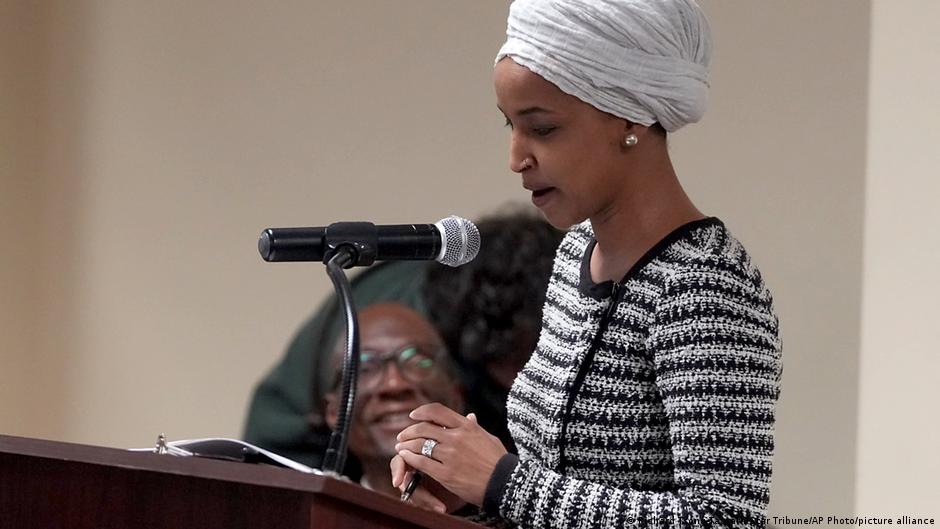
Donald Trump has launched some of his most intense and highly personal attacks against US Democratic Congresswoman Ilhan Omar, singling her out for fierce political hostility. Throughout his political campaigns and presidency, Trump has utilized a barrage of derogatory rhetoric targeting Omar, mocking her name, her religion, and her origins. He has repeatedly accused her of doing “nothing but complain” and labeled her and her associates as “garbage.” Furthermore, Trump has questioned her understanding of American values, arguing that her background from Somalia—a country he has characterized as lawless and unstable—disqualifies her from commenting on the US Constitution.
But why has Trump focused such disproportionate and aggressive hostility on the prominent congresswoman? This targeted campaign highlights a broader political strategy of using controversial figures to rally his base and criticize Democratic policies.
Who is Ilhan Omar?
Ilhan Abdullahi Omar, 44, was born in Mogadishu, the capital of Somalia. She fled the country’s devastating civil war while still a child, spending four years in a refugee camp in Kenya before finally arriving in the United States with her family in 1995 at the age of 12. She became a US citizen in 2000 and subsequently joined the Democratic Party, building a career on the party’s progressive wing. Since January 2019, she has served as the representative for Minnesota and stands as one of the first two Muslim women elected to the US Congress.
A practicing Muslim who wears a hijab, Omar successfully advocated for Congress to revisit and alter a 180-year-old rule that previously prohibited head coverings on the chamber floor. Politically and socially, she champions progressive values, frequently linking her Islamic faith to her commitment to social justice, human rights, and the protection of marginalized communities.
Omar’s legislative priorities include advocating for universal health insurance, increasing the minimum wage, climate protection, and the cancellation of student debt. She is also one of Donald Trump’s most prominent and outspoken critics, repeatedly accusing him of racism and systematically fomenting hatred against minorities, immigrants, and Muslims. She has frequently condemned raids by the US Immigration and Customs Enforcement agency (ICE), describing them as a “militarized campaign of fear,” and has accused the administration of corruption.
Criticism of Israel and accusations of antisemitism
Young, outspoken, female, Muslim, and a left-wing Democrat – politically, Ilhan Omar represents almost the polar opposite of the 80-year-old Republican Trump. However, she remains a highly controversial figure within her own party due to her foreign policy stances.
Omar is one of the fiercest critics of Israel in US politics and has repeatedly called Washington’s support for the country into question. She has faced accusations of antisemitism and criticism for her support of the BDS (Boycott, Divestment, and Sanctions) movement, which encourages boycotts of Israeli businesses. Omar has defended BDS as a legitimate form of non-violent protest and freedom of expression. In 2019, she introduced a resolution in the US Congress aimed at strengthening the right of Americans to boycott, countering laws that restrict the BDS movement’s activities.
In early 2023, Republicans successfully removed her from the House Foreign Affairs Committee over controversial tweets, including a 2021 comment that equated the actions of the US and Israel with those of the Taliban in Afghanistan and the Palestinian group Hamas, which is classified as a terrorist organization by the US and many international allies.
Accusations of embezzlement and immigration fraud
Omar’s critics have repeatedly attempted to link her to corruption scandals in her home state of Minnesota. During the COVID-19 pandemic, approximately $250 million (€220 million) was misappropriated from a government-funded food program for children. Omar had previously called for the easing of the program’s strict rules. While many of those convicted of the fraud were from the state’s Somali community, political opponents—including Trump—seized on this to claim Omar was involved. To date, no law enforcement authorities have accused her of any wrongdoing.
The most recent accusations against Omar concern her immigration history. For years, opponents have claimed she made false statements during her immigration proceedings, even alleging that she entered into a fraudulent marriage with her biological brother to help him secure a US visa. On October 12, federal officials executed a search warrant at Omar’s home, investigating allegations that her father lied about her age on her immigration application.
Controversial house search
Omar has repeatedly denied these accusations, describing them as part of a “campaign of political intimidation” and “an attempt to target political enemies.” Several leading Democratic politicians have come to her defense, accusing the Trump administration of weaponizing the Justice Department and Department of Homeland Security against its political opponents.
Former immigration officials have told the Reuters news agency that conducting a house search in connection with such an investigation is extremely unusual, as the government should already possess all relevant immigration documents.
Many observers see the raid on the home of a sitting member of Congress over a formality from 26 years ago as highly excessive. Critics have been especially vocal about the timing of the raid, which occurred just three weeks before the Congressional elections in which Omar is running for re-election.
The long-standing, unwritten “60-Day Rule” holds that authorities do not take public action against political candidates in the two months leading up to an election to avoid influencing the outcome. Critics argue that ignoring this practice in Omar’s case amounts to direct election interference.
‘Timing wildly suspicious’ — Unpacking the search of Ilhan Omar’s home
To view this video please enable JavaScript, and consider upgrading to a web browser that supports HTML5 video
Other Muslim politicians also targeted
With the midterm elections looming, Trump is battling with plummeting approval ratings, and Omar is not the only Muslim politician the president has been attacking. Abdul El-Sayed, the Democratic candidate running for the Senate in Michigan, is another.
At a rally last Saturday in Tennessee, Trump said of El-Sayed: “I call him Mohammed. Somebody said, ‘His name isn’t Mohammed, it’s Abdul.’ I said, ‘To me, it’s Mohammed.’ I’m the president. I can call him whatever the hell I want. To me, he’s Mohammed, and he’s a radical jihadist.”
There is no intelligence whatsoever to suggest that El-Sayed has any extremist connections. The 41-year-old epidemiologist was born and brought up in Michigan. He went to university there, then won a Rhodes scholarship to Oxford, where he gained a doctorate in public health. For many years, he was the health director of the city of Detroit. Like Omar, he too belongs to the progressive left wing of the US Democratic Party.
During the election campaign, El-Sayed has repeatedly emphasized that he is not the one responsible for the rise in food prices, the expensive rents, and other political grievances. He has placed the blame squarely on what he describes as the failed policies of the administration in Washington.
This article has been translated from German.
Also Read
- US ambassador urges Israel to prosecute over ‘act of terror’ against American photographer
- French Mayor Assaulted by Israeli Settlers During West Bank Olive Harvest Visit
- Al Jazeera Journalist Assaulted Amid Widespread French Protests and Looting
- UN Under‑Secretary Calls for Immediate Halt to Drone Strikes in Sudan


