






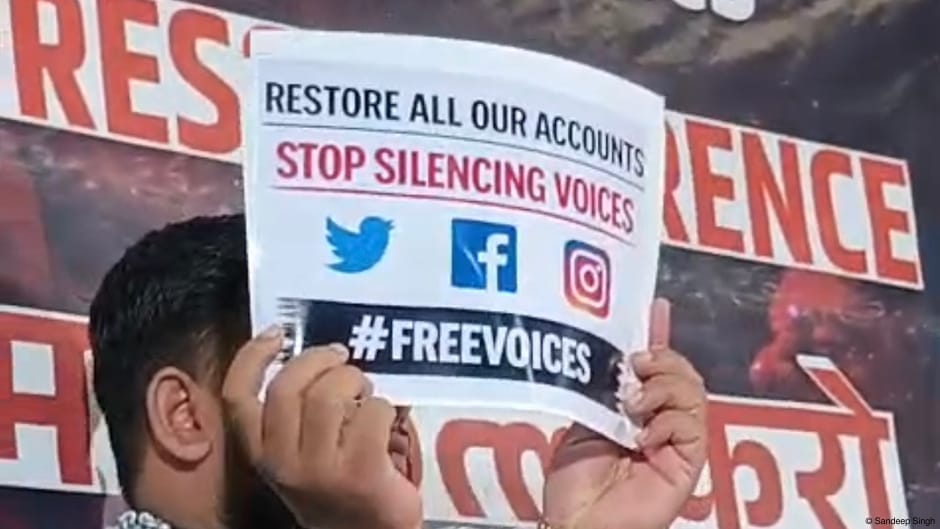
Among the content recently restricted on social media in India are a video of a young girl in tears recounting alleged police brutality during July’s youth-led Cockroach Janata Party (CJP) protests, an analysis of the Hindu-nationalist Rashtriya Swayamsevak Sangh’s (RSS) role in the rise of the ruling Bharatiya Janata Party (BJP), and a satirical cartoon aimed at Prime Minister Narendra Modi’s government.
These are just a handful of the posts that have been curtailed on Indian social media in recent months.
A pattern of restrictions
Content creator CitySavitri calls herself a “nobody” in the world of social media. She had been making videos for only two months and had roughly 600 followers on Instagram.
Yet a video examining the RSS’s role in the BJP’s 2014 election win was restricted in India within an hour of going live. It was the first of three of her videos to face restrictions.
The experience left her convinced that “anti-government commentary” was being watched and quietly suppressed.
“It is very plain and simple to understand,” the content creator told DW.
Independent journalist Sadhika Tiwari was covering the CJP protest in New Delhi on July 20, when police deployed batons and tear gas against demonstrators.
Her video of a frightened young girl crying as she spoke about police brutality drew around 10 million views within hours, she said, before it was restricted in India.
Political cartoonist Satish Acharya has likewise faced repeated restrictions, with Instagram blocking his profile twice in recent weeks.
‘Suppressing independent journalism’
In May 2025, during the conflict between India and Pakistan, the X account of independent digital news outlet Maktoob Media was withheld in India even as it reported on the escalating crisis, founder and editor Aslah Kayyalakkath told DW.
“We received no official notice or email from either the government or X. It was our readers who first alerted us to the blocking,” he said.
Maktoob Media said it reached out to Indian officials and to X but heard nothing back. Access to the account was restored a few days later, again without any explanation.
Kayyalakkath said Maktoob’s coverage of the July protest also ran into restrictions. “Suppressing independent journalism undermines transparency, accountability and democratic values,” he said.
Several of the creators and journalists who spoke to DW said they were given no advance notice or reason for the restrictions.
Some users remained unsure whether their content had been blocked at the government’s behest or proactively by the platforms themselves.
Asked for comment, Meta, the parent company of Facebook and Instagram, directed DW to a web statement noting that users can appeal content and account restrictions.
How does the system work?
At the center of the debate are India’s IT Rules, 2021, amended in February 2026. Section 79 of India’s IT Act shields social media platforms and other intermediaries from liability for content posted by third parties, so long as they meet certain legal conditions.
One such condition, introduced through the February 2026 amendments, requires platforms to remove or disable access to specified unlawful content within three hours of receiving a valid court order or a reasoned government notice. The previous deadline was 36 hours.
Failure to comply can cost intermediaries their liability protection.
Censorship in India: Muzzled by the government
To view this video please enable JavaScript, and consider upgrading to a web browser that supports HTML5 video
The government’s Sahyog portal, which coordinates takedown requests among law enforcement, platforms and telecom providers, has drawn criticism over how quickly it issues notices.
Meta said it relies on automated tools and technologies to detect and review content that may breach its community standards. It also automatically restricts access to certain categories of content in India to comply with legal requirements under the IT rules.
Pranesh Prakash, a technology law and policy adviser, said the amended rules let authorized police officials notify intermediaries about content they deem unlawful without necessarily filing a formal complaint or starting other legal proceedings.
“This has led to the worst period of social media censorship that India has ever seen, with digital news media accounts being blocked, cartoonists’ accounts being blocked, and even mere discussions of an opposition leader’s memoirs being blocked,” he said. “Clearly, none of these disclosed any ‘unlawful acts.'”
Prakash also flagged the absence of public information on government takedown requests, which he said makes it difficult to gauge the true scale of the restrictions.
A flaw in the system
The Software Freedom Law Center, India (SFLC.in), a digital rights organization, said the growing reliance on automated takedowns raises serious questions about transparency, accountability and due process.
“There is little transparency about the processes through which content is identified, flagged and restricted, or whether there is any meaningful human oversight before a takedown is implemented,” SFLC.in told DW.
The group also put X’s verification process to the test, submitting a takedown request against one of its own posts using a fake email address. X registered the request, raising doubts about how it confirms the identity and authority of those filing requests.
After SFLC.in alerted the company, X began requiring email verification codes from anyone submitting takedown requests.
“A channel that lets anyone pose as a law enforcement official can be misused to silence lawful speech,” SFLC.in said.
X did not respond to DW’s request for comment.
Government says no censorship
The Indian government denies that it censors online content.
While the ministry did not answer DW’s most recent request for comment, in an email to DW in August, Vinod Kumar, chief of media and communications at the Information Technology Ministry, said Instagram posts by students and protesters after the July CJP protests “are not being taken down as alleged.”
“Media enjoys freedom in India. The Government does not censor online content,” Kumar said, adding that the government acts only against “objectionable content.”
Under the Indian IT rules, “unlawful content” broadly covers material that could threaten India’s sovereignty and integrity, disturb public order, incite violence, or amount to defamation.
Even so, social media influencers such as university professor Madri Kakoti, known online as Dr. Medusa, continue to report restrictions. Kakoti said her Instagram account was restricted in India on November 16 without notice, as was the account of satirist Shamita Yadav.
The price of free speech
Rights groups, including Human Rights Watch, have warned that widening content restrictions could chill free expression and push journalists, creators and ordinary users toward self-censorship.
Acharya, for his part, said he has no intention of stopping his work.
“The Indian Constitution gives me the right to draw political cartoons,” he said. “It’s totally democratic to question and criticize the government in India.”
For Tiwari, the stakes extend well beyond the reach of a single video. It is also about preserving a record of what happened, after the Delhi Police rejected allegations of using excessive force during the July 20 protest in front of the Supreme Court.
“We have seen several other videos now, and it’s well established why that girl was crying, and that the Delhi Police used force and lied about it,” she said.
“Still, I want that video back up because it needs to stay for posterity. I think that’s the larger idea: they want to take this stuff down so it fades from memory, allowing them to categorically deny it later when we have little left to show for what happened.”
India’s ‘Cockroach’ protesters claim online censorship
To view this video please enable JavaScript, and consider upgrading to a web browser that supports HTML5 video
Also Read
- Van Gogh’s ‘Chestnut Trees in Flower’ Commands Record $190.4 Million at Auction
- Defense Business Brief: Vantor’s Raptor Navigates GPS-Denied Skies, While Hadrian Breathes New Life Into a 150-Year-Old Steel Foundry
- EU-UK Negotiations Intensify Ahead of Crucial Brussels Summit
- International Court of Justice Delivers Landmark Genocide Ruling Against Myanmar Over Rohingya Atrocities


