






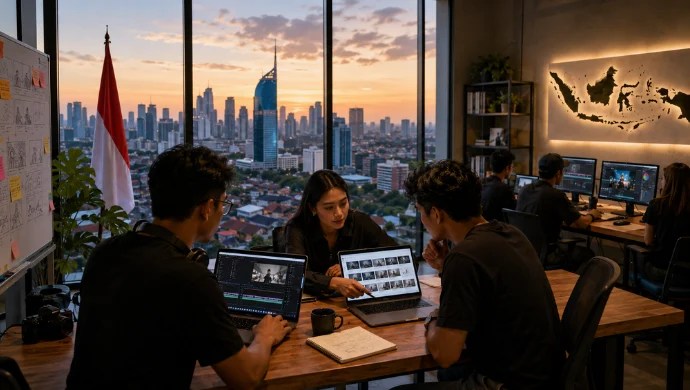


Establishing our Indonesia office followed the conventional approach: a client needed local presence, so we set up operations. It was the standard expansion model familiar to founders across the region—work exists there, so you establish yourself there.
Earlier this year, that logic quietly reversed for us. An international vertical microdrama platform commissioned a complete series—90 episodes, one minute each—delivered within three weeks. We accomplished this through a distributed freelance network supported by generative AI video tools that continue improving weekly. Production, it turns out, no longer needs to be anchored to any specific location. This forced a question I had not seriously considered since signing that first Indonesian lease: if work can happen anywhere, what purpose does our Indonesia office actually serve?
Wrestling with that question revealed more about where Indonesia’s creative market is headed than any industry report could offer—because the answer reveals as much about the market as it does about our operations.
Understanding a Market on Its Own Terms
Indonesia’s creative economy is not a subplot of the Southeast Asia growth narrative; it represents one of the largest creative workforces in the region. The sector contributed approximately Rp1,500 trillion (roughly US$90 billion) to GDP, employing 27.4 million workers, or 18.7 percent of the national labor force, according to Statistics Indonesia. Creative exports reached US$12.9 billion in the first half of 2025, the highest figure in five years. All of this operates within Southeast Asia’s largest digital economy, projected to exceed US$130 billion.
The first wave of that digital expansion centered on e-commerce and ride-hailing. The second wave, from my perspective, is content—Indonesian creative talent connecting directly with global, AI-accelerated production pipelines. The microdrama phenomenon exemplifies this shift most clearly: Deloitte projects in-app revenue for micro-series will more than double in 2026, from US$3.8 billion to US$7.8 billion, a format whose economics depend entirely on speed and volume. This is precisely the type of work a large, young, mobile-first creative workforce should be capturing.
Observing Real-World AI Adoption Enthusiasm
What reports overlook and ground-level experience makes clear: the appetite for AI among Indonesian creatives and clients is not cautious. It is enthusiastic—in my experience, more openly so than in some wealthier markets, where hesitation is a luxury people can afford.
Throughout 2024 and much of 2025, numerous clients and freelancers across the region remained uncertain about generative AI. By 2026, that uncertainty has evaporated. Conversations with our Indonesian clients shifted toward how to deploy and scale AI across their organizations, including agentic workflows. Tool developers have noticed this demand: OpenAI launched its ChatGPT Go tier in Indonesia at approximately US$4.60 per month—about one-third of the S$13 Singapore price—with Google matching at a comparable local rate. When global AI companies introduce Indonesia-specific pricing, it signals where they believe the users are.
The Hidden Cost Beyond the Headlines
Yet here lies the concealed cost of this growth, and I believe this is a critical factor we must acknowledge: enthusiasm is not the same as access.
Consumer AI is being price-localized for Indonesia. Professional-grade creative AI is not. The frontier video generation tools that freelancers actually bill with—the credits that made our 90-episode sprint feasible—remain priced in flat US dollars globally. A motion designer in Jakarta pays Silicon Valley prices against Jakarta rates. Even in Singapore, accessing premium AI tools represents a significant consideration: the Budget 2026 provides citizens enrolled in selected AI courses six months of free access to premium AI tools, an explicit acknowledgment that serious capability exists behind paywalls. Indonesia’s 27 million creative workers face identical paywalls with a fraction of the purchasing power.
The risk is a two-tier creative workforce: a thin layer of professionals who can afford frontier tools and compete for global, AI-accelerated work, and a much larger base whose enthusiasm never converts into billable capability. If that gap solidifies, the second wave of Indonesia’s digital economy will be powered by its talent but captured elsewhere.
Reframing the Office’s Purpose
My answer, more clearly crystallized in 2026, is that our Indonesian presence matters more than when we established it—but for inverted reasons. It is no longer primarily a production hub; production travels. It is where trust resides: client proximity, talent relationships, and the cultural judgment that determines whether AI-accelerated content feels distinctly Indonesian or generically produced.
Notably, a growing portion of what Indonesian clients request from us is no longer content at all—it is guidance on AI adoption itself: which tools to trust, how to redesign workflows, how to bring teams along. In a market this enthusiastic, the scarce resource extends beyond willingness. It is judgment.
Key Takeaways
If you are building in or entering Indonesia’s creative economy, retire the question “is this market ready for AI?”—it is more than ready. Instead, ask: who in your network can actually afford the professional tools the work now demands, and what are you doing to bridge that gap? Operators who treat tool access as part of their talent strategy—subsidizing credits, pooling licenses, training for capability rather than mere exposure—will be the ones who convert Indonesia’s enthusiasm into tangible output. Everyone else will compete for the same thin layer at the top.
Indonesia does not need convincing about AI. It needs the economics of professional AI to catch up with its ambition. The first movers who solve that, even partially, will find 27 million reasons it was worth the effort.
Also Read
- The Rise of Immersive, Large‑Scale Entertainment Experiences
- Israeli Forces Prevent Knesset Member From Accessing Besieged Palestinian Home in Qusra
- Peter Thiel Has Steadily Sold Down His Palantir Stake for Years Yet Remains Its Largest Individual Shareholder. Here’s What His Selling Pattern Signals for Investors.
- UK Financial Regulators Assemble Industry Experts for MiFIR, EMIR, and SFTR Reporting Harmonisation Initiative


