






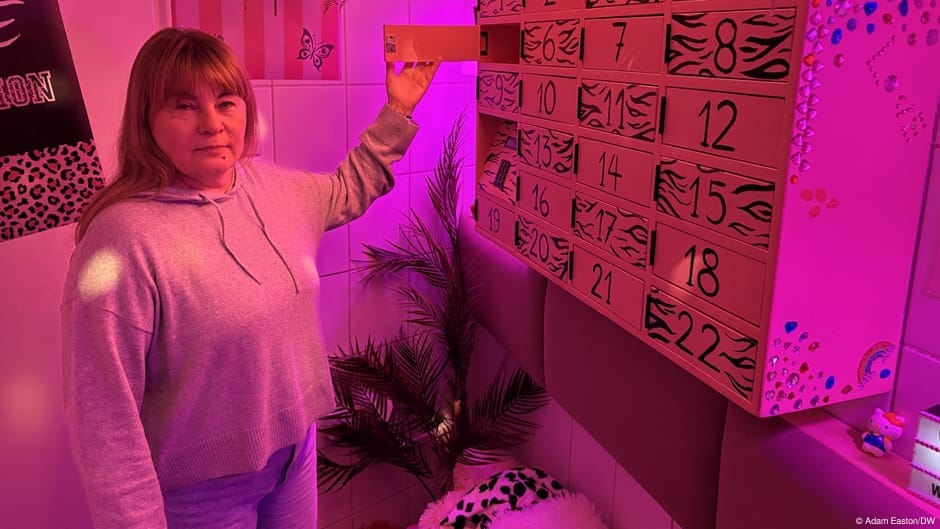
Women’s rights campaigners in Poland have unveiled what they describe as the world’s first parcel locker dispensing abortion pills, a deliberately public provocation in a country with some of the strictest termination laws in Europe.
The installation, dubbed the “Abortomat,” sits in a building directly across from the Polish parliament — a location its creators say is aimed squarely at politicians including Prime Minister Donald Tusk. Before the 2023 election, Tusk promised to legalize abortion on request up to the 12th week of pregnancy, but his coalition has never managed to settle on a shared position.
Poland and Malta remain the only European Union member states where abortion is not available on request.
Under current Polish law, a termination is permitted only in cases of rape or incest, or where the pregnancy threatens the woman’s health or life.
Pink lockers and PIN codes
Justyna Wydrzynska of the nonprofit Abortion Dream Team led DW into the “Abortomat,” tucked away in a small room behind a tasseled portiere at Abotak, Poland’s first dedicated abortion center.
Inside, low pink lighting mixes with glitter tassels, baubles and spotlights, giving the space an atmosphere Wydrzynska likened to a disco.
The locker bank opened in late September and holds 22 pink compartments. A woman unlocks one using a PIN code issued by the organization Women Help Women after she completes a medical questionnaire that a doctor reviews.
Automated parcel lockers have spread rapidly across Poland in recent years, reaching even the country’s smallest villages.
“Walk around Poland and you find vending machines everywhere. This is our culture. People in the US have Amazon; we have vending machines for everything,” Wydrzynska said.
Convicted of helping a woman to have an abortion
Women who terminate a pregnancy in Poland are not prosecuted. Anyone who assists them, however, can face up to three years in prison.
In 2023, Wydrzynska became the first activist in Poland convicted of helping a woman obtain an abortion by mailing her pills. A court later quashed the conviction and ordered a retrial.
‘Abortomat’: World’s first abortion pill-dispensing locker in Poland
To view this video please enable JavaScript, and consider upgrading to a web browser that supports HTML5 video
Each compartment holds a package containing two medicines, mifepristone and misoprostol, a combination typically used up to the 14th week of pregnancy.
Mifepristone has no Polish marketing authorization, so it has to be sourced from abroad. Navigating that process is difficult, which is where Abortion Dream Team and Abotak step in: they guide women through the practicalities of ordering medication shipped in by Women Help Women, or help arrange travel abroad for a procedure.
A ‘complicated’ legal situation
Wydrzynska argues the “Abortomat” stays within the law on the grounds that a machine, not a person, hands over the pills — while acknowledging she cannot be certain.
Sabrina Mana-Walasek, a reproductive rights lawyer who represents her, described the legal picture around abortion pills as “complicated.”
Although mifepristone is unregistered in Poland, she noted, it is authorized elsewhere in the European Union, and Polish women as EU citizens may order it and take it.
“If a woman orders pills for herself and pays for them herself, it’s not a crime,” she said.
Opposition from Catholic groups
The ultra-Catholic legal organization Ordo Iuris rejects that reading and has reported the activists to prosecutors as suspected offenders.
“With an ‘Abortomat,’ the acts that enable an abortion are, in theory, carried out by the woman herself through the device. In practice, however, the machine is run by people — they issue the code that opens the compartment holding the pills, they order and source them, and they refill the compartments,” said Katarzyna Gesiak, director of the Ordo Iuris Center for Medical Law and Bioethics.
Anti-abortion demonstrators turn up outside Abotak regularly, Wydrzynska said, blaring horns and loudspeakers to disturb the center’s residential neighbors and pressure the landlord into ending the lease.
At one such protest, a woman holding an image of the Virgin Mary told DW she regards abortion as “the work of Satan.”
“Abortion is evil, it’s demonic, it’s against the fifth Commandment, ‘Thou shalt not kill,'” she said.
Support for women seeking an abortion
Earlier this year, Diana, a 25-year-old Ukrainian woman living in Warsaw, ended a pregnancy at six weeks with pills obtained through information supplied by Abortion Dream Team — several months before the “Abortomat” opened. She has never wanted children.
“I expected something like a headache or a stomachache, maybe vomiting, but there was nothing. It was just like a normal period. I felt no pain. It was really easy for me,” she said.
“I felt relief, because I knew it was the right choice for me. I knew I could get on with my life,” she added.
Fellow Abortion Dream Team activist Natalia Broniarczyk said the group assists roughly 130 women a day across Poland. About 125 of them rely on pills costing around €75 ($83); the rest travel to clinics outside the country.
By comparison, Polish hospitals recorded just 851 abortions last year.
Rising support for right-wing parties
Broniarczyk is uneasy about the growing popularity of right-wing parties heading into next year’s parliamentary election, yet she is equally angry at what she sees as the passivity of the liberals in Tusk’s coalition.
“I’m mad at the liberals because for three years they did nothing to protect us. They lost three years, and now, with an election approaching, they are suddenly fighting for our voices and our respect. People are more progressive than politicians,” she said.
Tusk’s coalition, an uneasy mix of left-wing and conservative partners, never found common ground after taking office in 2023, and its competing bills failed to win parliamentary approval in 2024.
Tusk subsequently conceded that abortion on request would not happen during the current parliamentary term.
Two bills approved by parliament
In October, both proposals were tabled again in the Sejm, the lower house, where they passed by narrow margins.
One would restore severe, irreversible fetal defects as grounds for a legal termination — a provision the Constitutional Court struck down in 2020 under the previous Law and Justice (PiS)-led government.
That ruling triggered tens of thousands of people, most of them women, to pour into the streets of towns and cities nationwide in some of the largest demonstrations since the fall of communism in 1989.
Parliament also backed a bill that would partially decriminalize helping a woman end a pregnancy.
A recent SW Research poll for Onet.pl found that almost 61% of respondents want Karol Nawrocki, the right-wing president backed by PiS, to sign the fetal defect bill into law.
Nawrocki opposes abortion, and both Wydrzynska and Broniarczyk expect him to veto the two measures, stopping them from taking effect.
Also Read
- Yazidi Survivors Testify at Berlin Truth Commission on Genocide Atrocities
- Nvidia Executive Resignation Sparks Debate Over US‑China Chip Competition in AI Era
- After a Year of Going Nowhere, Kraft Heinz May Be Poised for a Turnaround
- Homs Children’s Book Fair Encourages Reading and Cultivates Young Literary Voices


