






Record $7 Billion Fails into Bitcoin and Gold Amid Accelerating Dollar Weakness
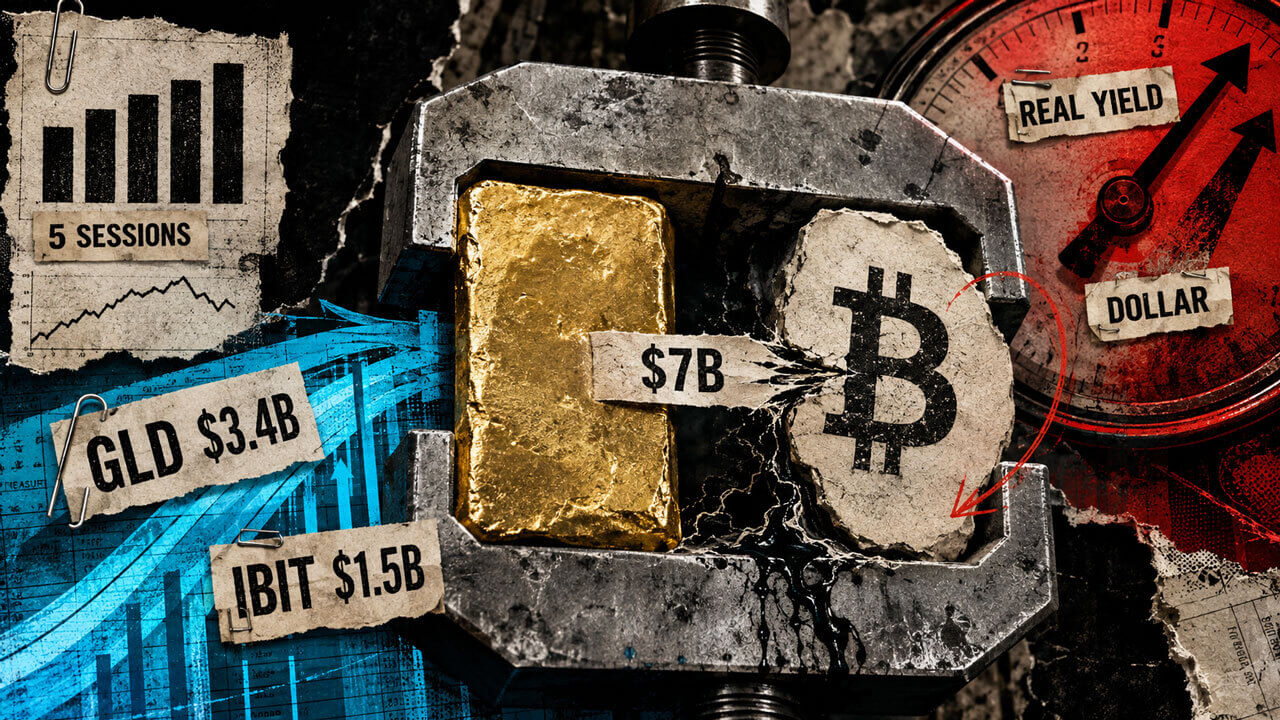
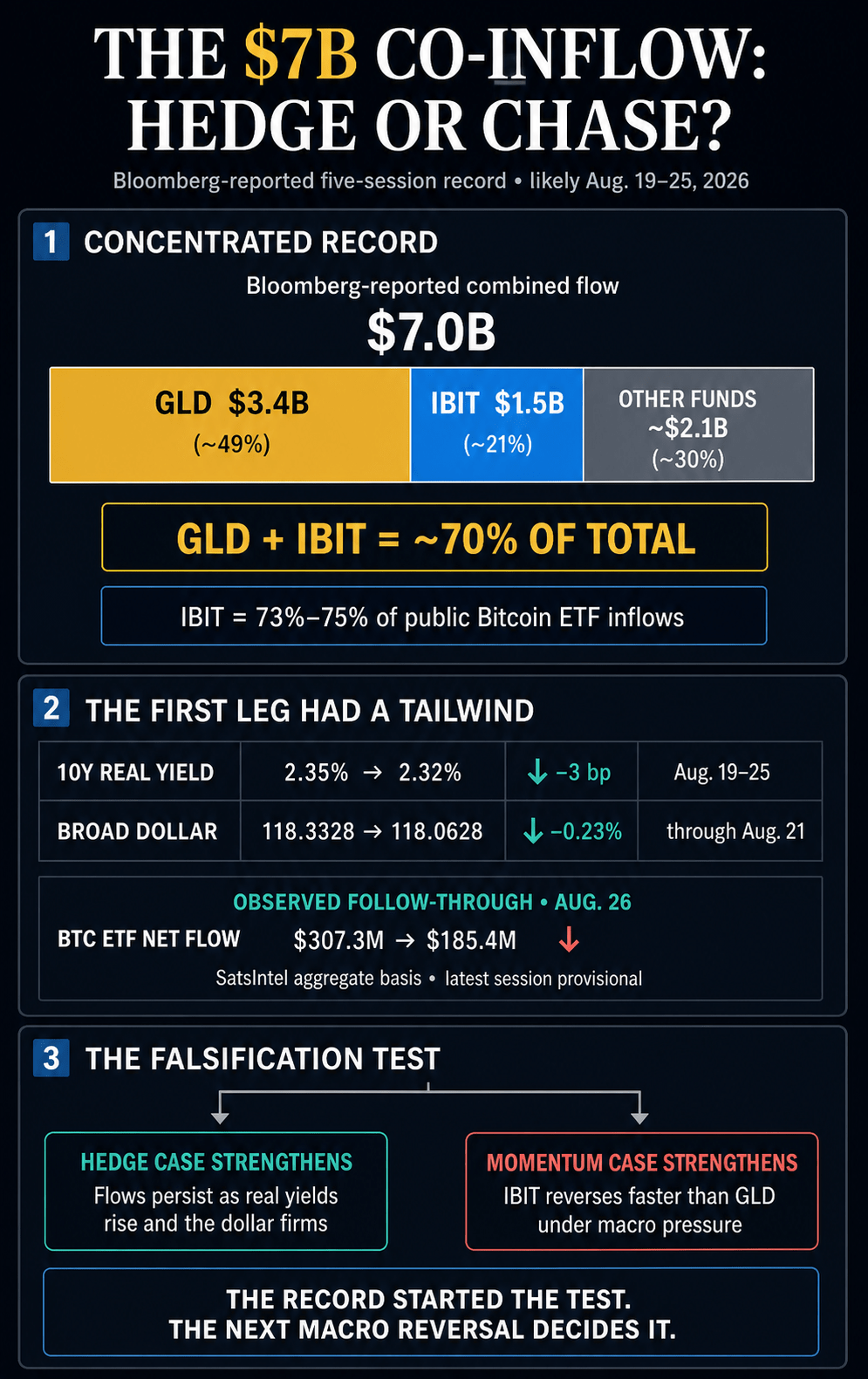
Gold and Bitcoin exchange‑traded funds (ETFs) gathered approximately $7 billion across five U.S. trading sessions—a record combined haul that places both assets at the forefront of a renewed investor push for protection against currency weakness and mounting fiscal pressure.
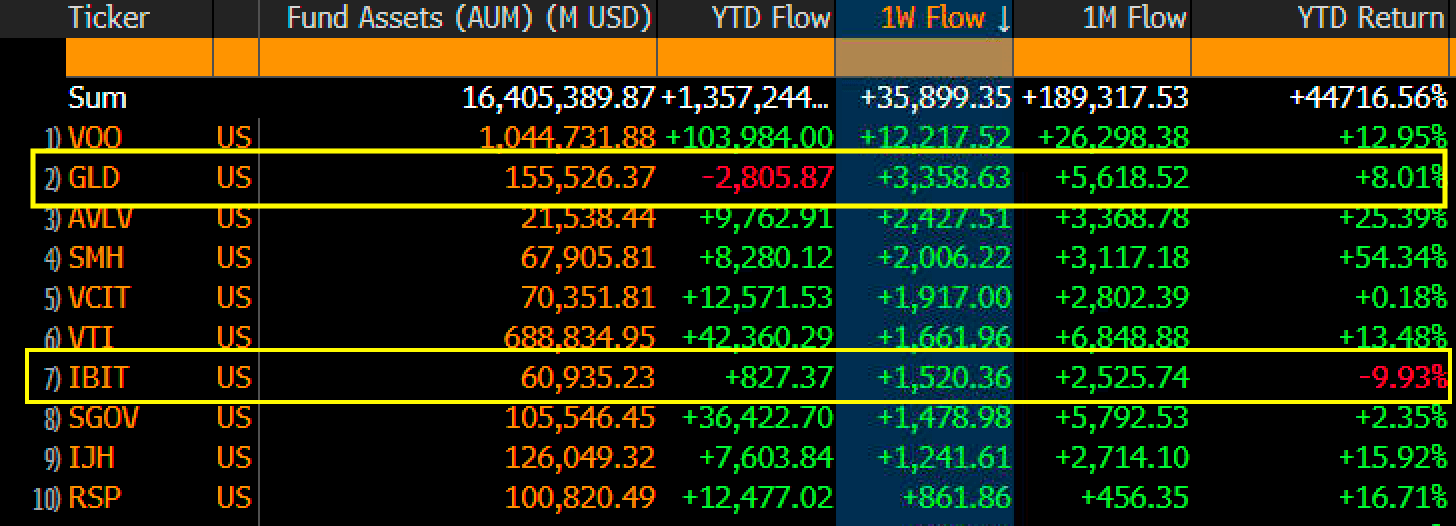
About $3.4 billion of this capital flowed into SPDR Gold Shares (GLD), while BlackRock’s iShares Bitcoin Trust (IBIT) attracted roughly $1.5 billion. GLD oversees more than $150 billion in assets, whereas IBIT holds around $60 billion, making each the dominant institutional gateway in its market.
Together, the two funds accounted for roughly 70 % of the combined “debasement trade” inflows, highlighting how concentrated the movement is within the largest investment vehicles.
Bloomberg Intelligence analyst Eric Balchunas noted that the five‑day total set a clear record for the pair, with both GLD and IBIT ranking among the ten largest U.S. ETFs by weekly inflows. He also observed that IBIT’s year‑to‑date flows had turned positive after an earlier deficit.

The surge occurred as both assets climbed sharply. Bitcoin突破了 $80,000 mark, while gold traded above $4,600 per ounce, reinforcing a link between the commodities through shared scarcity dynamics.
Fiscal pressure revives demand for hard assets
The coordinated buying surged as investors focused on U.S. debt, Treasury‑market strain, and a softening dollar.
Treasury’s August 19 decision to at least double the maximum size of liquidity‑support buybacks for longer‑dated securities to $4 billion per operation created additional context. This move initially lowered long‑term yields and coincided with U.S. public debt exceeding $40 trillion.
That combination has rekindled the so‑called “debasement trade,” where investors target assets with limited supply as protection against potential erosion of purchasing power from persistent deficits and currency expansion.
Bitwise chief investment officer Matt Hougan explained that part of this appeal reflects how traditional portfolios remain fully denominated in fiat money.
“A 60/40 portfolio is 100 % exposed to fiat currency,” Hougan argued, noting that investors are increasingly seeking modest diversifications amid rising fiscal uncertainty.
The signal, before the noise.
[poll id=”cs-inline-newsletter-1-title” class=”cs-inline-newsletter__title”>The signal, before the noise.Start your day with the crypto stories moving markets, decoded by CryptoSlate’s editors.
Whoops, looks like there was a problem. Please try again.
You’re on the list. Your next Daily Brief is on its way.

Strive Chief Executive Matt Cole framed the shift through scarcity, suggesting that dollar debasement widens the capital pool seeking scarce supplies while Bitcoin’s ongoing monetization captures expanding demand.
< p>Bitcoin’s capped 21‑million supply makes it a natural choice for this trade, though it remains considerably more volatile than gold and has a shorter history as a defensive holding.
| Asset | Supply | Volatility |
|---|---|---|
| Gold | Finite mineral reserve | Moderate |
| Bitcoin | Fixed 21 M cap | High |
Market trends mirror this divergence; Charlie Morris, founder of ByteTree, noted that both Bitcoin and gold display positively sloping 200‑day moving averages and receive ByteTrend scores of 5—the firm’s strongest bullish rating—while the dollar holds a score of 0. This alignment underscores the broader misalignment between scarce assets and the currency used to price them.
Wall Street sees a longer‑term scarcity trade
The strengthened argument hinges on whether this pressure persists beyond recent yield changes and a softer dollar.
Bernstein observes that the four‑decade decline in interest rates appears complete precisely as sovereign debt burdens reach record highs, exposing governments to heightened debt‑servicing costs. Rising yields can subsequently drive up interest billing, widen deficits, and increase borrowing demands, complicating public‑finance stabilization.
The firm contends that policymakers likely will prioritize curbing currency debasement over sustained fiscal restraint—an approach deemed less politically disruptive. That preference bolsters the case for assets whose supply cannot be readily expanded.
Bernstein highlights Bitcoin’s positioning, citing its fixed issuance schedule, broad institutional and retail accessibility, and a holder base historically resilient through severe drawdowns. Roughly 60 % of Bitcoin holdings were retained by investors who survived declines exceeding 50 %, according to the firm.
The asset manager has also pushed Bitcoin deeper into conventional portfolio discussions. Recent research indicates that allocating 1 %–2 % of capital to Bitcoin could have enhanced the risk‑adjusted performance of a standard 60/40 equity‑bond portfolio.
These points help explain why the latest ETF inflows have garnered more interest than adjacent temporary rallies. Gold offers an entrenched role as a hedge against monetary and fiscal uncertainty, while Bitcoin is increasingly viewed through the same scarcity lens—but faces a shorter track record and substantially higher volatility.
This dynamic creates distinct tests; if the dollar recovers or real yields climb while Bitcoin ETF inflows persist, the $7 billion influx will resemble a durable portfolio refinement rather than a short‑term trend play.
Conversely, should Bitcoin demand wane while gold remains robust, the two may have been driven by the same debasement narrative without yet achieving parity in investor adoption.
Also Read
- Rich Sees $3.40 XRP as Conservative Ahead Of Crypto Vote
- Pembroke Pines Aesthetic Nurse Accused of Defrauding Coworkers in $16,000 Forex Investment Scheme
- Morgan Stanley drives $9 million Solana ETF inflows as SOL reclaims the $100 mark
- Cleveland Fed Calls for Immediate Tightening, Kansas City Seeks Further Data, Warsh’s Jackson Hole Remarks Test Market’s Patience


