






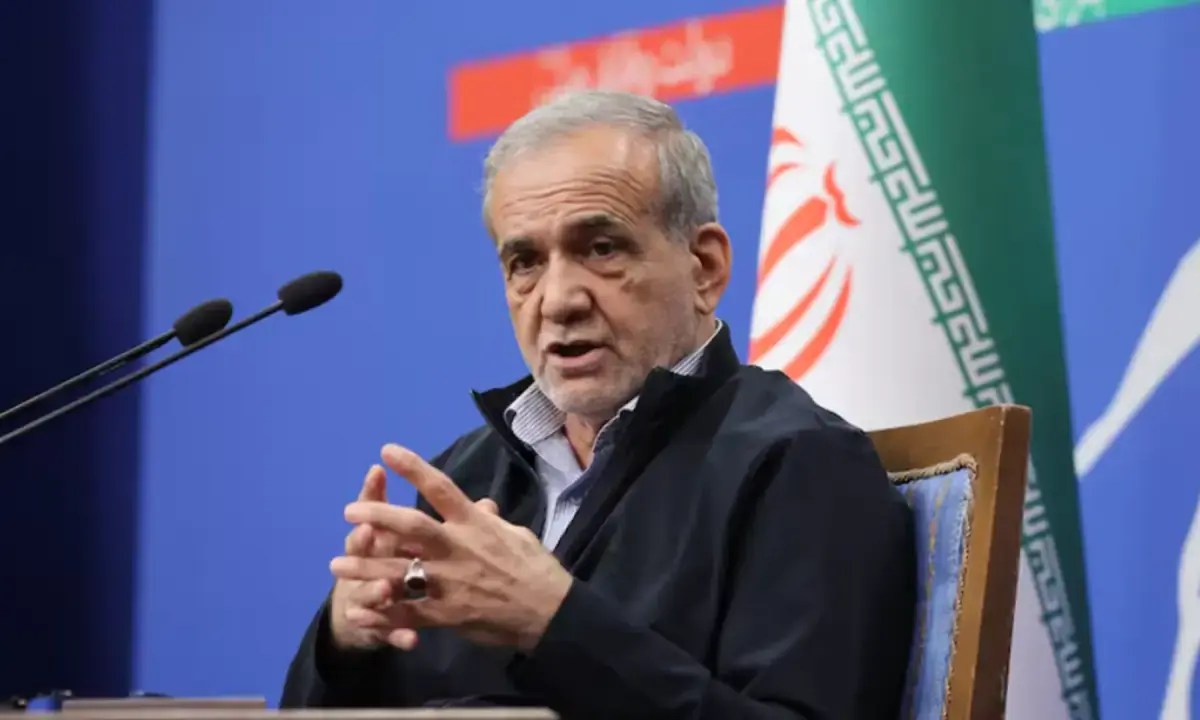
Iran’s President Masoud Pezeshkian will travel to Pakistan for an official visit tomorrow, the Foreign Office (FO) announced on Monday.
Invited by Prime Minister Shehbaz Sharif, the president will be accompanied by a high‑level delegation comprising ministers and senior officials.
During the trip, Pezeshkian is scheduled to meet President Asif Ali Zardari and hold discussions with Prime Minister Shehbaz Sharif.
Senate Chairman Yousuf Raza Gilani, National Assembly Speaker Ayaz Sadiq and Deputy Prime Minister‑Foreign Minister Ishaq Dar will receive the visiting dignitary, according to the FO.
“This marks Dr. Pezeshkian’s second visit to Pakistan in his presidential capacity,” the FO noted.
The two sides will review the full range of bilateral ties and explore new avenues to deepen cooperation across trade, energy, border security, people‑to‑people exchanges and regional connectivity, it added.
The visit is also seen as an important forum to discuss ongoing diplomatic efforts following the Islamabad Memorandum of Understanding, as well as regional and global developments of mutual interest.
“The forthcoming visit underscores the shared commitment of Pakistan and Iran to strengthen their historic and cultural bonds and highlights their common aspiration for peace, stability and sustainable progress in the region,” the FO emphasized.
His trip follows high‑level direct talks — dubbed the “Lake Lucerne Summit” — held between the United States and Iran in Switzerland, which launched negotiations under the Islamabad MoU signed on 18 June.
Under the 14‑point accord, Washington and Tehran agreed on a framework to end the war, reopen the Strait of Hormuz and negotiate key issues within 60 days of the signing.
The US‑Iran discussions at the Swiss resort of Bürgenstock were mediated by Pakistan and Qatar, with Prime Minister Shehbaz Sharif and Chief of Defence Forces Field Marshal Asim Munir representing Pakistan.
The Lake Lucerne Summit established a mechanism for further technical talks that will continue this week and set up communication lines to de‑escalate fighting in Lebanon and keep the vital Strait of Hormuz open.
“Encouraging progress has been made,” the mediators said in a joint statement, highlighting the creation of a contact channel to “avoid incidents and miscommunication” in the strait.
A ‘de‑confliction cell’ has also been agreed upon between the parties and Lebanese authorities to prevent renewed clashes.


