






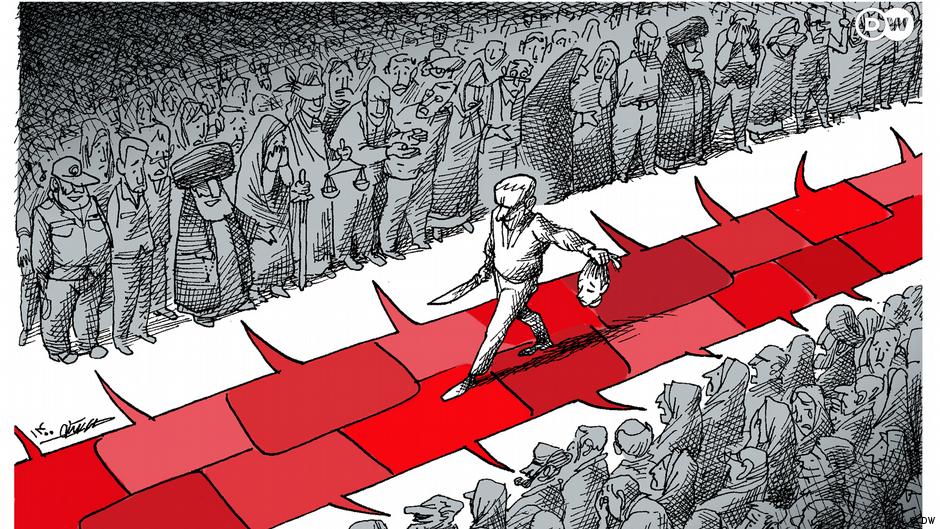
On Monday, October 5 2026, 28‑year‑old mother of two, Maryam Yarmohammadi, was fatally stabbed by her brother and husband on Qeshm Island in southern Iran. Her genitalia were mutilated, and she died shortly thereafter in hospital. Both perpetrators were taken into custody.
Media reported that roughly 50 relatives gathered outside the hospital to protest the arrests, believing that death was the “least severe punishment” Maryam Yarmohammadi deserved.
The exact nature of her alleged offense and the reasons for her relatives’ condemnation remain unclear. Nevertheless, the circumstances and brutal violence echo the classic pattern of honor killings.
All the Ayatollah’s men — ensuring the regime’s survival
To view this video please enable JavaScript, and consider upgrading to a web browser that supports HTML5 video
No opportunity to defend themselves
What constitutes “honor” or “proper conduct” is often defined by family expectations or local social and cultural norms. In some traditionally conservative regions, even laughing loudly or engaging in a friendly conversation with an unrelated man may be viewed as a violation of these norms. Women accused of such transgressions are frequently denied any meaningful opportunity to defend themselves against the allegations.
Women’s‑rights activists in Iran have long worked to build nationwide support networks that provide counseling and protection for women at risk. One such initiative is the Campaign to End Honor Killings.
Campaign spokesperson Rezvan Moghaddam told DW that there seemed to be no local activist group capable of assisting Maryam Yarmohammadi in the region.
Failure of the justice system
Iran’s legal system, rooted in interpretations of Sharia, does not grant women equal status in many aspects of life. Decisions on education, employment, or travel often require consent from a father or, later, a husband. Even after a woman’s death, male relatives can influence criminal proceedings under certain provisions. Iranian criminal law employs the principle of retributive justice for crimes such as murder, allowing the victim’s family to demand the death penalty or grant forgiveness. In honor‑killing cases, this framework creates a severe conflict of interest when the perpetrator is also a family member with authority over the decision. Critics argue that such dynamics reveal systemic gaps in protecting women from violence.
Iranian Revolution: From Shah to Mullahs
To view this video please enable JavaScript, and consider upgrading to a web browser that supports HTML5 video
A 2020 study by Iran’s Police Academy found that honor killings—murders of women by male relatives such as fathers, brothers, or uncles for alleged breaches of social modesty and family honor—made up as much as 45 % of all murders in some conservative western and southern provinces.
In March 2025, the United Nations Special Rapporteur on human rights in Iran reported that at least 179 women were killed by male family members in 2024, a figure recorded as femicides.
When violence is socially legitimized
The extreme brutality of Maryam Yarmohammadi’s murder sparked widespread grief and outrage on social media, with many women denouncing it as a hate‑driven femicide perpetrated in the name of “honor” and “shame.” Conversely, numerous comments engaged in victim‑blaming, portraying Maryam as responsible for her own death. Some described the killing as the “punishment of an unfaithful woman” or attempted to justify it by “understanding the men’s anger.” Psychoanalyst Saba Alaleh notes that men are socialized to view themselves as protectors who must control women’s behavior and decisions, tying male identity to female “obedience.” When cultural, social, political, economic, legal, and educational factors intertwine, they reinforce a system in which violence becomes normalized, women remain economically dependent, social support is scarce, preventive measures are absent, and the risk of abuse escalates.
Iranian women unveiled: A shift in hijab enforcement?
To view this video please enable JavaScript, and consider upgrading to a web browser that supports HTML5 video
Women’s struggle for self-determination
Atefeh Rangriz, a sociologist and women’s‑rights activist, told DW that femicides have existed throughout history, from forced unveiling under Reza Shah Pahlavi in the 1930s to the Islamic Republic’s slogan “Either the headscarf or blows to the head.” Despite massive obstacles, she says Iranian women understand the path to liberation and have made considerable progress in recent decades. Women have been driving since 1940, gained the right to vote and hold office in 1963, and now represent half of all university graduates. Divorce filings and mutual dissolution of unhappy marriages are also on the rise. The “Woman, Life, Freedom” movement, born from the 2022 nationwide protests after Jina Mahsa Amini’s death in police custody, has reshaped public attitudes toward women. “Women focus on the present and demand justice now,” Rangriz added. “They seek autonomy over their bodies, the freedom to live as they choose, and to break free from domination, oppression, and exploitation—a radical revolution.” Many Iranian women now defy the mandatory hijab, yet little attention is given to what young mother Maryam Yarmohammadi herself wanted or how she wished to live. She was brutally killed.
This article was originally written in German.
Also Read
- Robotics Could Fuel U.S. Manufacturing Revival as Nation Races to Match China’s Automation Pace
- Older Americans feel less of the affordability crunch. How that could affect the midterm elections
- Israeli settlers attack olive farmers and Washington Post journalist in West Bank
- The artisanal miners behind Nigeria’s lithium boom


