






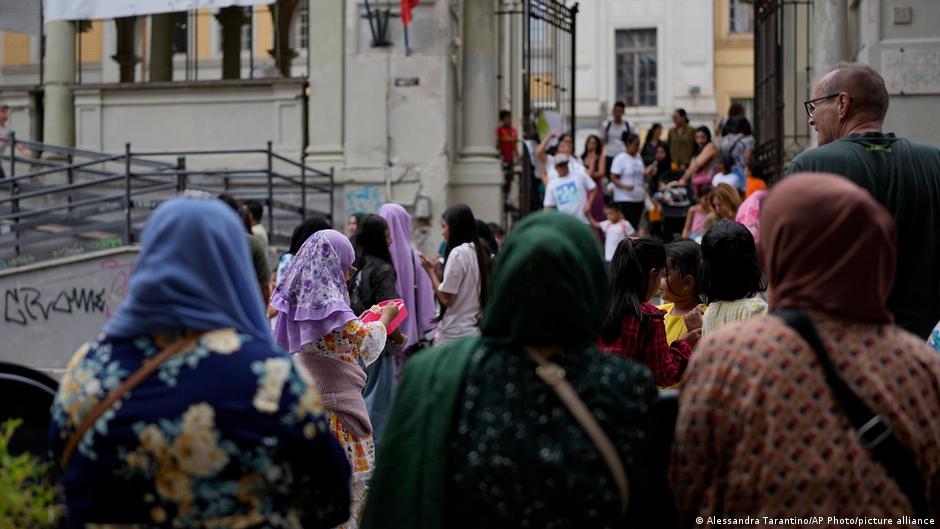
Italy’s conservative government approved a decree on Thursday that prohibits face-covering Islamic veils, including burqas and niqabs, in schools and imposes a cap on the number of students with limited Italian proficiency in each classroom.
Prime Minister Giorgia Meloni described the cabinet’s measures as “tools of common sense that do not divide,” asserting they would foster integration by preventing what she termed “ghetto classes” and ensuring all students receive the “same opportunities.”
Opposition parties and critics have condemned the move, with some labeling it a “witch hunt” and others accusing the government of politicizing immigration ahead of next year’s general election.
Details of the New School Regulations
The measures take immediate effect but require parliamentary approval within 60 days; Meloni’s coalition currently holds a legislative majority.
The decree stipulates the following:
- A per-classroom limit of 30% for foreign students who lack sufficient proficiency in Italian.
- In primary schools, the cap applies to pupils without Italian citizenship who were not born in Italy or did not attend at least two years of preschool in the country.
- In lower and upper secondary schools, the same threshold applies to students without Italian citizenship who have not attended the Italian school system for at least three years.
- Non-compliance is punishable by a fine of up to €1,000 ($1,140).

Ban on Face-Coverings in Schools
The decree bans burqas and niqabs in educational settings while continuing to permit hijabs.
Meloni characterized the burqa ban as “a matter of security,” stating in a television interview: “When a woman — or worse, a young girl — is forced to cover her face, she is being denied fundamental rights and the very integration that is so often loudly championed.”
Education Minister Giuseppe Valditara estimated the decree would affect approximately 1,000 classrooms, representing 0.3% of the national total. Official data indicates that pupils without Italian citizenship accounted for 11.2% of the school population during the 2022–2023 academic year, while classes exceeding the 30% foreign-student threshold constituted 7.6% of the total.
Critics Warn of Discriminatory Effects
Opponents argue the measure could force students to attend schools far from their neighborhoods. School administrators have also raised concerns about the practical implementation of the rules in areas with high migrant populations.
Save the Children urged the government to consider the measure “with the utmost political responsibility,” warning it risked creating discriminatory outcomes. “Such a criterion would create ‘first-class’ and ‘second-class’ students,” the organization stated.
Opposition leader Elly Schlein denounced the decree as “a new witch hunt at the expense of children.” Meloni leads the most right-wing government Italy has seen since World War II.
Also Read
- Nigeria Faces Growing Malnutrition Crisis as Regional Conflicts Drive Up Food Prices
- Taiwan says Xi ‘distorted facts’ to Trump as analysts read between lines
- Beyond Interest Rates: Real Estate Expert Warns of the ‘Obstacle Course’ Trapping Homebuyers
- Trump Hosts Xi Jinping at White House Amid Unfinished Diplomacy


