







Japan’s private-sector expansion slowed in September, with the PMI Manufacturing index easing from 54.9 to 54.1, PMI Services falling from 52.5 to 51.6, and the PMI Composite declining from 53.5 to 52.5. Manufacturing output also moderated from 56.1 to 54.9. Although the Composite PMI remained in expansion for an eighteenth consecutive month, the pace of growth reached a four-month low as both manufacturing and services recorded slower increases in activity and new orders.
The slowdown was primarily driven by a contraction in domestic demand rather than external trade. Overall new-order growth weakened, with S&P Global identifying softer domestic demand as the primary drag on the sector. In contrast, new export orders continued to rise at the same robust pace as August’s eight-and-a-half-year high, driven entirely by manufacturing, while services export demand fell again. Employment provided another positive signal, rising at the fastest pace in seven months, while business confidence strengthened to its highest level since February, buoyed by optimism surrounding AI-related demand, semiconductors, defence, and automobiles.
Inflation pressures eased only marginally. Input-cost inflation slipped to a four-month low but remained historically sharp, with firms citing higher energy and raw-material costs linked to the Middle East conflict and the weak Yen, alongside rising staff and transport expenses. Selling prices increased at a rate only slightly below August’s survey record. S&P Global’s Annabel Fiddes noted that growth had “slipped down a gear,” but the persistence of high costs means Japan is facing a combination of softer domestic momentum and elevated price pressure, rather than a clean slowdown accompanied by meaningful disinflation.
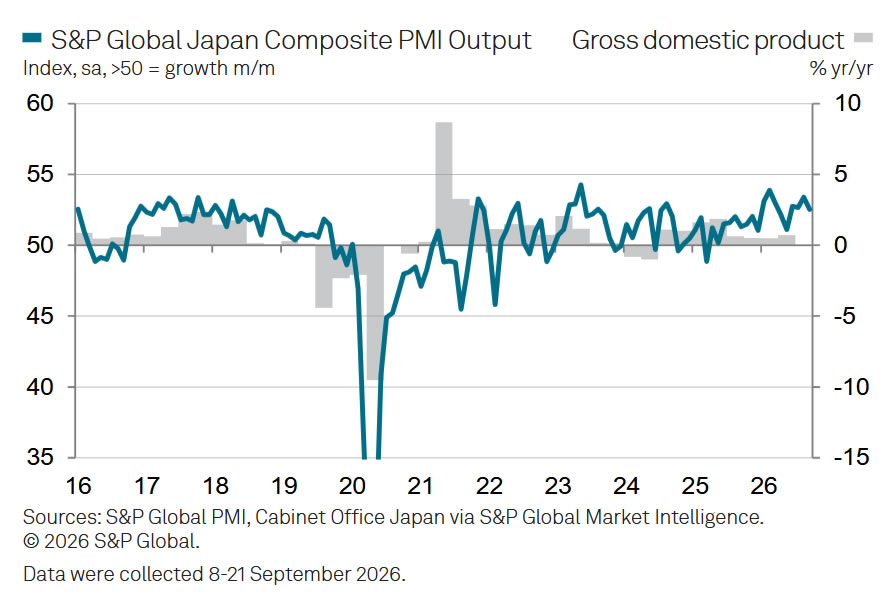

Data Summary
| Indicator | September | August | Trend |
|---|---|---|---|
| PMI Manufacturing | 54.1 | 54.9 | Slower expansion |
| PMI Services | 51.6 | 52.5 | Four-month low |
| PMI Composite | 52.5 | 53.5 | Four-month low |
| Manufacturing Output | 54.9 | 56.1 | Three-month low |
Japan’s private-sector expansion continued in September, but momentum weakened across both manufacturing and services.
Components
| Component | Trend |
|---|---|
| New orders | Slower overall growth |
| Domestic demand | Softer; main drag on momentum |
| New export orders | Continued marked growth; unchanged from August’s eight-and-a-half-year high |
| Manufacturing exports | Main source of export strength |
| Services exports | Continued decline |
| Employment | Fastest growth in seven months |
| Backlogs | Fastest increase in seven months |
| Business confidence | Highest since February; above series average |
| Input costs | Eased to four-month low but remained historically sharp |
| Selling prices | Slowed only slightly from August’s survey record |
| Supply chains | Vendor delivery times lengthened substantially amid shortages |
The release points to weaker domestic momentum but resilient external demand, hiring and confidence, alongside still-elevated cost pressures.
Key Takeaways
- Japan’s private-sector growth slowed to a four-month low, with both PMI Services and PMI Composite easing in September.
- The slowdown was driven mainly by softer domestic demand, while manufacturing export orders remained robust.
- New export orders continued expanding at the same marked pace as August’s eight-and-a-half-year high, though the strength was concentrated in manufacturing.
- Employment rose at the fastest pace in seven months, while backlogs also increased at the quickest rate in seven months.
- Business confidence strengthened to its highest since February, supported by optimism around AI, semiconductors, defence and automobiles.
- Inflation pressure remained elevated despite some easing, with firms citing the weak Yen, Middle East conflict, energy, raw materials, staff and transport costs.
- Selling-price inflation slowed only slightly from August’s survey record, showing that softer growth has not yet produced meaningful disinflation.
For the complete details, please refer to the full Japan PMI flash release.
Also Read
- Australia Adds 39.5k Jobs, but Rising Unemployment Reveals a Softer Undercurrent
- Security Researchers Recover Over 52 BTC from Coldcard Vulnerability, Launch Public Eligibility Portal
- Claude Identifies an Unexplained DNA System in Bacteriophages, but Anthropic Says Its Function Remains Unknown
- Circle Debuts 24/7 Stablecoin FX Settlement Engine on Arc Blockchain to Tap $10 Trillion Daily Market


