






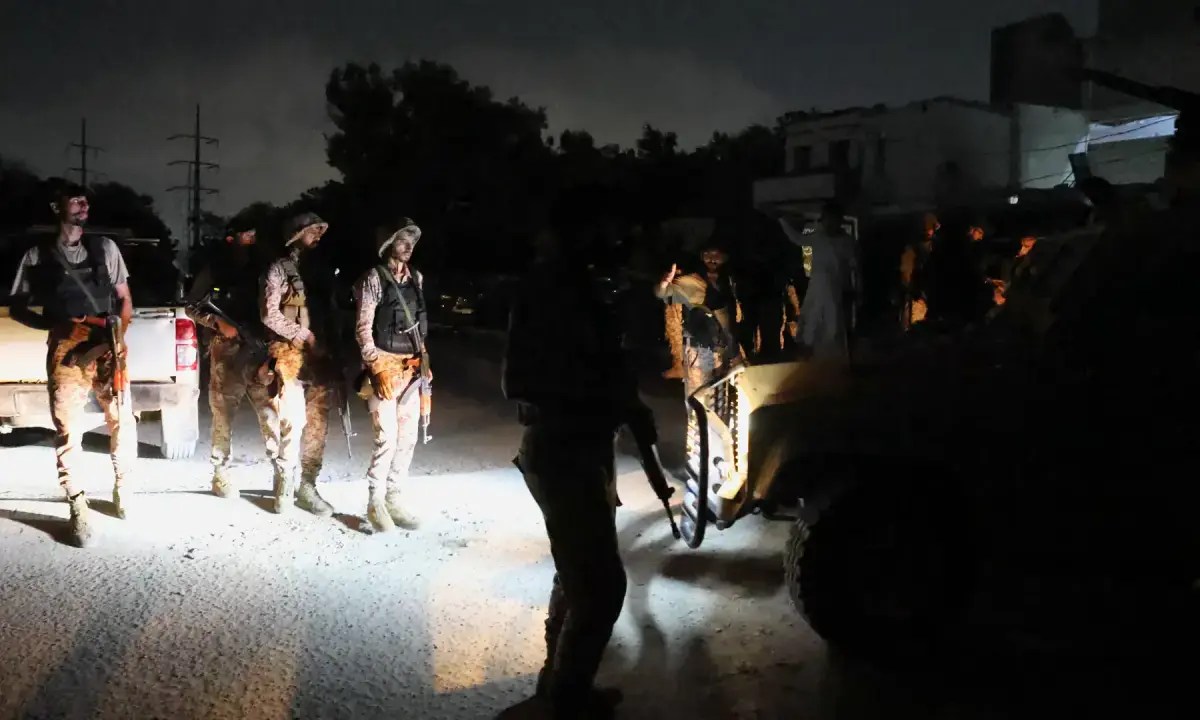
A suspect involved in the attack on the Pakistan Rangers (Sindh) Camp in Karachi’s Gulistan-i-Jauhar described the operation’s execution and disclosed that he received training in Afghanistan, according to security officials.
The assault occurred on Saturday night, resulting in the deaths of three security personnel during clashes with the attackers, the Inter-Services Public Relations (ISPR) reported on Sunday.
ISPR released a statement indicating the attackers were linked to the Indian‑backed group Jamaatul Ahrar; three militants were killed in the subsequent retaliation, and one individual was apprehended.
Security officials later identified the detainee as Usman Ali, who disclosed his arrival from Jalalabad, Afghanistan. He named the remaining three assailants as Abdul Hadi, Janaan, and Umar Farooq.
He further confessed membership in Jamaatul Ahrar and identified its Afghan commander as Ahrar Moulvi.
Ali stated that he and his comrades underwent training in Afghanistan, where they were provided with a jacket by a figure named Umar Qari, who also instructed them in making explosive devices, according to the sources.
Ali revealed that Janaan hurled a bomb at the Rangers camp.
He explained that they arrived at Hadi’s residence in Bajaur seven days earlier and were housed in an unfinished building, as reported by security sources.
Ali added that all logistical arrangements were prepared before their arrival in Karachi, noting that Hadi was already familiar with the plan, as he had visited previously.
He further said that Hadi obtained the weapons used in the attack from Waziristan.
He also said he was shot while fleeing the scene.
Residents of Gulistan-i-Jauhar reported hearing an explosion and gunfire around 8 p.m. on Thursday as the attack began.
The blast and ensuing gunfire compelled residents and bystanders to seek safety; law enforcement and emergency services responded promptly, and several arterial routes from Mosamiyat to the Rangers camp were closed throughout the night for the security operation.
Islamabad has repeatedly urged the Taliban administration in Kabul to dismantle terrorist sanctuaries on Afghan territory used for attacks in Pakistan, but these appeals have so far been ignored.
Earlier this month, Pakistan conducted strikes on terrorist hideouts along its border with Afghanistan, resulting in the deaths of 26 militants.
Information Minister Attaullah Tarar noted that the strikes followed recent Pakistani terrorist incidents, including an attack on a Federal Constabulary post in Musa Dara, Peshawar, on June 11, as well as foiled vehicle‑borne suicide attacks on a North Waziristan military post on June 2 and a May 9 suicide bombing at a Bannu police station that killed 15 officers.
Also Read
- Experts Warn of Iranian Influence Campaign Targeting US Public to Undermine Trump’s Nuclear Diplomacy
- Marvell (MRVL) Rises on AI Chip Momentum: Is the Stock’s Recovery Sustainable?
- Serbian Protesters Express Skepticism Over Vucic’s Pledge to Step Down
- Right-Wing Parties Exploit European Heatwave to Push Air-Conditioning Amid Climate Tensions<]p<[EU governments scramble to respond to record-breaking temperatures as populist leaders leverage the crisis to criticize green policies and advocate for fossil fuel expansion.


![Right-Wing Parties Exploit European Heatwave to Push Air-Conditioning Amid Climate Tensions<]p<[EU governments scramble to respond to record-breaking temperatures as populist leaders leverage the crisis to criticize green policies and advocate for fossil fuel expansion.](https://i3.wp.com/static01.nyt.com/images/2026/07/25/multimedia/29int-theworld-top2/25int-europe-heat-politics-02-qwfk-facebookJumbo.jpg?w=1024&resize=1024,1024&ssl=1 "Right-Wing Parties Exploit European Heatwave to Push Air-Conditioning Amid Climate Tensions<]p<[EU governments scramble to respond to record-breaking temperatures as populist leaders leverage the crisis to criticize green policies and advocate for fossil fuel expansion.")


