






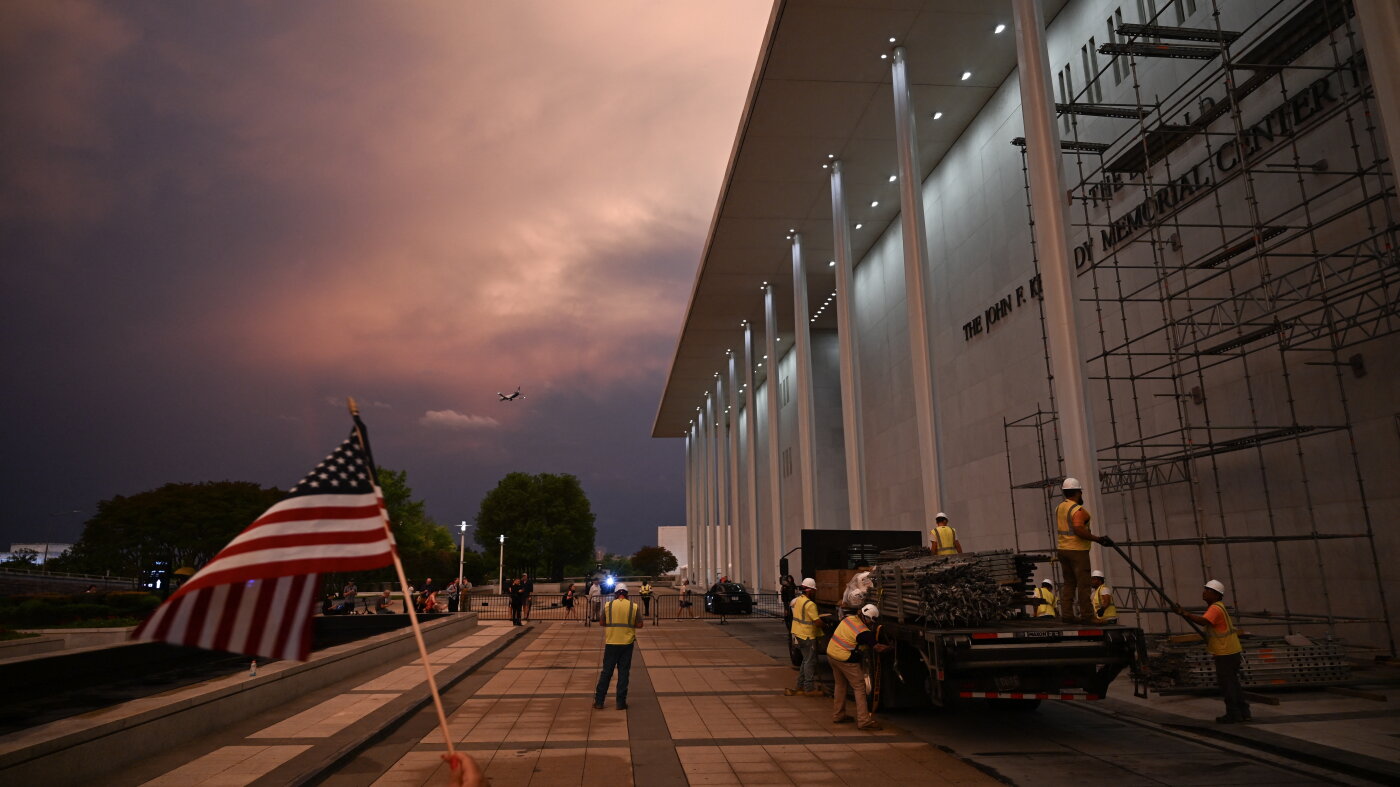

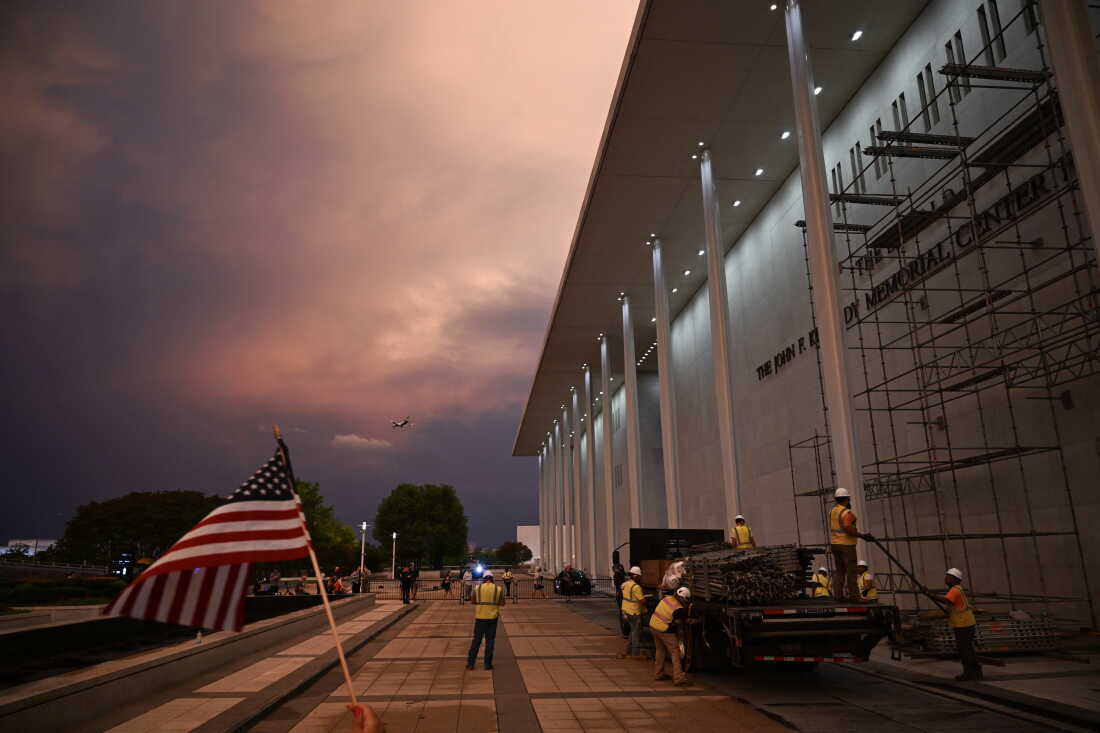
Workers build scaffolding on The Kennedy Center on June 12, 2026.
Alex Wroblewski/AFP via Getty Images
hide caption
toggle caption
Alex Wroblewski/AFP via Getty Images
On Sunday evening, The Washington Post reported that Kennedy Center officials informed the board that the institution faces imminent bankruptcy and could be forced to close by Tuesday. Most of the administration and board members were appointed by President Trump.
NPR confirmed the existence of the document outlining this plan, which was released ahead of a Tuesday board meeting—the same day as a status hearing before Judge Christopher Cooper. Cooper is overseeing the federal lawsuit filed by Rep. Joyce Beatty, an Ohio Democrat and ex-officio board member, seeking to block the center’s renaming to honor Trump last December.


On Monday, Beatty filed two board resolutions with the court, one calling for an immediate shutdown on safety grounds. However, accompanying documents indicate that the construction consultants retained by the board never made such claims. The board also stated that the Kennedy Center is in such a precarious fiscal position that it cannot meet payroll obligations or routine maintenance contracts within weeks.


On Sept. 5, the administration reported that a portion of the ceiling in the grand foyer collapsed due to rain damage. The Kennedy Center has argued that it is in dire financial shape and that President Trump is uniquely positioned to raise funds at scale and oversee a major renovation—as such, his name belongs on the building, similar to how major donors at hospitals and universities receive prominent recognition.

The Kennedy Center did not respond to NPR’s request for comment on Monday.
Commerce Secretary Howard Lutnick, whose wife Allison was appointed to the board in February 2025, made a similar argument last month outside a court hearing in the Beatty case. He stated that the renovation would cost $400 or $500 million over time but only $257 million with Trump as construction manager, adding that Trump has the power, expertise, and ability to complete the project on time and on budget.

Nevertheless, the institution faces genuine challenges. Large legacy nonprofit institutions like the Kennedy Center typically rely on a mix of earned revenue, philanthropic contributions, and government grants.
Former Ambassador Richard Grenell, the center’s previous president, insisted that every performance be revenue-generating or at least revenue-neutral. Current president and CEO Matt Floca was promoted from head of facilities and lacks experience in artistic direction, fundraising, or arts administration—unlike leaders at comparable institutions nationwide. No other board member has known experience with similar performing arts organizations.
Artists and audiences have largely abandoned the Kennedy Center over the past year, citing politicization under Trump. The live event calendar is now a fraction of its former size, and donations have dwindled. It remains unclear whether further presidential endorsement would alter this trajectory.
Also Read
- The Decade’s Finest Thrillers: A Ranked Guide to the Last 10 Years’ Best
- Oasis Announces 2027 Tour Dates, Inciting Glastonbury Festival Speculation
- CMAT Shines on SNL UK With Musical Performance and Lightsaber-Fight Cameo
- ‘A Talent for Murder’ Review: Helen Mirren Unlocks the Dark Psyche of Patricia Highsmith in Anton Corbijn’s Sinister Psychological Thriller


