






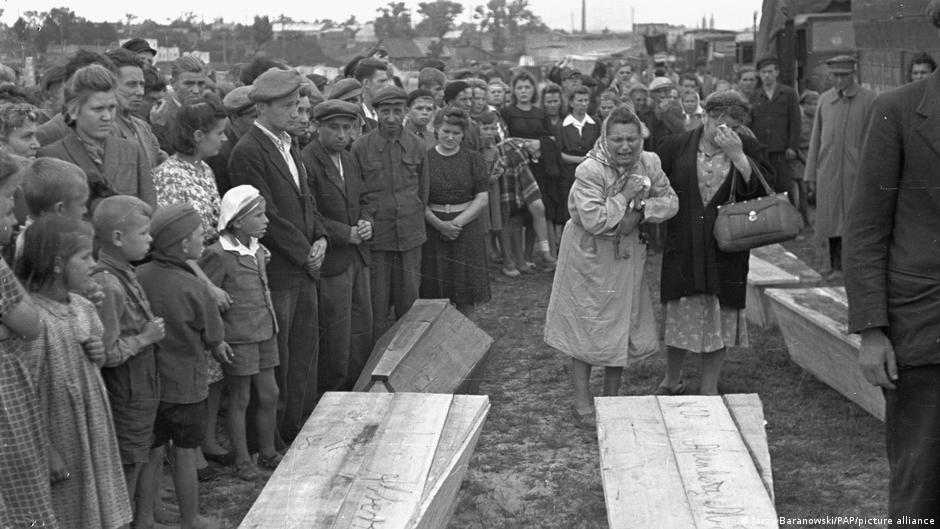
Eighty years ago, the southern Polish city of Kielce became the site of the deadliest pogrom in the country’s post‑World‑War‑II history. In July 1946, only 14 months after the Allies’ victory over Nazi Germany, an estimated 40 Jewish Holocaust survivors were robbed, beaten and murdered by local residents.
On the morning of July 4, 1946, an angry mob gathered in front of the so‑called “Jewish House” at 7 Planty Street, which housed several Jewish aid organizations and sheltered more than 150 Jews who had survived the Nazi regime by hiding in Poland or returning from exile in the Soviet Union. These traumatized individuals were attempting to rebuild their lives in Poland or prepare for emigration to Palestine.
A rumor was spreading through the town that Jews had kidnapped and murdered Christian children. A civic militia was dispatched to the building, and after telling others they would search for the missing children, their warning only inflamed the crowd further.
A child’s false accusation
The violence erupted after a young boy, Henryk Blaszczyk, aged eight or nine, fabricated a story to avoid punishment for his own disappearance. Having wandered off to a nearby village without informing his parents, he later claimed that a Jewish man had lured him into a basement where other Polish children were being held captive.
After his parents reported him missing, the boy’s father filed a complaint at the local police station. Police officers later took the child on a walk, during which he identified a Jewish resident of the Planty Street house as the alleged kidnapper and pointed out the “Jewish House” as the location of his captivity—despite the building having no basement.
A second wave of violence began in the early afternoon when rumors of child murders reached workers at the Ludwików metalworks. Several hundred workers armed themselves with tools and joined the pogrom.
Attacks spread throughout the city. Jews at the train station and on board trains were also targeted. It was not until later in the afternoon, when additional soldiers were called in to quell the unrest, that the killing and beatings stopped and survivors were taken to safety.
Death toll and differing accounts
The precise number of fatalities remains contested. The Polish Institute of National Remembrance reports that 37 Jews died that day, along with three Polish Catholics—including a caretaker who had defended the residents—while the Museum of the History of Polish Jews (POLIN) puts the Jewish death toll at “at least 40,” noting two Poles who were also killed while attempting to protect the besieged Jews.
According to POLIN, the pogrom triggered widespread panic within Poland’s Jewish community, prompting an exodus of roughly 100,000 people, many of whom emigrated to Germany and other countries. Polish historians point out that the Kielce incident was not isolated; anti‑Jewish riots erupted in several Polish cities after liberation, often ignited by the same false claim that Jews had murdered Christian children.
Historian Julian Kwiek of Kraków documented about 1,100 Jewish murders between 1944 and the end of 1947, describing the violence as a “widespread phenomenon.” Cultural anthropologist Joanna Tokarska‑Bakir notes that the blood‑libel myth resurfaced after World War II, driving many pogroms, while disputes over property rights also fueled animosity toward Jews who returned to reclaim their homes.
Not a communist conspiracy
“This met with resistance from the new Polish owners, who had already been living there for three years and who considered them their property,” the historian observed during a recent discussion at POLIN.
In Kielce, after authorities lost control of the town for several hours, a hasty trial was organized. Nine defendants were convicted, sentenced to death, and executed less than a week after the pogrom.
For decades the Kielce pogrom was a taboo subject under communist censorship. Recent investigations by the Institute of National Remembrance found no evidence supporting theories that the massacre was provoked by communist or Soviet operatives, closing the case in 2006. Researchers concluded that the event was the result of a “spontaneous reaction” fueled by entrenched anti‑Jewish prejudice.
This article was originally written in German.
Also Read
- BlackRock Shifts Focus to Private Markets as Strategic Growth Engine
- FIA Arrests Ghotki Resident for Forging National Assembly Appointment Letter
- Pakistan Advocates Global Tech Collaboration to Combat Illegal Immigration at Vienna Forum]
- SECP and PSX Host Webinar on Broker Compliance and Market Integrity

![Pakistan Advocates Global Tech Collaboration to Combat Illegal Immigration at Vienna Forum]](https://i3.wp.com/www.arabnews.pk/sites/default/files/styles/660x371_watermarkpakistan/public/main-image/2026/07/04/4727944-1370438754.jpg?itok=XwPocYLa&w=1024&resize=1024,1024&ssl=1 "Pakistan Advocates Global Tech Collaboration to Combat Illegal Immigration at Vienna Forum]")


