






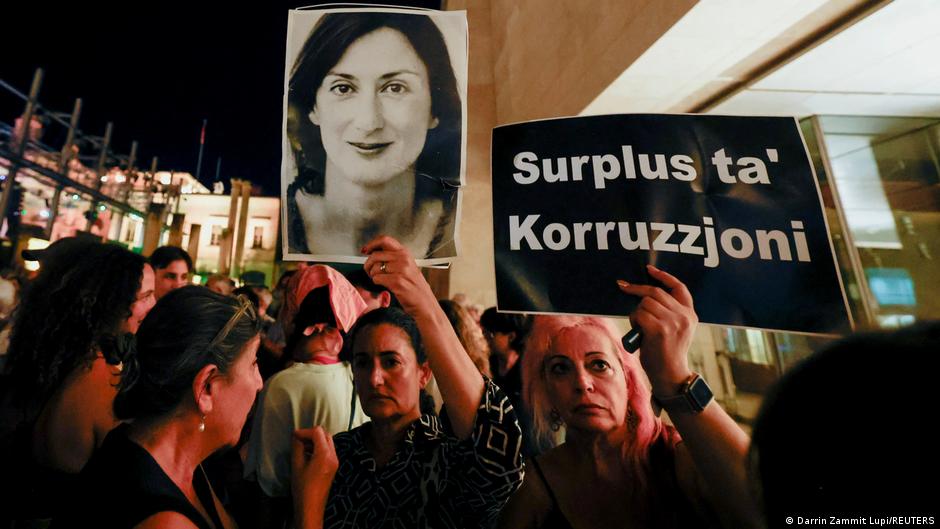
“Murderer!” — “Scum!” — “Mafia!”
After exiting the Valletta courthouse on Wednesday evening, Yorgen Fenech was confronted by an angry crowd outside. The 44-year-old Maltese businessman navigated through the gathering, flanked by security personnel. Just minutes prior, a jury had acquitted him of ordering the 2017 assassination of investigative journalist Daphne Caruana Galizia, 53.
The verdict stirred profound shock among her family. Matthew Caruana Galizia, her son, criticized the verdict as a “terrible decision by the jurors that our country may never recover from.” Later, he reiterated his condemnation on social media, calling the judgment “obscene” and asserting it defied “all evidence, of all logic, of the truth.”
Nearly nine years after Caruana Galizia’s death, Malta grapples with the unresolved question: Who orchestrated her October 2017 murder? The men who planted and detonated the car bomb have been convicted, but the higher-level client remains unidentified in legal proceedings.
A Challenging Trial
For years, Fenech was viewed as the central suspect in the investigation. His November 20, 2019, arrest—just as his luxury yacht “Gio” departed harbor—mirrored a Hollywood scene when military patrol boats intercepted the vessel. Police detained him onboard and conducted intensive questioning.
His arrest and the suspicion of government involvement ignited nationwide protests. Then-Prime Minister Joseph Muscat faced accusations of shielding political allies and resigned in January 2020. Fenech spent over five years in detention before gaining bail in early 2025. The trial began only this summer, with eight of nine jurors rejecting the prosecution’s argument that Fenech ordered the killing.
The Prosecution’s Case
The prosecution’s argument centered on testimony from Melvin Theuma, who claimed Fenech hired him to plan the assassination. Theuma received a pardon for cooperating with authorities. Fenech’s defense team challenged Theuma’s credibility, pointing to inconsistencies in his statements and prior false claims.
Additionally, Fenech’s lawyers argued that evidence implicating Keith Schembri, former chief of staff to Muscat, was inadequately investigated. Schembri has consistently denied involvement, and authorities did not formally charge him.
Prosecutors argued Caruana Galizia was probing Fenech’s business dealings, particularly his company 17 Black and the energy firm ElectroGas, on corruption allegations. They claimed this motivation fueled his alleged decision to silence her. However, she had not yet published material directly threatening him.
Unresolved Questions
While public outrage mounts, there is no indication the trial was flawed or manipulated. To secure a conviction, Fenech’s guilt would need to be proven beyond reasonable doubt. Caruana Galizia’s family now shifts focus to institutional failures they believe enabled the murder, criticizing unaddressed systemic issues and unmet reform demands. A 2021 official investigation concluded an “atmosphere of impunity” in Malta facilitated the crime.
Progress and Persistent Gaps
Since then, Malta has implemented reforms, though many deem them insufficient, particularly regarding press freedom. A 2021 committee recommended stronger protections for journalists and institutional support, yet comprehensive media reform remains unpassed. A media law bill introduced in 2026 stalled amid early elections. The European Commission’s latest Rule of Law Report acknowledges limited progress but notes core recommendations remain unmet.
The government counters that judicial, anti-corruption, and journalistic source protections have improved, aligning with EU Commission descriptions of measurable progress. It also highlights judicial system reforms, though the Daphne Caruana Galizia Foundation reports high homicide case backlogs—46% pending in mid-2025—as a structural flaw. Prolonged trials, they warn, risk undermining prosecutions.
Potential for New Investigations
Judge Edwina Grima has ordered trial evidence to be forwarded to the police chief to determine if further charges are warranted. Former Prime Minister Muscat stated that public prosecutors are still pursuing active investigations. The Institute of Maltese Journalists (IGM) urges authorities to explore all investigative avenues, including potential leads involving former officials. While respecting the legal verdict, the IGM emphasizes the case remains open.
Crowds gathered outside the courthouse conveyed certainty that someone orchestrated the journalist’s killing. After almost nine years, no individual has faced legal consequences.


