A colossal outflow of stellar wind is causing a distant neutron star to emit repeated bursts of X‑rays toward Earth, according to new research. These unprecedented observations illuminate how some of the universe’s most extreme objects interact.
Located about 13,000 light‑years away, the binary system BP Crucis consists of a blue hypergiant roughly sixty times the Sun’s diameter, known as Wray 977, and a neutron star — the ultra‑dense remnant of a supernova — designated GX 301‑2.
This neutron star, packing the Sun’s mass into a sphere roughly 20 kilometres across, is a pulsar with an intensely strong magnetic field and rapid spin. It emits a sweeping beam of high‑energy radiation, including X‑rays, that sweeps past Earth about every eleven minutes, producing detectable flashes.
Unlike typical pulsars, GX 301‑2 also produces frequent X‑ray flares that are separate from its regular beam, causing it to brighten repeatedly. The origin of these flares had remained unclear.
Using the X‑ray Imaging and Spectroscopy Mission (XRISM) — a joint NASA‑JAXA observatory — scientists examined BP Crucis in detail, published September 18 in *Science Advances*. They found that the neutron star’s flares occur each time it traverses a massive plume of stellar‑wind plasma ejected by its hypergiant companion.
New observations reveal that GX 301-2 flares up when it passes through the stellar wind plume ejected by Wray 977. This animation shows how the plasma swirls around and interacts with the wobbling neutron star.
(Image credit: NASA’s Goddard Space Flight Center/Conceptual Image Laboratory)
This marks the first detection of such stellar‑wind material interacting with a neutron star or any similar stellar remnant, opening a new avenue for studying comparable systems.
“We have never before observed clear evidence of wind plasma falling onto a compact object,” said lead author Roi Rahin of the University of Maryland, Baltimore County and NASA’s Goddard Space Flight Center. “These observations allow us to examine these processes in far greater detail.”
What drives the explosive flashes?
All stars undergoing nuclear fusion emit streams of radiation and charged particles known as stellar wind. The Sun’s outflow, the solar wind, can generate vivid aurorae near Earth’s poles.
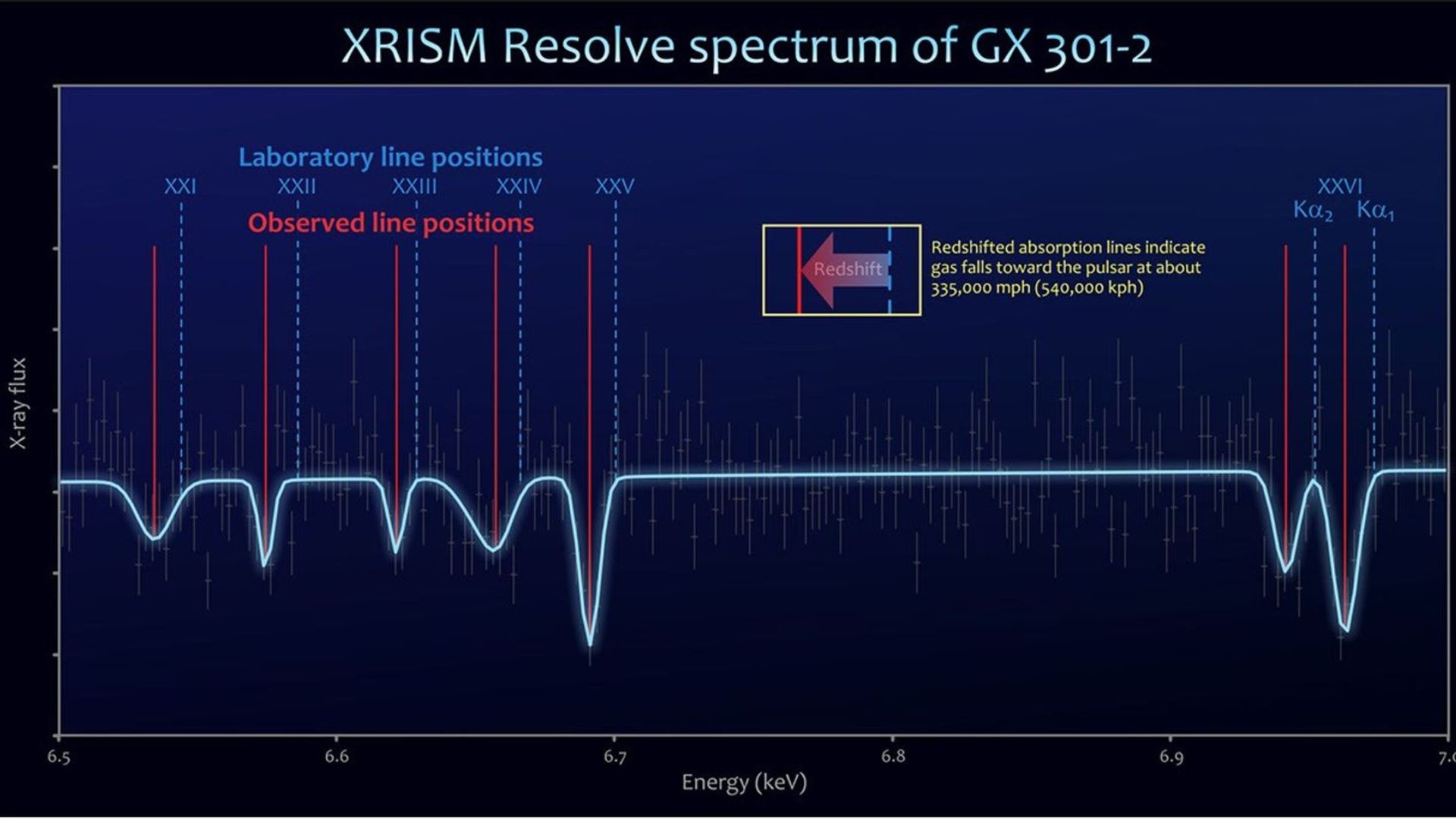
However, massive stars like Wray 977 produce far more extreme winds. The blue hypergiant launches a single, concentrated plume of ionized gas — plasma — racing outward at about 335,000 mph (540,000 km/h). Scientists believe the gravitational pull of the neutron star shapes this wind into a tight stream.
GX 301‑2 orbits Wray 977 every 41.5 days, and its X‑ray flares appear when the neutron star reaches the closest and farthest points in its orbit, with the strongest bursts occurring at periapsis. Researchers had long suspected the flares stemmed from passage through the stellar‑wind plume, but lacked direct evidence.
XRISM was able to capture detailed spectra of GX 301-2 and Wray 977’s plasma plume, allowing the researchers to accurately simulate how the stellar wind material interacted with the neutron star.
(Image credit: NASA’s Goddard Space Flight Center, JAXA/NASA, Rahin et al. 2026)
During a 16‑hour observation that captured one of the neutron star’s flares, XRISM recorded detailed X‑ray spectra showing rapidly shifting emission and absorption lines, revealing how the plasma plume ebbed and flowed around GX 301‑2, according to NASA.
“We could observe how the dense plasma stream behaves in the immediate vicinity of the neutron star,” said co‑author Nazma Islam of the Manipal Centre for Natural Sciences in India, formerly with UMBC and NASA Goddard. “While the findings are groundbreaking, they also required especially meticulous analysis.”
Using these data, the team modeled how the plasma accumulates on the neutron star’s surface and swirls around it. When sufficient material builds up, the star undergoes a runaway release, producing the bright X‑ray flashes detectable from Earth.
The researchers plan to use XRISM to monitor future flaring episodes, aiming to clarify the interplay between GX 301‑2 and the windy outflow of Wray 977.
“The BP Crucis system offers an ideal laboratory for studying wind‑fed pulsar accretion,” noted Brian Williams, XRISM project scientist at NASA Goddard. “XRISM is likewise an ideal instrument for advancing our understanding of these processes.”
Rahin, R., Ballhausen, R., Islam, N., Leutenegger, M. A., Behar, E., Zamora, D., Coley, J., Hell, N., Kallman, T., Lorenz, M., Pradhan, P., Wilms, J., & Zainab, A. (2026). Direct spectroscopic observation of matter falling onto a compact stellar object. Science Advances, 12(38), eaef6686.